


Key Takeaways
- Treat sport psychology coaching as periodized infrastructure with curriculum, screening cadence, referral pathways, and trained staff — not a preseason workshop or app recommendation sitting beside a real system.
- Evidence supports layering psychological skills training, mindfulness, and imagery as components rather than picking one, while actively reducing anxiety sources and maladaptive motivational climates that drag performance down 2.
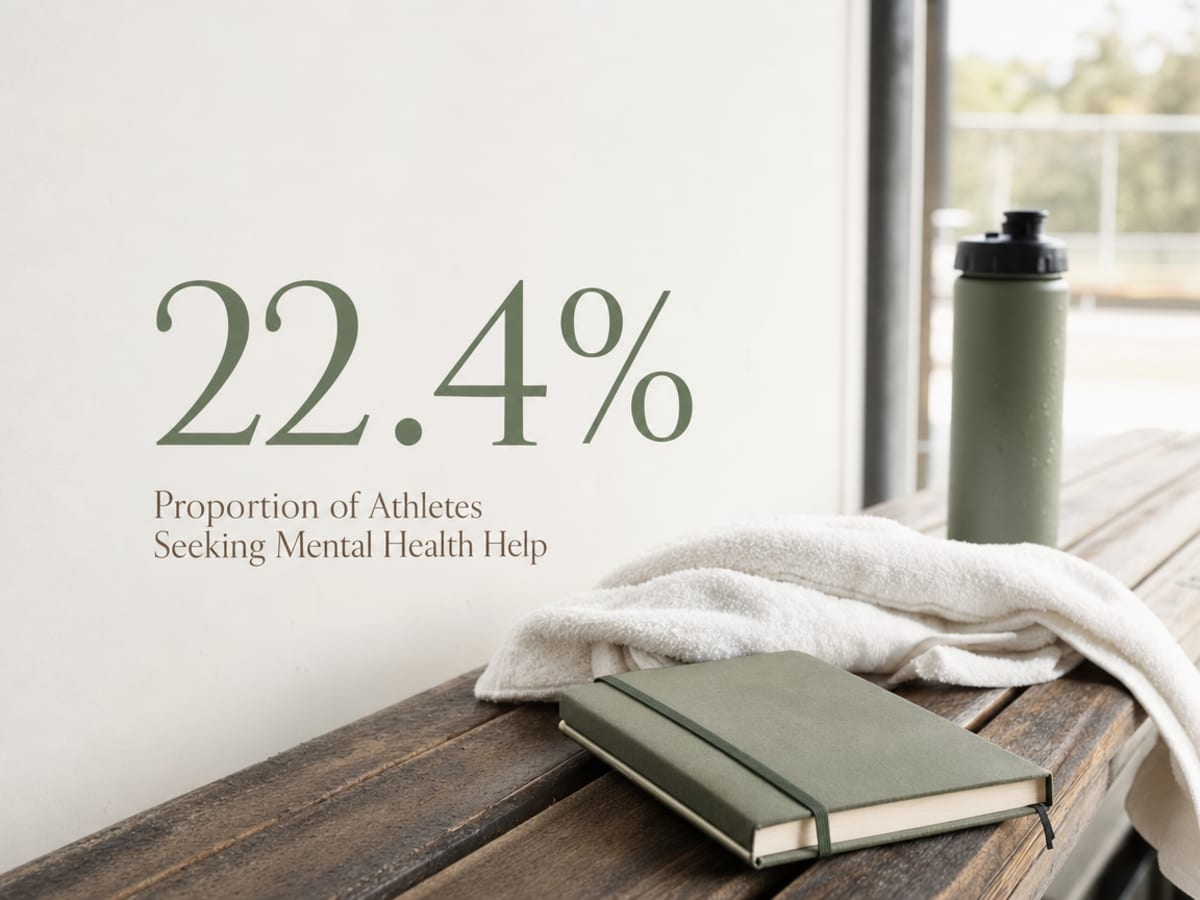
- Only 22.4% of athletes seek help, and the barriers — stigma, fear of deselection, confidentiality concerns, low awareness — are design problems your referral pathway and policy firewall control 9.
- Focus next on the dimension where your gap is biggest, usually screening cadence or referral clarity, and extend the system to coaches, youth-specific safeguards, and nutrition handoffs.
Mental fitness is infrastructure, not a workshop
You already run strength and conditioning on a periodized plan. You already treat nutrition as a scheduled, measured, staffed layer of athlete development. Sport psychology coaching deserves the same treatment, and most programs still don’t give it that.
The gap usually isn’t belief. You know mental fitness matters. The gap is architecture. A one-off speaker in preseason, a mindfulness app recommendation in week six, a referral number taped to the training room wall — that’s not a program. That’s a set of good intentions sitting next to a system that was actually designed.
The International Olympic Committee’s consensus work has been direct about this: mental health is inseparable from physical health, affects performance and injury recovery, and should be addressed through interdisciplinary systems rather than individual troubleshooting 6. The 2026 update pushes further, recommending routine monitoring, treatment access, and action on the environmental factors that drive symptoms in the first place 7.
That reframing matters for how you build. If mental fitness is infrastructure, it needs a curriculum, a screening cadence, a referral pathway, trained staff, and feedback loops — the same scaffolding your S&C program has had for years.
The rest of this piece walks through what the evidence actually supports, how to design the program as a system, and where directors most often lose traction. The honest news: this is hard to build well, and the pieces you already have are a real head start.
What the evidence actually says about mental performance work
Moderate effects, honest caveats
Before you commit staff hours and budget, you deserve a clear read on what the research actually supports. The honest answer is encouraging but not triumphant, and that distinction matters when you’re defending the program line to a board or athletic director.
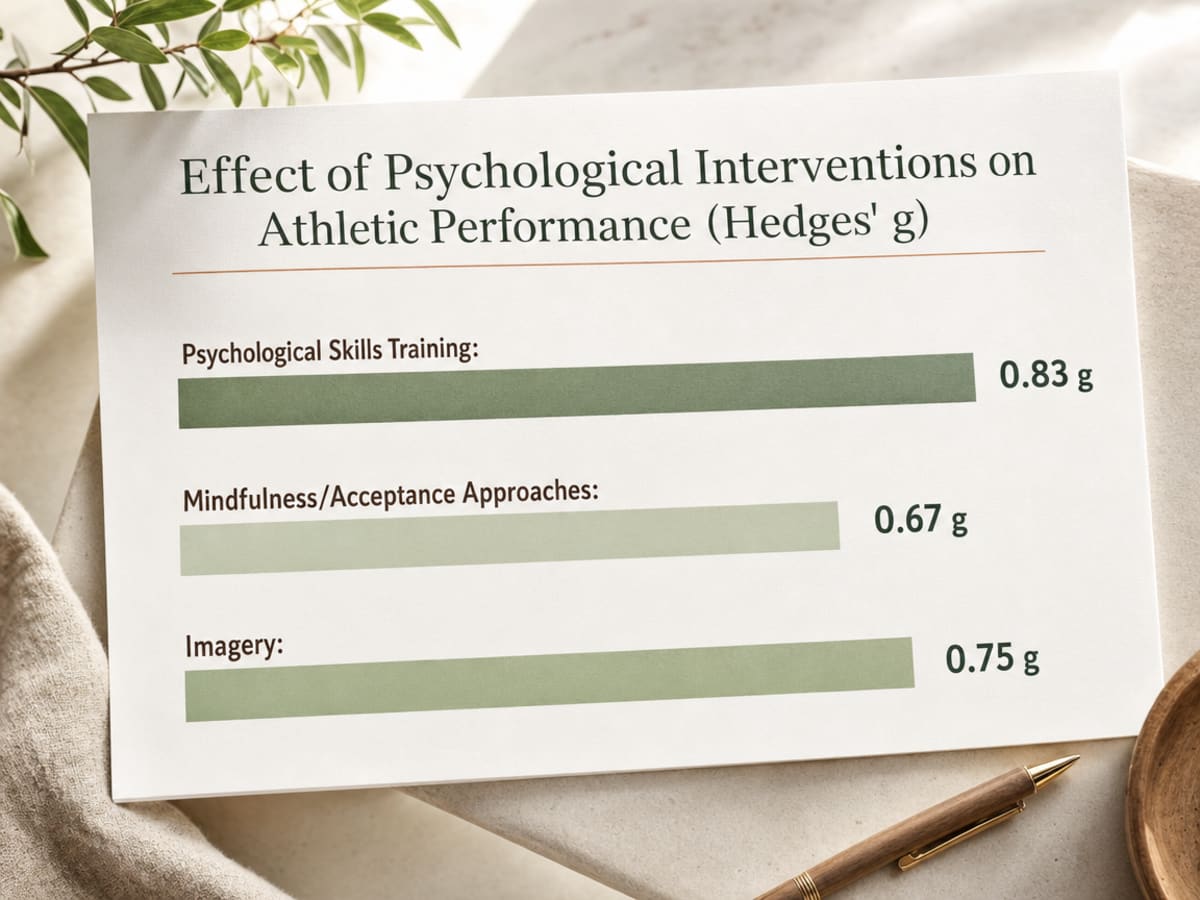
A 2024 systematic review and meta-analysis of 111 studies examined the three interventions most programs rely on. In the primary analyses, psychological skills training produced a Hedges’ g of 0.83, imagery 0.75, and mindfulness- and acceptance-based approaches 0.67 — moderate to large effects on performance-related outcomes 1. Those are the numbers that get quoted in conference talks.
Here’s the part that gets quoted less often. When the reviewers ran stricter sensitivity analyses that excluded non-randomized designs and subjective performance measures, those effects were no longer statistically stable 1. The signal is real, but it’s softer than the headline suggests, and much of it rests on study designs you wouldn’t accept from your sports medicine team.
What does that mean for how you build? It means picking a single technique and expecting a reliable competitive bump is the wrong bet. The evidence rewards programs that treat PST, mindfulness, and imagery as components of a longer curriculum, delivered by trained practitioners, measured with better outcomes than self-report surveys, and sustained across a season rather than compressed into a two-day camp.
You’re not chasing a magic intervention. You’re building a system where several moderately effective tools, used consistently and well, compound. That’s a reasonable thing to tell your leadership, and it’s a defensible place to spend money.
The two-sided ledger: what helps and what harms performance
Mental performance work isn’t only about adding capability. A larger review of 30 meta-analyses, spanning 1983 to 2021 and covering 16 psychological constructs, laid out both sides of the ledger. Performance-enhancing variables and interventions — confidence, cohesion, mindfulness, adaptive motivational climates — produced a moderate overall effect of d = 0.51. Detrimental variables — anxiety, depression, and maladaptive motivational climates — produced a small but real negative effect of d = -0.21 2.
Read those two numbers together. They tell you something your S&C staff already knows about physical training: you can add strength all day, but if you’re also quietly accumulating injury risk through poor movement patterns, the net gain shrinks. The same logic holds here. A great mental skills curriculum delivered inside a punishing, deselection-driven climate is working against itself.
That reframes where you spend attention. Climate work — how coaches communicate, how mistakes are handled in practice, how status gets allocated on the roster — isn’t a soft-skills side project. It’s a direct performance input. The variables on the negative side of the ledger live in your environment, not just inside individual athletes.
For program design, that means two parallel tracks. One builds confidence, focus, and cohesion through structured coaching. The other actively reduces anxiety sources and dismantles motivational climates that correlate with worse outcomes. Doing only the first is like adding plates to a bar someone’s gripping wrong. You’ll get some lift, but you’re leaving performance on the floor.
Wellbeing is a performance variable too
You probably have someone on staff who still treats wellbeing work as separate from competitive output — nice to do, but not on the critical path. The evidence doesn’t support that split, and holding onto it will cost you.
A recent systematic review and meta-analysis of psychological interventions aimed at elite athlete mental wellbeing reported standardized effects of 0.78 for psychological skills training, 0.58 for positive-psychology interventions, and 0.32 for third-wave approaches like acceptance and commitment work 3. The same tools your sport psychologist uses to sharpen focus and manage pressure also move the wellbeing needle. They’re not competing budgets. They’re the same budget doing double duty.
This matters for how you talk about the program internally. When a head coach asks whether a session is about performance or mental health, the honest answer is usually both — and that’s a feature. Athletes carrying lower anxiety and better recovery habits make better decisions in the fourth quarter. Athletes who feel supported stay longer, train harder, and come back from injury on schedule.
The IOC consensus work has been saying this for years: mental health is inseparable from physical health and affects performance and injury recovery 6. You don’t have to choose. Build the curriculum so the same practitioners, in the same sessions, serve both outcomes. That’s cheaper, more coherent to athletes, and better supported by the evidence than running two parallel programs that never talk to each other.
Designing the program as integrated infrastructure
The curriculum: PST, mindfulness, imagery as components, not substitutes
Once you accept that no single technique carries the program, the curriculum question gets easier. You stop asking which approach to pick and start asking how to sequence them.
Psychological skills training is the backbone most programs build on first: goal setting, self-talk, arousal regulation, pre-performance routines. It’s the most studied component and the one your coaches can reinforce in practice without a sport psychologist in the room every day. Mindfulness- and acceptance-based work sits alongside it, not on top of it. A meta-analysis of 12 randomized trials with 614 elite athletes found large pooled effects for mindfulness programs on anxiety (g = -0.87), stress (g = -0.91), and psychological wellbeing (g = 0.96), with the honest caveat that heterogeneity was high and instructor competence varied widely 4. Translation: mindfulness works when it’s taught well by someone qualified, and falls flat when it isn’t.
Imagery is the third leg. It’s most useful when it’s sport-specific, rehearsed on a schedule, and tied to actual skill execution rather than used as a generic visualization exercise before competition.
A 2025 review of psychological interventions in elite sport underlines what you probably suspect from running S&C: multi-component programs tend to outperform single-technique deployments, and effects shift with delivery method and athlete characteristics 5. Build the curriculum so these three pieces reinforce each other across the year, and pick practitioners who can teach all three with fidelity. You’re not choosing between them. You’re layering them.
Season architecture: an eight-stage support model
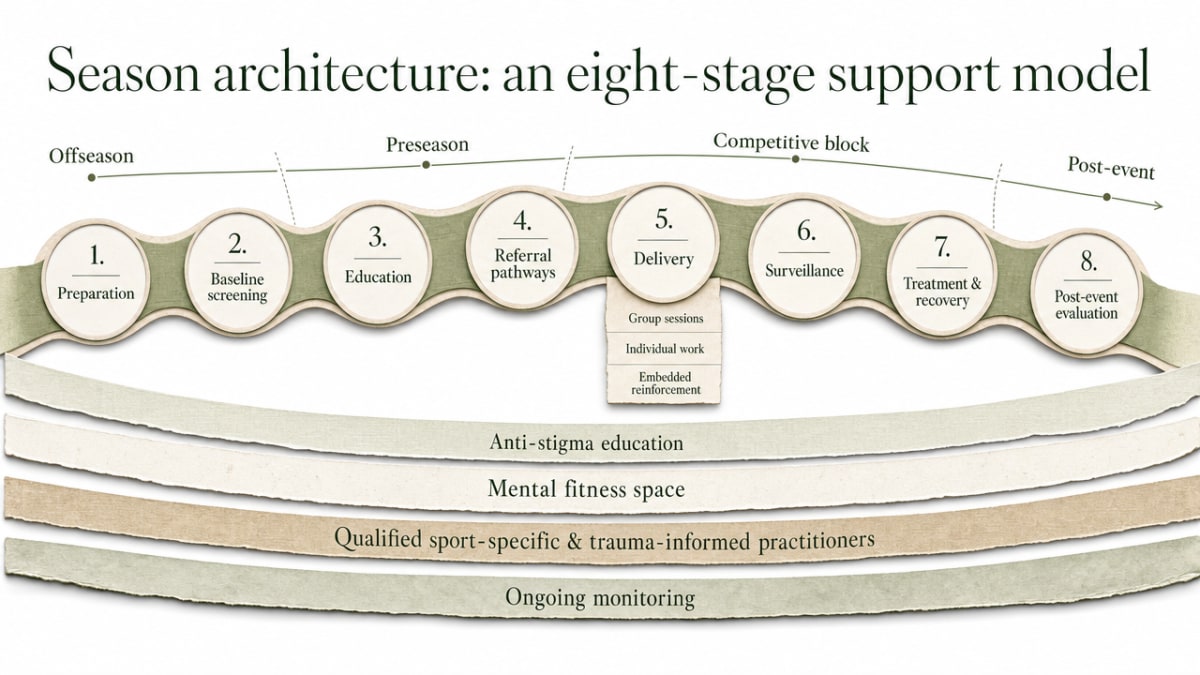
You already periodize physical training. The mental fitness program needs the same calendar discipline, and the IOC’s consensus-driven recommendations for mental health support at sporting events give you a usable template. The eight-stage model covers preparation, delivery, surveillance, treatment, recovery, and post-event evaluation, with anti-stigma education, a designated mental fitness space, qualified sport-specific and trauma-informed practitioners, and ongoing monitoring built in across the arc 8.
Adapt it to your season rather than treating it as event-only. Preparation lives in the offseason and preseason: curriculum rollout, baseline screening, education for athletes and staff, referral pathway briefings. Delivery runs through the competitive block as scheduled group sessions, individual work, and embedded reinforcement from coaches. Surveillance is the quiet work most programs skip — repeated check-ins using validated tools so symptoms get caught early rather than at crisis.
Treatment access needs to be ready before anyone needs it. That means your referral list, consent process, and confidentiality boundaries are documented before week one, not improvised in week nine. Recovery stages matter after playoffs, deselections, and injuries — predictable high-risk windows where athletes often disengage from support exactly when they need it most. Post-season evaluation closes the loop: what hit, what missed, what to change.
Mapped this way, the program stops being a floating resource and becomes a scheduled layer of the performance plan your staff can actually hold accountable.
Screening cadence and validated instruments
Screening is where most programs leak credibility. If you only check in when something is visibly wrong, you’ve built reactive care with a wellness label on it. The 2026 IOC consensus is direct on this point: routine monitoring with validated instruments, paired with treatment access and action on environmental contributors, is the standard to design toward 7.
Set a cadence your staff can actually sustain. Baseline at intake or preseason, repeat at predictable stress points — mid-season, pre-playoffs, post-injury, post-deselection, and offseason transition. Use instruments your clinicians recognize so results travel if an athlete needs a referral, and keep the item count short enough that athletes complete them honestly rather than clicking through.
Done well, screening gives your sport psychology staff a workload signal, your medical team an early warning system, and your athletes a signal that this program takes their internal state as seriously as their sprint times.
The help-seeking problem is a design problem
If you’ve ever stood in a staff meeting and asked why the mental health resources you funded aren’t getting used, you already know this gap in your gut. The pooled data confirms it. Across 11 studies and 3,415 athletes, only 22.4% sought mental health help, with documented barriers clustering around stigma, fear of deselection, confidentiality concerns, low awareness of what’s available, and negative attitudes toward services 9.
Read those barriers again. Not one of them is ‘athletes don’t care about their mental health.’ Every single one is something your program design controls or influences.
Stigma responds to education and to who delivers it. When captains, veterans, and head coaches talk openly about using mental fitness resources, the social cost of asking for help drops. Anti-stigma work belongs in preseason orientation, not in a one-time module no one remembers by October.
Fear of deselection is the barrier that cuts deepest, and it’s the one most organizations handle badly. If an athlete suspects — even without evidence — that disclosing anxiety or depression affects minutes, roster spots, or scholarship conversations, they won’t disclose. Write the firewall into policy. Separate clinical records from performance staff access. Say it out loud, repeatedly, in athlete-facing language.
Confidentiality concerns respond to clear consent documents and a named point of contact athletes trust. Low awareness responds to repetition: the same referral pathway shown in orientation, posted in the training room, mentioned by position coaches, and surfaced during screening check-ins.
You don’t fix a 22.4% utilization rate by telling athletes to be braver. You fix it by removing the friction, risk, and ambiguity your current pathway quietly asks them to accept.
Fragmented mental skills vs. integrated mental fitness
You’ve probably seen both models in action — maybe inside the same organization in different seasons. One year it’s a visiting speaker, a mindfulness app subsidy, and a referral number on the training room wall. The next year someone pushes to build it as a layer, and the difference in what athletes actually use shows up fast.
Here’s how the two approaches compare across the dimensions that matter when you’re designing the system:
| Dimension | Fragmented mental skills | Integrated mental fitness system |
|---|---|---|
| Curriculum | One-off workshops, external speakers, app recommendations | Sequenced PST, mindfulness, and imagery delivered across the season by trained practitioners 5 |
| Screening | None, or crisis-triggered only | Validated instruments on a scheduled cadence with clear data boundaries 7 |
| Referral pathway | Ad hoc, informal, often improvised | Documented pathway, named contacts, consent and confidentiality written down in advance 8 |
| Coach and staff support | Excluded; athletes only | Coach-the-coaches work and staff wellbeing included as part of the system 12 |
| Environment | Untouched; climate assumed neutral | Active work on motivational climate and anxiety sources alongside skill building 2 |
The fragmented model isn’t lazy — it’s usually what budget and buy-in allowed at the time. But it leaves the heaviest lifting to individual athletes, who have to notice they need help, find the right door, and walk through it alone. A 2025 review of psychological interventions in elite sport is clear that multi-component programs delivered with context sensitivity outperform single-technique drops 5. The integrated version isn’t more expensive in the ways that count. It’s more coherent, which is why it gets used.
If you’re moving from one model to the other, you don’t have to flip everything at once. Pick the dimension where your current gap is biggest — usually screening or referral clarity — and build that piece to the integrated standard first. The rest follows because the scaffolding starts holding weight.
Coaches and staff are part of the system
Most mental fitness programs are built as if athletes are the only humans in the building. That’s a design flaw. A head coach running on three hours of sleep, a position coach carrying unresolved anxiety, or an athletic trainer absorbing everyone else’s stress — those states travel. They shape practice tone, feedback quality, selection calls, and the micro-decisions athletes read all day.
The evidence here is still catching up to the athlete literature, but the direction is clear. Poor coach mental health can diminish coaching performance and may impair athletes’ mental health in turn 12. The person delivering your motivational climate is also living inside it.
Build the program so coaches and performance staff get the same three things athletes get: education on their own mental fitness, confidential access to support, and a referral pathway separate from their employment review. Coach-the-coaches work pays off twice — once in coach wellbeing, and again in how coaches handle disclosure, pressure, and difficult conversations with athletes.
You don’t have to launch all of this at once. Adding staff to the next screening cycle, or offering one confidential coaching slot per coach per quarter, is a real start.
Youth, nutrition, and clinical safeguards
If your program touches athletes under 18, the design assumptions change. A scoping review of 33 studies covering 5,826 elite youth athletes flagged disordered eating, anxiety, depression, and the heavy influence of coaches, parents, and peers on wellbeing, with disordered-eating caseness ranging from 0%-14% for males and 11%-41% for females 10. Curriculum, consent, and communication all have to shift accordingly. Parent workshops aren’t optional at this level — they’re part of the system.
Nutrition is the other place where mental fitness and performance overlap more than most programs acknowledge. A global review of 177 studies and nearly 71,000 athletes found a mean self-reported disordered-eating prevalence of 19.23%, with high variation across sport, sex, and measurement 11. If your performance nutritionist and your sport psychology staff aren’t talking regularly, you’re missing cases that neither will catch alone.
What to measure and what to avoid
If you can’t name the metrics your mental fitness program moves, you can’t defend the line next budget cycle. Pick a small set and track them from day one.
Four categories cover most of what matters.
- Utilization: help-seeking rates, session attendance, screening completion.
- Clinical signals: anxiety, depression, and sleep scores from your validated instruments, tracked at the cohort level with privacy protections intact 7.
- Performance-adjacent markers: return-to-play timelines, availability, and the subjective load scores your sports medicine staff already collects.
- Climate measures: brief pulse surveys on psychological safety, coach communication, and perceived fairness of selection — the environment variables that quietly swing the ledger 2.
Three things to avoid.
- Don’t tie individual screening scores to selection decisions, even informally. Once that firewall leaks, the data stops being honest.
- Don’t over-rely on self-report performance measures to prove the program works; the evidence base already struggles with that limitation 1.
- Don’t chase a single hero metric. Programs that promise a clean before-and-after number usually oversell and underdeliver.
Report quarterly to leadership in plain language. What you measured, what moved, what you’re changing next cycle. That’s how mental fitness earns the same credibility your S&C data already has.
Start building mental fitness with your team
Explore custom mental fitness support designed for your athletes and coaching staff in a free consult.
Frequently Asked Questions
How is sport psychology coaching different from clinical mental health care?
Coaching builds skills and habits — focus, routines, confidence, communication — in athletes who are functioning. Clinical care treats diagnosable conditions like major depression, eating disorders, or trauma, and requires a licensed provider. Your program needs both, with a documented handoff between them. The IOC consensus frames mental health and physical health as inseparable, which is why coaching and clinical care should sit inside the same system rather than compete for budget 6.
What does the evidence actually show about sport psychology coaching outcomes?
A review of 30 meta-analyses covering 16 psychological constructs reported a moderate beneficial effect for performance-enhancing variables and interventions, and a small negative effect for anxiety, depression, and maladaptive climates 2. Multi-component programs delivered with context sensitivity tend to outperform single-technique drops 5. Expect meaningful but variable gains, not guaranteed wins, and design accordingly.
How should we staff and integrate sport psychology coaching alongside S&C and nutrition?
Treat it as a scheduled layer with its own curriculum, screening cadence, and referral pathway, delivered by qualified sport-specific practitioners 8. Build weekly touchpoints with your S&C and nutrition leads so cases get caught across disciplines — disordered eating, sleep, and injury recovery rarely sit cleanly in one lane. Include coach-the-coaches work so position staff can reinforce the curriculum in practice.
Why do so few athletes actually use the mental health services we offer?
Documented barriers include stigma, fear of deselection, confidentiality concerns, low awareness, and negative attitudes toward services 9. Every one of those is a design problem, not an athlete problem. Separate clinical records from performance staff access, name a trusted point of contact, repeat the referral pathway across orientation and training room touchpoints, and have captains and head coaches model use openly.
Should coaches and performance staff be included in the program, or just athletes?
Include them. Poor coach mental health can diminish coaching performance and spill into athlete wellbeing through tone, feedback, and selection decisions 12. Offer coaches the same three things athletes get: education, confidential access to support, and a referral pathway kept separate from employment review. A single confidential coaching slot per quarter per coach is a defensible starting point.
What KPIs or measures should we track to know the program is working?
Track utilization (help-seeking, attendance, screening completion), clinical signals from validated instruments reported at the cohort level 7, performance-adjacent markers like availability and return-to-play timelines, and climate pulse measures on psychological safety and perceived fairness. Keep screening data walled off from selection decisions. Report quarterly in plain language: what you measured, what moved, what you’re changing next cycle.
References
- Effects of Psychological Interventions to Enhance Athletic Performance: A Systematic Review and Meta-Analysis. https://pubmed.ncbi.nlm.nih.gov/37812334/
- Sport psychology and performance meta-analyses: A systematic review of the literature. https://pmc.ncbi.nlm.nih.gov/articles/PMC8849618/
- Psychological Interventions to Improve Elite Athlete Mental Wellbeing: A Systematic Review and Meta-analysis. https://pubmed.ncbi.nlm.nih.gov/39815135/
- Effect of mindfulness-based programmes on elite athlete mental health. https://pubmed.ncbi.nlm.nih.gov/36223914/
- The effectiveness of psychological interventions in elite sport. https://pmc.ncbi.nlm.nih.gov/articles/PMC11814180/
- Mental health in elite athletes: International Olympic Committee consensus statement (2019). https://bjsm.bmj.com/content/53/11/667
- Mental health in elite athletes: International Olympic Committee consensus statement (2026). https://pubmed.ncbi.nlm.nih.gov/42580854/
- International Olympic Committee consensus-driven recommendations for mental health support at sporting events. https://pubmed.ncbi.nlm.nih.gov/40701786/
- Athlete mental health help-seeking: A systematic review and meta-analysis of rates, barriers and facilitators. https://pubmed.ncbi.nlm.nih.gov/38128709/
- Mental health and well-being of elite youth athletes: a scoping review. https://pubmed.ncbi.nlm.nih.gov/39122370/
- A systematic review, meta-analysis, and meta-regression of the prevalence of self-reported disordered eating and associated factors among athletes worldwide. https://pubmed.ncbi.nlm.nih.gov/38326925/
- Mental Health in Elite Coaches. https://pubmed.ncbi.nlm.nih.gov/38246889/