


Key Takeaways
- Headline effect sizes for psychological skills training, mindfulness, and imagery weaken under sensitivity analyses, so budget mental performance work against measurable wellbeing and operational outcomes rather than scoreboard attribution 1.
- The firmest returns show up in rehab adherence, coach referral literacy, captain and authentic leadership development, and wellbeing programming — not in-game performance promises 3, 4, 5, 10.
- Allocate hours deliberately across five lanes: intake screening, opt-in one-on-one work, coach education, embedded rehab support, and transition or alumni care, with dual reporting into performance and medical.
- Avoid crisis-only staffing, over-promised performance gains, blurred clinical lines, and coach-only reporting; extend the same seriousness to youth pipelines and departing players, where post-career depression runs 2.58x general population 9.
The Honest Version of What Mental Performance Work Delivers
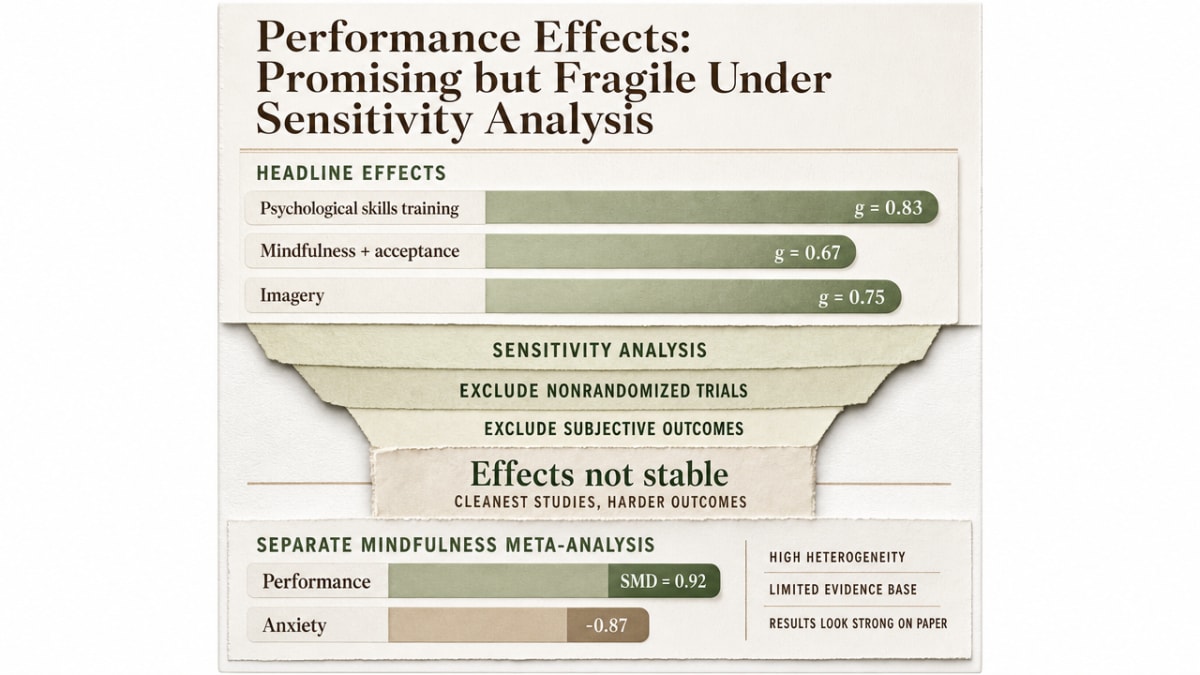
Here’s the uncomfortable opener: when researchers tightened the screws on the performance-enhancement literature — stripping out nonrandomized trials and self-reported outcomes — the headline effects for psychological skills training, mindfulness, and imagery got noticeably shakier 1. The initial numbers looked strong. The sensitivity analyses did not. That’s the frame you should carry into any conversation about hiring, embedding, or expanding a sport psychologist on your staff.
That doesn’t mean the work is theater. It means the pitch you’ve probably heard — mental skills coach rides in, player hits the game-winner — is the wrong story to buy. The reliable returns are quieter and more operational. They show up in rehab adherence, in a coach who recognizes a struggling rookie three weeks earlier than last season, in a captain who runs a better locker room, in a veteran who makes it through a transition without unraveling.
You already know elite performance isn’t a mindset problem waiting for a slogan. It’s a system problem. The question worth your time isn’t whether sport psychology works. It’s whether your organization is deploying it in the places where the evidence is firmest, and whether you’re asking it to carry weight the evidence can’t actually hold.
The rest of this piece walks that line honestly — where the data is solid, where it’s soft, and how to staff the role so it earns its seat.
Where the Evidence Actually Holds Up
Performance Effects: Promising but Fragile Under Sensitivity Analysis
Start with the headline numbers, then watch what happens when the methodology tightens. A 2024 meta-analysis of 111 studies reported moderate effects for psychological skills training on performance (g = 0.83), mindfulness and acceptance approaches (g = 0.67), and imagery (g = 0.75) — the kind of effect sizes that make a good slide deck. But those effects did not hold stable once the authors ran sensitivity analyses excluding nonrandomized trials and subjective outcome measures 1. In plain terms: the cleanest studies, measuring the hardest outcomes, told a less flattering story.
A separate mindfulness-focused meta-analysis of 582 athletes across 11 studies reports a performance SMD of 0.92 alongside an anxiety reduction of -0.87 2. Impressive on paper. The authors also flag high heterogeneity, a limited evidence base, and open questions about dose and sport specificity. Translation for your staff planning: mindfulness is a defensible tool, not a universal lever.
You should treat this honestly with your coaching staff and ownership. A sport psychologist who promises reliable in-game performance gains from a visualization block is overselling what the literature can support. The person who says, “we can likely sharpen attention, reduce competition anxiety, and build routines that hold under fatigue — and here’s what we can’t promise” is reading the same evidence you are.
Wellbeing, Awareness, and Leadership: The Firmer Ground
Here’s the quiet upside: the evidence looks steadier when you step away from pure performance claims and look at wellbeing, education, and leadership. A 2024 systematic review of elite-athlete mental wellbeing interventions reported SMD = 0.78 for psychological skills training and SMD = 0.58 for positive psychology approaches on overall wellbeing 3. That’s not a scoreboard promise. It’s a signal that the same skill set — self-regulation, goal structuring, acceptance work — reliably supports the humans who have to show up on game day in condition to perform.
Education programming shows a similar pattern. Across 28 studies of athlete, coach, parent, and official awareness programs, seven improved referral efficacy and 12 improved knowledge about mental-health disorders 4. You can staff for that. A coach who recognizes a struggling player earlier, or a parent who knows where to call before a crisis, is a concrete operational win — even if it doesn’t photograph well.
Leadership is the third pillar with firmer footing. A 2025 meta-analysis of 50 studies covering 17,158 athletes found leadership was positively associated with performance (r = 0.21 overall), with stronger links for team captains and team performance (r = 0.34) and for authentic leadership styles (r = 0.44) 5. Modest, but real — and inside your control. If your sport psychologist is helping captains lead better and coaches communicate better, that’s performance work the data actually supports.
Five Places a Sport Psychologist Moves the Needle
Screening and Intake: Catching Risk Before It Becomes a Roster Problem
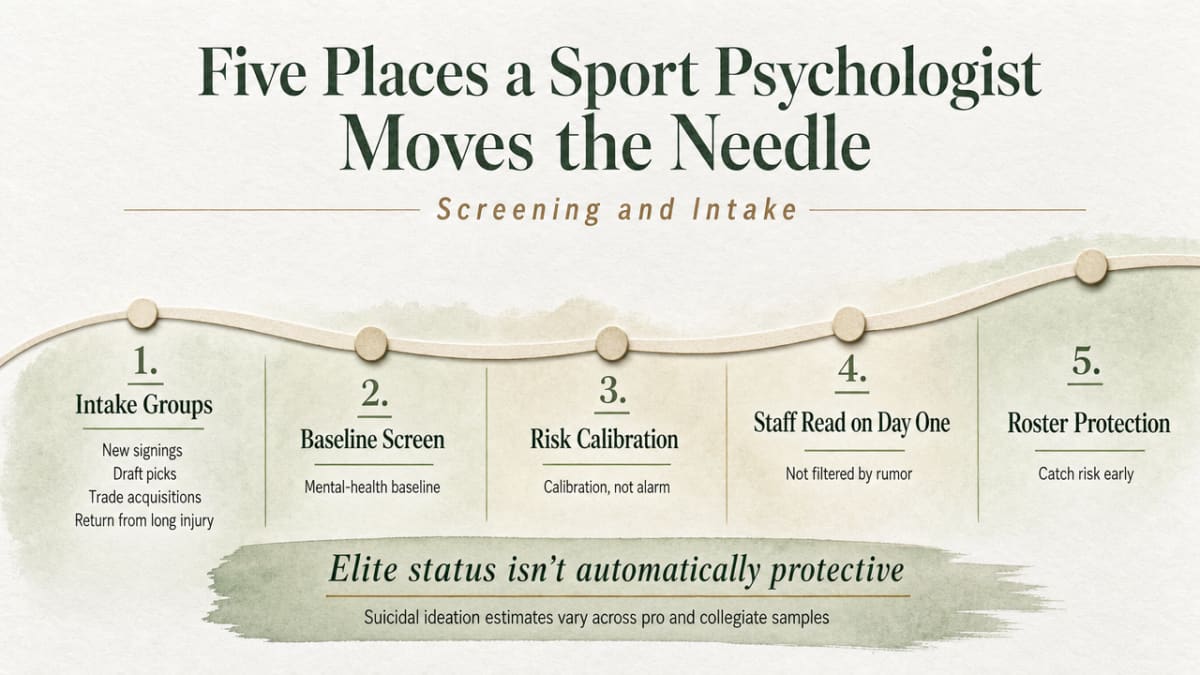
Think of screening as the quietest piece of roster protection you can build. It isn’t glamorous, and it won’t show up in a press release. But a baseline mental-health screen at intake — new signings, draft picks, trade acquisitions, players returning from long injuries — gives your medical and performance staff something they rarely have on day one: a read on risk that isn’t filtered through agent, media, or clubhouse rumor.
The right frame here is calibration, not alarm. In elite athletes, suicidal ideation estimates have ranged from 6.9% to 18% in professional samples and 3.7% to 6.5% in collegiate samples, with mixed comparisons to general populations 7. Those numbers aren’t a reason to panic. They’re a reason to stop assuming elite status is protective. A sport psychologist running intake isn’t diagnosing anyone — they’re flagging who might benefit from closer check-ins, who’s carrying unresolved stressors from their last environment, and who has a history your clinicians should know about before the regular season starts.
You already screen physical risk aggressively. Mental-health screening deserves the same seriousness, with the same confidentiality discipline. Done well, it quietly reduces the number of surprises your front office has to absorb in March.
Coach Education and Referral Literacy
Your coaches see your players more than anyone else in the building. They are, functionally, your first line of mental-health observation — whether you’ve trained them for that role or not. The evidence here is one of the firmer pieces in the whole literature: across 28 studies of sport-specific awareness programs, seven improved referral efficacy and 12 improved knowledge about mental-health disorders 4. That’s not a dramatic story, but it’s a concrete one.
A coach who knows what to look for, who understands the difference between a slump and something else, and who knows exactly which text message gets a player a confidential conversation within 24 hours — that coach is doing performance work. Not because they’re playing therapist. Because they’re shortening the time between “something’s off” and “the right person is involved.”
Build this as structured coach-the-coaches programming, not a one-off preseason talk. Short sessions, repeated across the year, with concrete referral pathways posted somewhere the staff actually looks. Include your assistant coaches, your strength staff, your athletic trainers, your travel staff. The people who see players at breakfast matter here as much as the people drawing up plays.
Injury Rehab Integration: Where the Return Is Clearest
If you want the cleanest case for embedding a sport psychologist in your medical department, injury rehab is where to make it. The evidence here is more consistent than it is for pure performance claims — and it maps directly onto a cost center you already understand.
A systematic review of eight studies on psychosocial interventions during musculoskeletal injury recovery found consistent associations with positive mood changes, pain management, exercise compliance, and rehabilitation adherence. Important caveat: no included study examined return-to-play timing directly 10. A separate 2024 review of mindfulness interventions during post-injury adaptation reported reduced anxiety and depression, increased pain tolerance, greater acceptance, and improved psychological well-being 11. A 2025 scoping review of 64 studies — 61% cross-sectional — mapped the gap between what rehabbing athletes need psychologically and what organizations actually deliver, finding that rehabilitation is emotionally complex and psychological support is often minimal 12.
Read those three together and the operational takeaway is specific. A sport psychologist in your rehab process reliably improves adherence, mood, and the emotional difficulty of long recoveries. It does not, based on current evidence, let you promise a faster return date. Don’t let anyone sell you that promise.
The economics still work. Adherence is upstream of everything else in rehab. An athlete who actually completes their program, who manages pain without catastrophizing, who doesn’t quietly lose their athletic identity around month four of an ACL recovery — that athlete comes back closer to form. Your medical staff already knows this. Give them the embedded resource to act on it.
Leadership, Culture, and Captain Development as Performance Variables
Culture gets talked about as if it were weather — present, powerful, impossible to engineer. The data is less mystical than that. A 2025 meta-analysis of 50 studies covering 17,158 athletes found leadership was positively associated with sports performance (r = 0.21 overall), with stronger links for team captains and team performance (r = 0.34) and for authentic leadership styles (r = 0.44) 5. The effects are modest. They are also inside your control in a way that in-game execution isn’t.
This is where a sport psychologist earns a seat at a different table. Not running mindfulness blocks with your stars, but working with your captains on how they handle conflict in the locker room. Working with your head coach on authentic communication. Working with your veteran leadership group on how they absorb younger players during slumps and bring them back into the fold.
Treat it as a development pipeline, not a one-time workshop. Identify your emerging leaders — the fourth-year player who’s about to inherit a letter, the rookie who’s clearly going to be a franchise voice in three years — and give them structured leadership coaching alongside their skill work. The scoreboard effect won’t be dramatic in any single game. Across a season of close ones, it compounds.
Recovery, Mental Fatigue, and Self-Regulation Routines
By the time your players hit the back half of a long season, physical fatigue isn’t the only variable eroding their execution. Mental fatigue — attention narrowing, decisions slowing, impulse control fraying — is a real performance input, and it responds to specific interventions.
A 2024 meta-analysis of interventions aimed at counteracting mental fatigue on sport-specific tasks found meaningful effects for shooting accuracy (ES = 0.591), decision-making accuracy (ES = 0.553), and reaction time (ES = -0.871), but no significant effect on completion time (ES = -0.302; p = 0.182) 13. Read that carefully: the tasks that depend on attention and judgment responded. The tasks that depend on how fast your body moves through a fixed distance didn’t change much.
That’s a useful signal for how to deploy a sport psychologist’s time. Self-regulation routines — pre-shift breathing resets, structured attention cues, sleep and recovery protocols that athletes actually follow — have the best shot at protecting the cognitive side of performance when the schedule gets ugly. They won’t make your tired players physically faster. They may keep them making the right read in the fourth quarter of a back-to-back, which is often the same thing on the scoreboard.
Build the routines in the preseason. Reinforce them during travel-heavy stretches. Measure what you can.
Allocating the Hours: A Planning Frame, Not a Price List
Here’s a question worth posing to your performance director: if you had 40 sport-psychology contact hours a week across your organization, where would they go? Most teams can’t answer that cleanly, because the role grew by accident — a workshop here, a one-on-one there, whatever the head coach asked for last Tuesday. The result is a service that’s active but not allocated.
A planning frame helps. Think about the hours in five lanes rather than as a single bucket of “mental skills work.” Each lane maps to an evidence base you’ve already seen in this piece, and each one has a different operational owner inside your building.
- Screening and intake. Baseline assessments for new signings, draft picks, and players returning from long injuries. Owned jointly with medical. Lightest hour load, highest leverage per hour.
- One-on-one performance work. Individualized sessions with players who opt in. Owned by the player, scheduled around their routine. This is the lane with the softest evidence under sensitivity analysis 1— real, but don’t let it dominate the schedule.
- Coach education. Structured coach-the-coaches sessions, referral-literacy training, and short recurring touchpoints across the season. Owned by the head coach and your player-development lead. Firmer evidence base 4.
- Injury rehab integration. Embedded hours inside your medical department during active rehab cases. Owned by the head athletic trainer. One of the clearer returns in the literature 10, 12.
- Transition and alumni. Hours reserved for players exiting the roster, retiring, or navigating a trade. Owned by player development and the front office.
Write the split down. Revisit it quarterly. The point isn’t to be rigid — it’s to notice when a lane with firm evidence is getting starved while the glamorous one is overfed.
Longevity, Transition, and the Alumni Risk You Already Own
The players who leave your organization don’t actually leave your organization. They stay in your alumni network, your community events, your Hall of Fame weekends, your scouting conversations with the next generation of parents deciding whether to let their kid sign with you. Their post-career trajectory is part of your brand, whether you treat it that way or not — and the data on that trajectory should sit in your planning conversations.
A 2024 systematic review and meta-analysis synthesized 23 studies involving 21,791 athletes and found a pooled depression prevalence ratio of 2.58 times the general population among former elite athletes 9. That’s not a comparison across careers. That’s after the uniform comes off. Identity collapse, loss of structured routine, financial transitions, the sudden absence of the physical-emotional feedback loop that defined their twenties — all of it hits at once, and most organizations hand departing players a parking-lot handshake and a LinkedIn tip sheet.
A sport psychologist embedded in your transition process can do specific work here. Identity scaffolding in the final contract year. Structured conversations about what the next five years actually look like. Connection to licensed clinicians who stay available after the roster spot ends. None of this prevents every bad outcome. It does make your organization one that handles the end of a career with the same seriousness it handled the start — and that reputation travels, in both directions.
Youth Pipelines and Developmental Programming
If your organization runs an academy, a youth affiliate, or any formal pipeline below the senior roster, the programming math changes. A scoping review of elite youth athletes reported disordered-eating caseness ranging from 0–14% in males and 11–41% in females, with similarly wide ranges for depression and anxiety depending on sample and sex 8. Those spreads tell you two things. First, risk is real at the developmental level. Second, one-size programming built for your senior roster will miss on both ends — too clinical for some, too light for others.
Developmentally appropriate work looks different. Shorter sessions. Parent workshops that teach the sideline language that helps rather than hurts. Coaches trained in referral literacy for a population still forming its identity. Clear safeguarding pathways to licensed clinicians outside the sport system. You’re not trying to produce mentally tougher 15-year-olds. You’re building the scaffolding so the ones who make it to your senior roster arrive with a mental fitness baseline you didn’t have to install under contract pressure.
What to Avoid When You Build the Role
A few failure modes show up repeatedly when organizations stand up this function. Knowing them in advance saves you a year of rework.
Hiring a crisis responder and calling it a program. If the sport psychologist only appears when something has gone wrong, you’ve built a fire department, not a performance function. The evidence for prevention, education, and embedded rehab support is firmer than the evidence for last-minute interventions 4, 10.
Over-promising in-game performance gains. Any pitch that leans on headline effect sizes without the sensitivity-analysis caveat is selling you a version of the literature that doesn’t quite exist 1. Push back. The honest version still justifies the hire.
Blurring the clinical line. A sport psychologist is not a substitute for a licensed clinician handling diagnosable conditions. Build the referral pathway before you need it, and make sure your staff knows where that line sits.
Letting the role report only to the head coach. That compromises confidentiality and narrows the work to whatever the coach cares about this week. Dual reporting into performance and medical protects both the player and the function.
Start Building Stronger, More Resilient Teams Today
Get expert guidance to support athlete longevity and elevate your organization’s mental performance foundation.
Frequently Asked Questions
Should we hire a sport psychologist in-house or contract one externally?
Depends on volume and integration needs. If you want the role embedded across medical, coaching, and player development — the setup where the evidence base is firmest — in-house usually wins because proximity drives trust. External contractors work when you need specialized coverage (youth affiliate, alumni, specific case load) or when roster size doesn’t justify a full-time hire. Most organizations end up with a hybrid.
What’s the difference between a sport psychologist and a licensed mental health clinician, and do we need both?
Yes, you need both, and the roles don’t substitute. A sport psychologist handles performance, skills, and sport-specific adaptation. A licensed clinician diagnoses and treats conditions like depression, anxiety disorders, and substance use. Blurring the line creates legal and clinical risk. Build an explicit referral pathway so your sport psychologist knows exactly when and where to hand off, and your athlete gets care without a gap.
How do we measure ROI on mental performance work when game outcomes are so noisy?
Stop measuring at the scoreboard. Track availability, rehab adherence, intake-to-referral time, coach confidence in handling at-risk conversations, and player utilization of the resource. Those move earlier and cleaner than win-loss. If you want a performance proxy, look at consistency metrics during travel-heavy stretches rather than peak games. Game outcomes will catch up to the operational ones over seasons, not weeks.
How do we get skeptical coaches and veteran players to actually engage with the sport psychologist?
Start with the veterans you already trust and let adoption travel sideways. Mandatory sessions kill the work. Confidential, opt-in, and genuinely useful on day one is what moves skeptics. For coaches, lead with referral literacy — short, practical, no therapy-speak. When a coach catches something early and the player thanks them, engagement stops being a sell. It becomes part of how your building operates.
What are the confidentiality boundaries between the sport psychologist, the front office, and medical staff?
Content of sessions stays confidential. The front office gets utilization data, program-level trends, and safety-threshold escalations — never individual session notes. Medical coordination requires explicit, written player consent for any specific case. Put the boundaries in writing before the first session happens, share them with players, and have the sport psychologist report dually into performance and medical rather than solely into coaching. That structure protects everyone.
At what roster or org size does a dedicated mental performance function become worth the overhead?
For a senior roster alone, a part-time or shared resource usually covers it. Once you add a youth or minor-league affiliate, embedded rehab support, and transition programming for exiting players, the hour math pushes toward at least one dedicated full-time role with contract specialists layered in. The real trigger isn’t headcount — it’s how many of the five evidence-supported lanes you’re actively staffing versus leaving unowned.
References
- Effects of Psychological Interventions to Enhance Athletic Performance: A Systematic Review and Meta-Analysis. https://pubmed.ncbi.nlm.nih.gov/37812334/
- A meta-analysis of the intervention effect of mindfulness training on athletes’ performance. https://pmc.ncbi.nlm.nih.gov/articles/PMC11210447/
- Psychological Interventions to Improve Elite Athlete Mental Wellbeing: A Systematic Review and Meta-analysis. https://pubmed.ncbi.nlm.nih.gov/39815135/
- An updated systematic review of interventions to increase awareness of mental health and well-being in athletes, coaches, officials and parents. https://pubmed.ncbi.nlm.nih.gov/35590425/
- Do Leaders Actually Influence Sports Performance? An Integrated Systematic Review and Meta-Analyses. https://pubmed.ncbi.nlm.nih.gov/40639794/
- Suicide in National Collegiate Athletic Association athletes. https://pubmed.ncbi.nlm.nih.gov/38575202/
- Mental Health in Elite Athletes: A Systematic Review of Prevalence, Risk, and Protective Factors. https://pubmed.ncbi.nlm.nih.gov/38407749/
- Mental health and well-being of elite youth athletes: a scoping review. https://pubmed.ncbi.nlm.nih.gov/39122370/
- Prevalence of anxiety and depression in former elite athletes. https://pmc.ncbi.nlm.nih.gov/articles/PMC11667483/
- Psychosocial interventions help facilitate recovery following musculoskeletal sports injuries: a systematic review. https://pubmed.ncbi.nlm.nih.gov/32186423/
- The effectiveness and applicability of mindfulness intervention in psychological adaptation after sports injury: a systematic review. https://pubmed.ncbi.nlm.nih.gov/40666634/
- Competitive athletes’ psychological and emotional experiences of injury rehabilitation: a scoping review. https://pubmed.ncbi.nlm.nih.gov/41361498/
- The counteractive effects of interventions addressing mental fatigue on sport-specific performance among athletes: A systematic review with a meta-analysis. https://pubmed.ncbi.nlm.nih.gov/38368626/