


Key Takeaways
- Begin with the right diagnostic question rather than proximity, since clinical care and performance consulting serve different needs and the wrong category wastes months.
- Learn the distinction between licensed clinicians who diagnose and treat conditions and CMPCs who build performance skills, because that line decides who can safely help 11.
- Read the signals carefully: struggles that stay inside the sport point to performance work, while symptoms bleeding into sleep, mood, or school call for a clinician first 11.
- Treat ‘near me’ as a licensure question, because the law follows where your athlete sits during the session, not where the provider’s office is located 1.
- Run a structured vetting call covering licensure, youth-sport experience, evidence-based methods, measurement, confidentiality, and crisis planning before committing 3, 5.
- After hanging up, weigh green flags like clear crisis plans and named methods against red flags like shifting titles or vague licensure answers 1, 3.
- Expect a provider to address social media pressure, early specialization, and your parent role, since those forces shape outcomes as much as the sessions themselves 6, 7, 8.
- Put one phone call on the calendar this week using a short observation card, two or three candidates, and the vetting questions already prepared.
Start With the Right Question, Not the Nearest Pin on a Map
You typed “performance psychologist near me” into a search bar at 10 p.m., probably after watching your athlete go quiet after a tough game, or scroll through comments that shouldn’t matter but clearly do. That search was already an act of care. Hold onto that.
Here’s the hard truth, though: proximity is the wrong filter to start with. The nearest provider is not automatically the right provider, and the right provider may not be the one with the shortest drive. Before you compare office locations, you need a sharper question: does your athlete need clinical mental health care, performance consulting, or some coordinated version of both?
Those two paths look similar from a Google search. They are not the same. A licensed clinical provider — a psychologist, psychiatrist, LCSW, LPC, or LMFT — is trained to assess and treat conditions that disrupt daily functioning. A Certified Mental Performance Consultant works with athletes who are functioning well but want to sharpen focus, confidence, routines, or competition nerves 11. Sometimes one is enough. Sometimes you need both, talking to each other.
Get the category right, and “near me” becomes a tiebreaker instead of a filter. Telehealth has widened your options, youth-sport fit matters more than zip code, and the vetting call matters more than the drive time. The next sections give you the framework to make that call with confidence — and the questions to ask once someone picks up.
Clinical Care vs. Performance Consulting: The Distinction That Changes Your Search
What Licensed Mental Health Providers Actually Do
A licensed mental health provider is trained to evaluate and treat conditions that interfere with how your athlete lives, sleeps, eats, learns, or relates to the people around them. That category includes psychologists (PhD or PsyD), psychiatrists (MD or DO, who can prescribe medication), licensed clinical social workers (LCSW), licensed professional counselors (LPC), and licensed marriage and family therapists (LMFT). Each holds a state-issued license, which means a board can sanction them if they practice outside their scope or cause harm.
That license matters more than the title on the website. It is the reason a clinician can diagnose an anxiety disorder, screen for depression or disordered eating, assess for suicidal thinking, and build a treatment plan that may include therapy, medication, or coordination with a pediatrician. If your athlete is losing weight, pulling away from friends, having panic attacks before practice, or saying things that scare you, this is the lane you want.
Clinical providers are also trained to work with risk. They should be able to tell you, in plain language, how they handle safety concerns, when they would involve you as a parent, and what the referral path looks like if your athlete needs a higher level of care 4.
What a Certified Mental Performance Consultant Does (and Doesn’t)
A Certified Mental Performance Consultant (CMPC) works with athletes who are functioning well but want to get sharper. Think: pre-competition routines, focus under pressure, confidence after a mistake, goal-setting, imagery, breathing, recovery between training blocks. The CMPC credential is issued by the Association for Applied Sport Psychology and requires coursework, supervised hours, and an exam. Many CMPCs also hold a clinical license; many do not.
Here is the line you need to hold in your head: a CMPC who is not independently licensed as a clinician does not diagnose or treat mental illness. A review of psychological interventions for elite athletes found promising effects for skills training, mindfulness-based approaches, and positive psychology on well-being and performance, while explicitly cautioning that these are not substitutes for established treatment of a diagnosed disorder 11.
If your athlete is stuck in their own head during competition but otherwise sleeping, eating, laughing, and showing up — a strong CMPC can be exactly the right fit. If something deeper is happening, a CMPC with good ethics will tell you so and refer out.
Side-by-Side: Clinical Provider vs. CMPC vs. Mental Fitness Coach
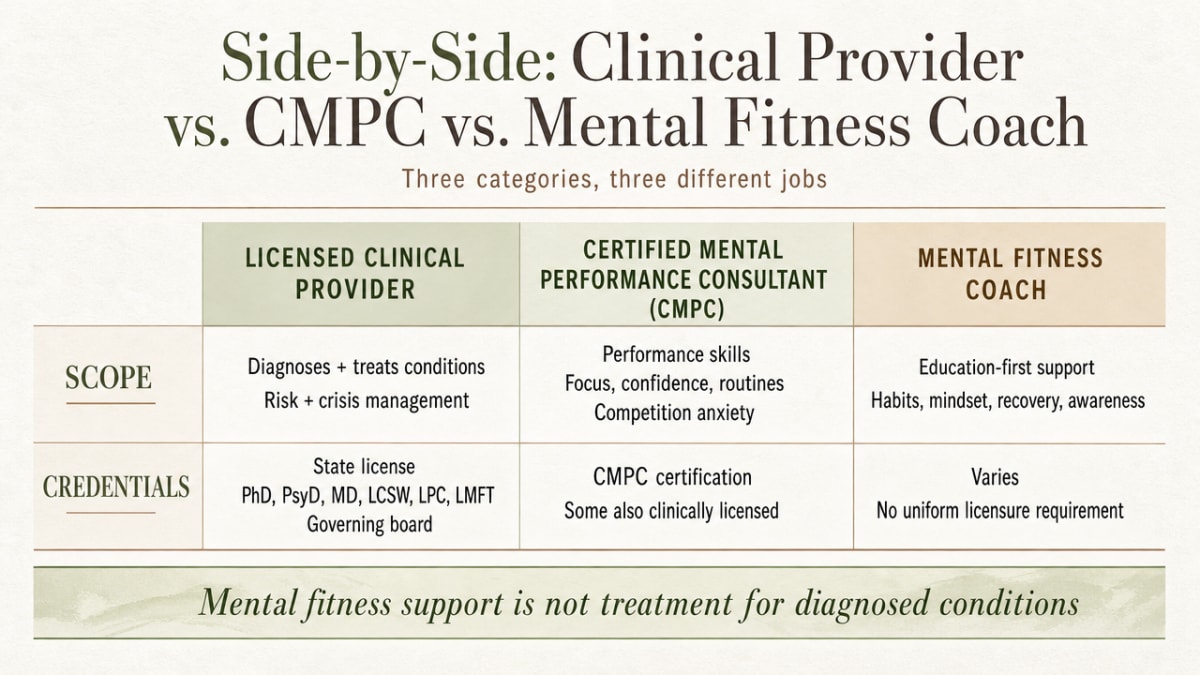
Three categories, three different jobs. The elite-athlete well-being review draws the clearest version of this line: performance and wellness interventions can meaningfully support mental fitness, but they are not treatment for diagnosed conditions 11. Use the comparison below to sort providers before you ever pick up the phone.
| Dimension | Licensed Clinical Provider | Certified Mental Performance Consultant (CMPC) | Mental Fitness Coach |
|---|---|---|---|
| Scope | Diagnoses and treats mental health conditions; manages risk and crisis | Builds performance skills: focus, confidence, routines, competition anxiety | Education-first support for habits, mindset, recovery, and awareness |
| Credentials | State license (PhD, PsyD, MD, LCSW, LPC, LMFT) with a governing board | CMPC certification; some also hold clinical licenses | Varies; no uniform licensure requirement — ask about training |
| When to choose | Symptoms disrupt sleep, eating, school, mood, or safety | Athlete is functioning well but wants a performance edge | Proactive mental-skills work alongside physical training |
| Limits | May not emphasize sport-specific performance strategies | Does not diagnose or treat clinical conditions 11 | Not a substitute for clinical care; should refer when needed |
Many athletes are best served by coordinated care: a clinician for what hurts, and a performance specialist for what the athlete wants to build. Those two can work together — and the best providers in either lane will tell you so without being asked.
Reading the Signals: Is This Performance Friction or a Clinical Concern?
You know your athlete better than any provider ever will. Trust that. The hard part is translating what you’re seeing at home into the language that tells you which door to knock on first.
Performance friction tends to live inside the sport. Your athlete is sleeping, eating, laughing with friends, keeping up in school — but the free throw won’t fall, the start blocks feel like quicksand, the yips showed up in warmups and won’t leave. They’re frustrated, maybe tearful after games, but they bounce back by Tuesday. That’s often where a Certified Mental Performance Consultant does their best work, and controlled trials show psychological interventions can meaningfully reduce competition anxiety when the athlete is otherwise functioning well 9.
Clinical concerns bleed outside the sport. Appetite changes, sleep that won’t come or won’t end, withdrawal from friends, flat affect that lingers past Sunday, panic attacks, self-criticism that sounds like contempt, hints of self-harm, or a drop in school that doesn’t match the kid you know. If any of that is on your list, you want a licensed clinician first, and you want them soon. A CMPC can join later once the clinical ground is steady 11.
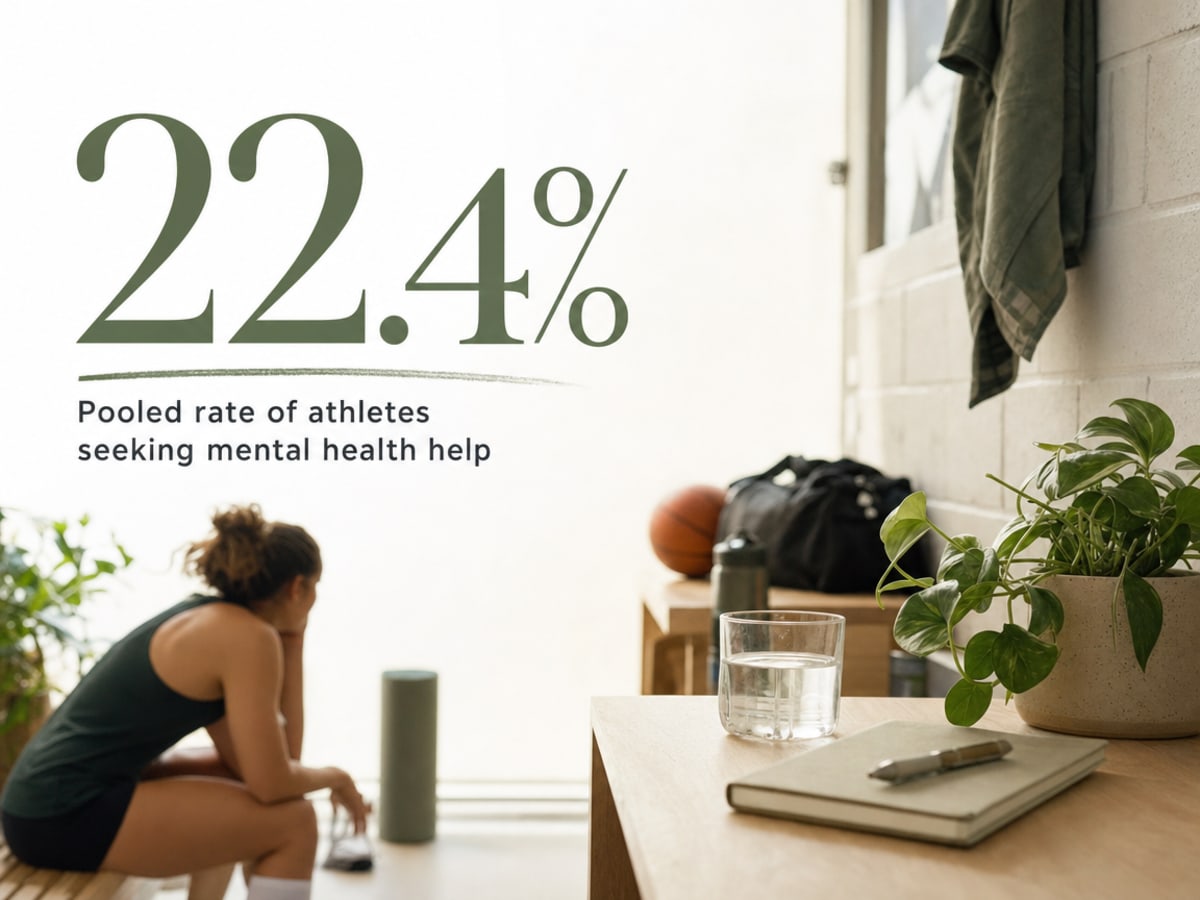
Here’s the part most parents don’t hear often enough: deciding to make the call puts you in a small minority. A meta-analysis of 22 studies of athletes found a pooled help-seeking rate of just 22.4%, and the authors identified normalization through sport settings and trusted adults as one of the strongest facilitators of actually reaching out 12. You are the trusted adult. The fact that you are reading this is already changing the odds in your athlete’s favor.
One more thing worth saying out loud: you are not overreacting. Parents in this spot almost always worry they’re either making too much of a slump or missing something serious. Both fears are normal. The signal check above is not a diagnosis — it’s a sorting tool that gets you to the right first phone call, which is all you need right now.
Why ‘Near Me’ Is Really a Licensure Question
The State Where Your Athlete Sits Is the State That Matters
Here’s the piece almost no one explains clearly: when your athlete logs into a telehealth session, the law treats the session as happening wherever your athlete’s body is sitting — not where the provider’s office is. HHS guidance is explicit that behavioral-health providers must be licensed or legally permitted to practice in the state where the patient is physically located during the session 1. So the “near me” question is really asking: who is legally allowed to see my athlete in our state, whether they’re down the street or across the country?
That reframe is good news. It means a provider two states away with deep experience in your athlete’s sport may be a better fit than the closest office, as long as the licensure math works. It also means you need to ask one direct question before you book: “Are you licensed to see a client located in [your state]?” If the answer is yes, ask what pathway makes that possible — full state license, a telehealth registration, or something else 2. A good provider will answer this in thirty seconds without flinching.
Travel, College, and Cross-State Competition
Now layer in the reality of your athlete’s calendar. Showcases in another state. A tournament weekend across the border. A freshman year that starts in August six hundred miles from home. Each of those is a different licensure situation, and the one you have today may not be the one you have in September.
HHS lists the pathways providers use to work across state lines: full licensure in a second state, interstate compacts like PSYPACT for psychologists, reciprocity, temporary practice authority, or telehealth registration 2. You don’t need to memorize those terms. You just need to ask the provider directly: “If my athlete is in a hotel in another state for a tournament, can we still have a session?” and “If my athlete starts college out of state next year, can we keep working together, or will we need a warm handoff?”
Providers who work with competitive athletes have answered these questions before. If yours hasn’t, that’s useful information too — before you commit, not after.
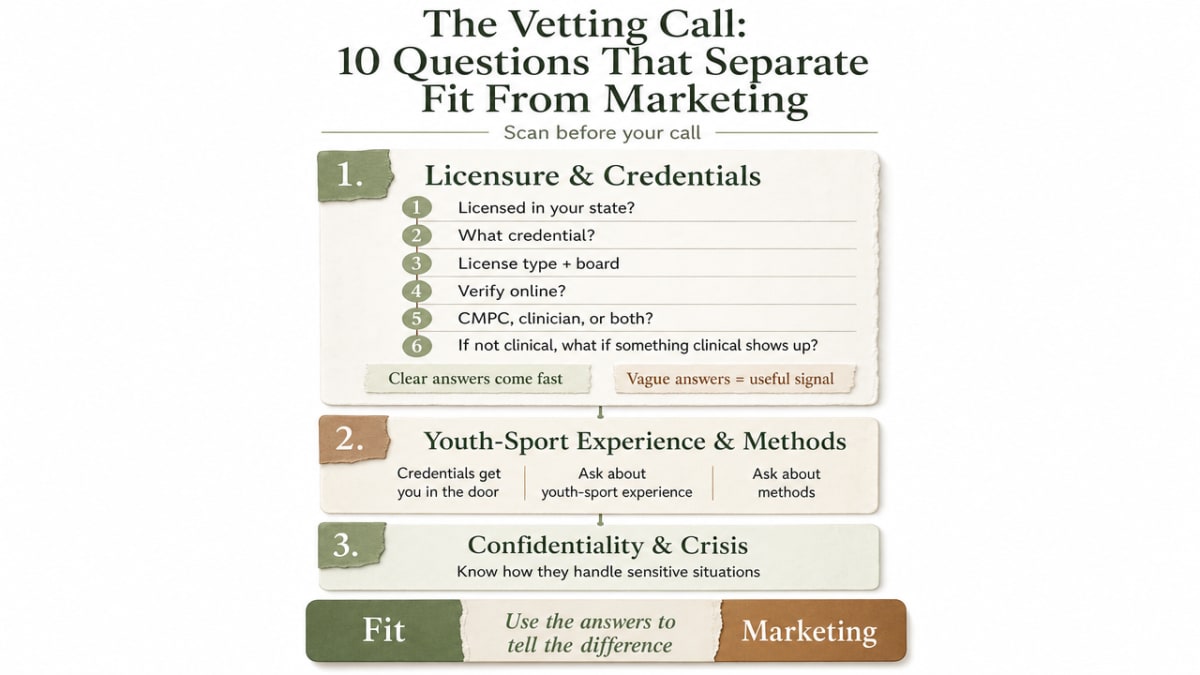
The Vetting Call: 10 Questions That Separate Fit From Marketing
Licensure and Credentials
Start every call in the same place. Ask: “Are you licensed to see a client physically located in [your state], and what credential are you working under?” HHS is clear that behavioral-health providers must be licensed or legally permitted to practice where the patient is sitting during the session 1. A clear answer takes under a minute.
Then layer in three more: “What’s your license type and board, and can I verify it online?” “Are you a CMPC, a licensed clinician, or both?” and “If you’re a performance consultant without a clinical license, how do you handle it when something clinical shows up?” Providers who work with athletes answer these without defensiveness. Vague answers or title inflation are information you can use.
Youth-Sport Experience and Methods
Credentials get you in the door. Fit with your athlete decides whether the work actually sticks. Ask: “How many youth or college athletes have you worked with in the last year, and in which sports?” and “What does a typical first month look like with an athlete like mine?”
Then push on method. “What evidence-based approaches do you use, and how do you decide which fits a given athlete?” You’re listening for named methods — cognitive-behavioral work, mindfulness-acceptance-commitment, imagery, exposure, relaxation training — not jargon. A network meta-analysis of 46 trials involving 2,049 participants found mindfulness-acceptance-commitment showed the largest point estimate for reducing competitive anxiety among the compared interventions, though uncertainty remained across several head-to-head comparisons 10. The practical implication: a good provider can name methods, explain why they chose one for your athlete, and acknowledge where the evidence is still mixed.
Finish with measurement. “How will we know this is working in six weeks? Twelve weeks?” You want specifics — brief check-in scales, performance markers your athlete already tracks, sleep, confidence ratings — not “we’ll see how it feels.”
Confidentiality, Parent Involvement, and Crisis Planning
This is the set of questions most parents forget to ask, and the one that matters most when things get hard. Start with: “What will you share with me, what will you keep private, and how does that change if my athlete is a minor versus eighteen?” HIPAA generally lets a parent access a minor’s records as personal representative, but state law can shift that, and good providers explain their communication policy before treatment begins rather than after a conflict 5.
Then ask about the hard moments: “What’s your written crisis plan if my athlete expresses thoughts of self-harm or shows up in a session in acute distress? Who do you call, and when do you call me?” HHS’s informed-consent guidance for telebehavioral health lists emergency procedures as a required part of the initial conversation 3. If a provider cannot describe their plan in concrete steps, that is your answer.
Close with involvement. “How do you want me involved — monthly parent check-ins, written updates, nothing unless there’s a safety issue?” and “What do you suggest I say or not say after a tough competition?” A research synthesis of 29 studies covering 9,185 young athletes and 2,191 parents found autonomy-supportive, moderately involved parenting with a task-focused tone produced the best motivational outcomes 7. Translation: you want a provider who gives you a clear role, not a vague one.
Green Flags and Red Flags After the First Call
Hang up the phone. Before you look at your notes, check your gut. Did you feel talked down to? Rushed? Sold to? Or did you feel like the person on the other end was already quietly on your athlete’s side? That first read matters, but it’s not enough on its own. Here’s what to pair it with.
Green flags.
- They told you where they’re licensed and which state boards oversee them without you having to pry 1.
- They described a written crisis plan in concrete steps, including when they would call you 3.
- They named specific evidence-based methods and matched them to your athlete’s situation instead of pitching a single technique as universal 9.
- They named referral partners by role — a sports-medicine pediatrician, a registered dietitian, a psychiatrist they trust — and offered to coordinate.
- They told you how they measure progress at six and twelve weeks.
- They acknowledged what they don’t do, and they didn’t flinch when you asked about confidentiality limits for a minor 5.
Red flags.
- Promises of results.
- A title that keeps shifting between “coach,” “consultant,” and “therapist” depending on the question.
- No clear answer on licensure in your state.
- A crisis plan that boils down to “I’ll call you.”
- Dismissiveness about your observations.
- Blurred roles — the same person coaching your athlete on the field and running clinical sessions.
- Pressure to commit to a package before a consultation.
If three or more green flags are present and no red flags showed up, book the consultation. If a red flag appeared, keep calling. The second call is almost always easier than the first.
Coordinating Care: Social Media, Specialization, and the Family Role
Online Pressure Belongs in the Care Plan
If your athlete has a phone, they have a second locker room. Comments after a bad game. Highlight reels of kids a year younger. Group chats that keep going at midnight. The U.S. Surgeon General’s advisory on social media and youth mental health found current evidence insufficient to conclude that social media is sufficiently safe for children and adolescents, and specifically flagged social comparison, cyberbullying, sleep disruption, and exposure to harmful content as risks worth active mitigation 6.
Ask any prospective provider how they handle this. “Do you talk with athletes about online comparison, criticism, and phone boundaries around competition and sleep?” A provider who treats social media as separate from performance is working with half the picture. One who weaves it in — screen cutoffs the night before a game, a plan for reading or not reading comments, a way to talk about trolls without shame — is treating the environment your athlete actually lives in.
Specialization, Identity, and Overtraining
Year-round club. One sport, one coach, one identity. A systematic review of parental influence on youth single-sport specialization emphasized communication with parents about specialization risks and the importance of monitoring participation and recovery, including identity foreclosure and injury-related distress 8.
A provider who gets this will ask about training load, offseason, injury history, and what your athlete would say they are besides their sport. If the answer is nothing, that’s a working topic, not a crisis — but it belongs on the plan. Ask: “How do you work with athletes whose identity is tightly fused to their sport?” and “What do you watch for that would tell us the training volume is too much?” The answers tell you whether the provider sees your whole athlete or just the competitor.
Your Role Without Adding Pressure
You already know the car ride home can undo an hour of good work. The research backs that instinct. A synthesis of 29 studies covering 9,185 young athletes and 2,191 parents found that autonomy-supportive, moderately involved parenting with a task-focused climate produced the strongest motivational outcomes 7. Translation: ask about effort and enjoyment, not outcomes. Resist the postgame debrief unless your athlete opens the door.
A good provider will give you a specific role — monthly check-ins, a short list of phrases that help, a shorter list of ones that don’t, and a clear plan for when to loop you in on something harder. If you leave the intake without that clarity, ask for it. Your job is not to disappear from the care team. It’s to show up in the way that actually helps.
Making the Call This Week
You don’t need a perfect plan. You need one phone call on the calendar before Sunday.
Here’s what to do this week:
- Write down three to five observations about your athlete — what you’ve seen on the field, at the dinner table, in their sleep, on their phone. Keep it to a notecard. That card becomes your script for the first thirty seconds of every call you make.
- Pick the door based on the signals you sorted earlier. If anything bled outside the sport, call a licensed clinician first. If the friction lives inside competition and your athlete is otherwise themselves, start with a CMPC. Either way, line up two or three candidates, not one. The second call almost always teaches you what you didn’t know to ask on the first.
- Run the vetting questions. Licensure in your state 1. Youth-sport experience. Written crisis plan 3. How they’ll keep you informed without breaching your athlete’s trust 5. How you’ll know in six weeks whether the work is helping.
- Then tell your athlete you made the call. Not what they said. Just that you reached out, because you’re on their team. That sentence does more than you think.
If you want a team like Blend MH in the mix as you compare options, add it to the list. The point is that you called.
Start Your Athlete’s Personalized Mental Coaching Journey
Connect with a specialist to map out a mental health and performance plan tailored to your athlete.
Frequently Asked Questions
What’s the difference between a performance psychologist and a mental performance coach?
A performance psychologist typically holds a state clinical license plus training in sport psychology, so they can both treat clinical conditions and work on performance. A mental performance coach or Certified Mental Performance Consultant focuses on skills like focus, confidence, and competition routines, and does not diagnose or treat mental illness unless they also hold a clinical license 11.
How do I know if my athlete needs clinical care instead of performance consulting?
Watch what spills outside the sport. Changes in sleep, appetite, mood, school, friendships, or any mention of self-harm point toward a licensed clinician first. If the struggle lives inside competition and your athlete is otherwise themselves at home and school, a performance consultant is often the right starting place, with a referral path if clinical concerns surface later 11.
Can my athlete work with a provider who lives in another state?
Often yes, but the deciding factor is where your athlete sits during the session, not where the provider sits. HHS guidance requires behavioral-health providers to be licensed or legally permitted to practice in the patient’s state, through pathways like full licensure, interstate compacts, reciprocity, temporary practice authority, or telehealth registration. Ask directly before booking 1, 2.
What should I ask on the first phone call with a potential provider?
Ask whether they are licensed to see a client located in your state, how many youth or college athletes they have worked with recently, what evidence-based methods they use, and how progress will be measured 9. Then ask about their written crisis plan and what they share with you versus keep private for a minor 3, 5.
Will I know what my teen talks about in sessions?
Not word for word, and that is usually by design. HIPAA generally lets a parent access a minor’s records as personal representative, but state law can shift that, and good providers set a clear communication policy up front — what triggers a parent call, what stays private, and how safety concerns are handled 4, 5. Ask for that policy in writing before the first session.
What are the biggest red flags when vetting a performance psychologist?
Watch for promises of results, shifting titles between coach, consultant, and therapist, vague answers about licensure in your state, and a crisis plan that amounts to “I’ll call you” 1, 3. Blurred roles — the same person coaching your athlete on the field and running clinical sessions — and pressure to buy a package before a consultation are also reasons to keep looking.
References
- Licensure for behavioral health. https://telehealth.hhs.gov/licensure/licensure-for-behavioral-health
- Licensing across state lines | Telehealth.HHS.gov. https://telehealth.hhs.gov/licensure/licensing-across-state-lines
- Obtaining informed consent for telebehavioral health. https://telehealth.hhs.gov/providers/best-practice-guides/telehealth-for-behavioral-health/preparing-patients-for-telebehavioral-health/informed-consent-for-telebehavioral-health
- Information Related to Mental and Behavioral Health, including Opioid Overdose. https://www.hhs.gov/hipaa/for-professionals/special-topics/mental-health/index.html
- Mental Health – HHS.gov. https://www.hhs.gov/hipaa/for-professionals/faq/mental-health/index.html
- Social Media and Youth Mental Health. https://www.hhs.gov/sites/default/files/sg-youth-mental-health-social-media-advisory.pdf
- The role of parents in the motivation of young athletes: a systematic review. https://pubmed.ncbi.nlm.nih.gov/38259527/
- Parental influence and perceptions on youth single sport specialization: a systematic review. https://pubmed.ncbi.nlm.nih.gov/39215398/
- Effects of psychological interventions on anxiety in athletes: a meta-analysis based on controlled trials – PubMed. https://pubmed.ncbi.nlm.nih.gov/40851578/
- The Effect of Different Psychological Interventions on Athletes’ Competitive Anxiety: A Systematic Review and Bayesian Network Meta-Analysis. https://pubmed.ncbi.nlm.nih.gov/41866642/
- Psychological Interventions to Improve Elite Athlete Mental Wellbeing. https://pubmed.ncbi.nlm.nih.gov/39815135/
- Athlete mental health help-seeking: A systematic review and meta-analysis of rates, barriers and facilitators. https://pubmed.ncbi.nlm.nih.gov/38128709/
- An updated systematic review of interventions to increase awareness of mental health and well-being in athletes, coaches, officials and parents. https://pubmed.ncbi.nlm.nih.gov/35590425/
- Mental Health Literacy Intervention on Help-Seeking in Athletes: A Systematic Review. https://pubmed.ncbi.nlm.nih.gov/33020448/
Book a call to start your athlete’s support
Connect with a specialist to discuss your athlete’s needs and map out next steps together.