
Key Takeaways
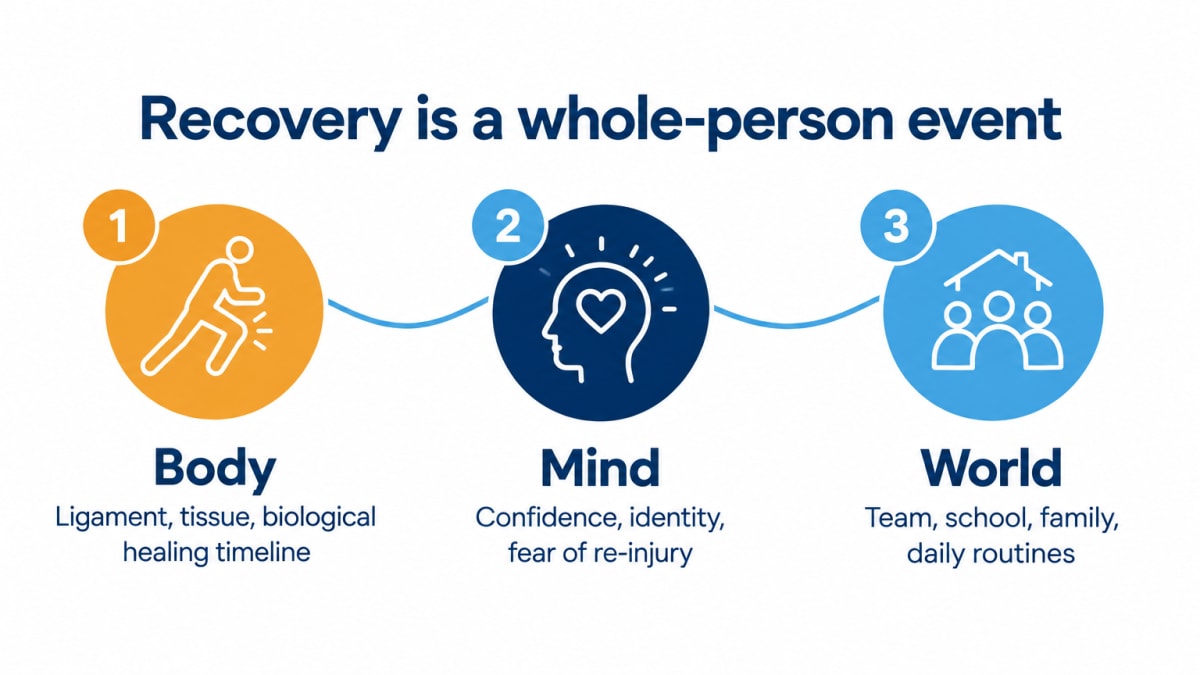
- Recovery is biopsychosocial: the body, mind, and people around your athlete all shape how healing unfolds, so emotion, thinking, and behavior deserve the same attention as the ligament itself 1, 3.
- Physical clearance and psychological readiness are two different finish lines, and the mind catches up on a slower clock, with fear of reinjury and lower confidence predicting whether athletes actually return 5, 6.
- Athletic identity cuts both ways, so widen the circle around the sport instead of replacing it, and lean on peers who’ve been through it as part of the village 11, 13.
- Focus next on small, consistent moves at home: name what you see without fixing it, keep invitations open, start mental fitness work alongside PT, and call a licensed professional when distress crosses safety lines 12.
The quiet car ride home from PT
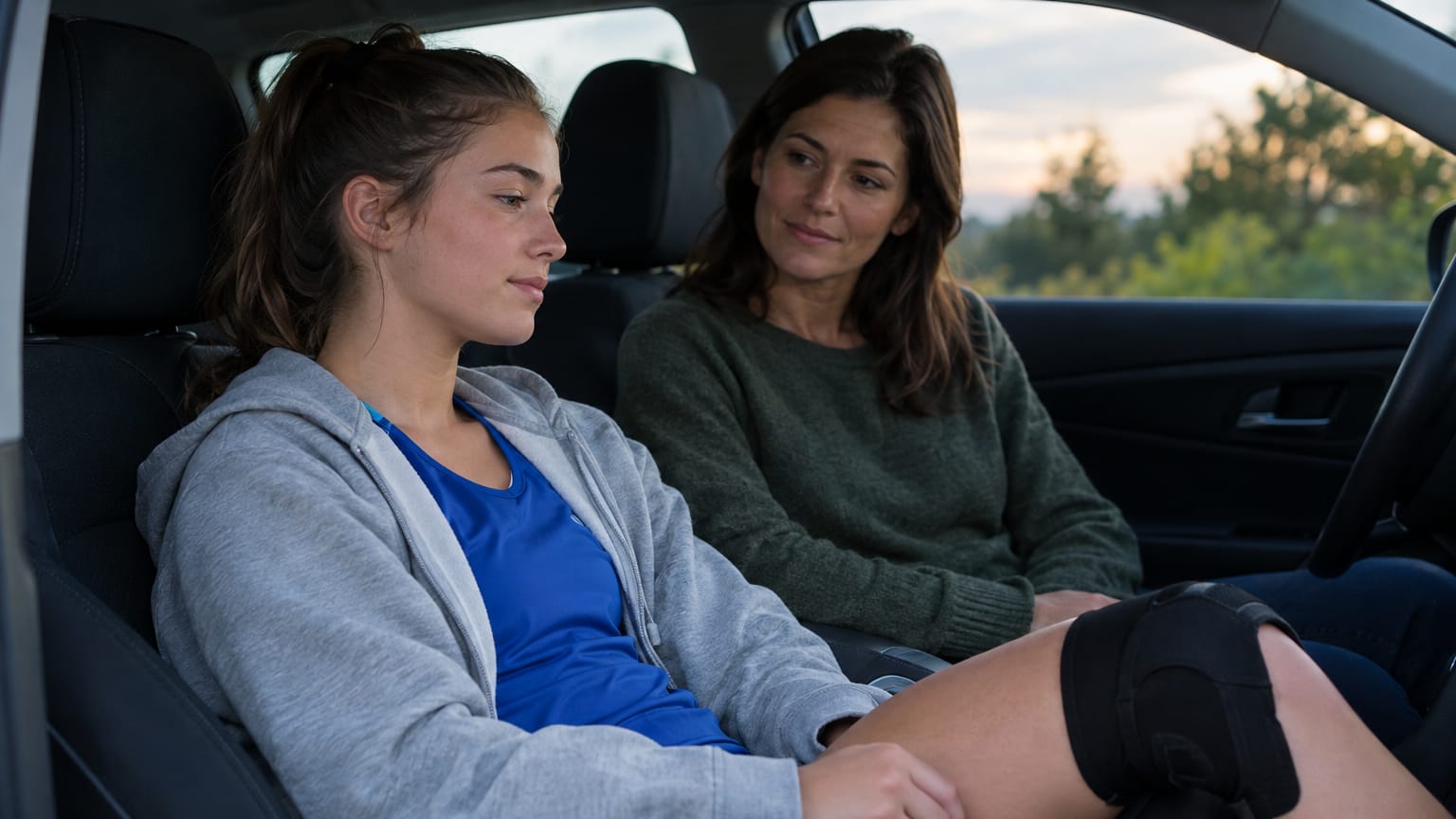
You know the drive. Your athlete climbs into the passenger seat after physical therapy, pulls the hood up, and doesn’t say a word. The brace is on. The exercises got done. On paper, recovery is on track. In the car, something else is going on.
Sport injury isn’t just a torn ACL on a soccer field or a stress fracture in a softball pitcher’s shoulder. It’s a sudden rewrite of how your athlete sees themselves, their team, and the next six months. Decades of research now treat recovery as biopsychosocial, meaning the body, the mind, and the people around your athlete all pull on the same rope 1, 2.
This pillar is written for you, the parent in the driver’s seat. You’ll learn what’s actually happening in your athlete’s head after an injury, why physical clearance and mental readiness are two different finish lines, and what to say tonight that doesn’t make it worse. You don’t need to fix anything on this car ride. You just need to understand what you’re sitting next to.
Why injury is a whole-person event, not just a torn ligament
Here’s the piece most clinic paperwork leaves out: when your athlete gets hurt, their body is one of several things that just changed. Their calendar changed. Their place on the team changed. The way they walk into school changed. The identity they’ve been building since they were seven changed. The ligament is the headline, but it isn’t the whole story.
Researchers now describe sport injury through a biopsychosocial lens, meaning biological healing, psychological responses, and the social environment around your athlete all shape how recovery actually unfolds 1. Five decades of consensus research back this up: competence, autonomy, relatedness, and confidence are not soft add-ons to physical rehab, they are part of the engine 2. When any of those pieces is missing, the body often heals on schedule while the athlete falls behind.
You can see this in the research base itself. A 2025 systematic review of 62 studies examined self-reported psychological-readiness measures across sport-injury recovery:
- 24 studies examined physical recovery
- 18 looked at return-to-sport practices
- 13 measured post-return performance
- 7 tracked quality of life or reinjury 7
Translation for your kitchen table: how your athlete feels during PT, the week before clearance, and the first game back are all part of the same recovery, not separate problems.
What you’ll actually see at home: emotion, thinking, and behavior
The emotional wave: grief, anger, and the flat days
Your athlete didn’t just lose a season. They lost the thing that organizes their week, their friends, and their sense of what tomorrow looks like. Grief is a fair word for it, even if nobody said it out loud at the orthopedist’s office.
Expect a wave, not a straight line. One afternoon your softball pitcher is cracking jokes about her sling. The next morning she’s crying in the kitchen because she saw her travel-ball jersey in the laundry. A soccer midfielder might slam a door for no reason you can trace. A hockey goalie might go quiet for three days and then ask, out of nowhere, whether anyone still misses him at practice. The mixed-studies review of 942 injured competitive athletes found emotion was one of three domains that consistently shaped how rehab went, alongside thinking and behavior 3.
You don’t have to name the feeling for them, and you don’t have to talk them out of it. A simple “this is a lot, and it makes sense you’re flat today” lands better than a pep talk. Flat days are part of healing, not a sign that something extra is wrong.
The thinking shifts: ‘I’m not an athlete right now’
Listen for the self-talk. It shows up in offhand lines: “I’m not really on the team anymore.” “Coach doesn’t text me now.” “What’s the point of lifting if I can’t play?” Your tennis player might stop checking the junior rankings. Your basketball guard might refuse to wear the warm-up because, in her head, she hasn’t earned it this month.
These thoughts are the cognitive piece of recovery researchers keep flagging. The same review of injured competitive athletes identified cognition, alongside emotion and behavior, as a domain that shows up again and again in how rehab actually goes 3. Confidence slides. Fear creeps in. Identity narrows to “the kid who got hurt.”
You can gently widen that story without arguing with it. Try reflecting instead of correcting: “Sounds like you’re feeling pretty disconnected from the team right now.” Then let a beat of silence do the work. You’re not trying to convince your athlete they’re still a baseball player. You’re letting them know the person under the jersey is still there, and still yours.
The behavior changes: dropped group chats and skipped games
Watch what your athlete does, not just what they say. The group chat they used to blow up at midnight goes quiet. The team dinner gets a “maybe later.” They stop watching the games on TV. Your hockey kid might refuse to go to the rink to cheer on his line. Your golfer might skip the Saturday range session she used to beg for.
Some of this is self-protection. Research with adolescent athletes found that concealment and social withdrawal often show up during injury, especially when the sport culture around them feels unsupportive or quick to judge 12. Watching from the bench can hurt more than staying home.
Make it easy to stay connected without forcing it. Offer options instead of ultimatums: “Want to come to the game, catch the second half, or skip it tonight? Any of those are fine.” Keep inviting, even when the answer is no. Behavior often lags emotion by a few weeks, and a door you leave open now is a door your athlete can walk back through when they’re ready.
Two finish lines: physical clearance vs. psychological readiness
Here’s the trap most families walk into: the surgeon says “cleared,” and everyone treats it like the race is over. The knee is strong. The scans look good. The hop tests check out. So why is your soccer midfielder suddenly inventing reasons to skip the first scrimmage back? Why does your hockey goalie freeze the second a shooter cuts into the slot?
Because clearance is one finish line. Psychological readiness is a different one, and it almost always arrives later.
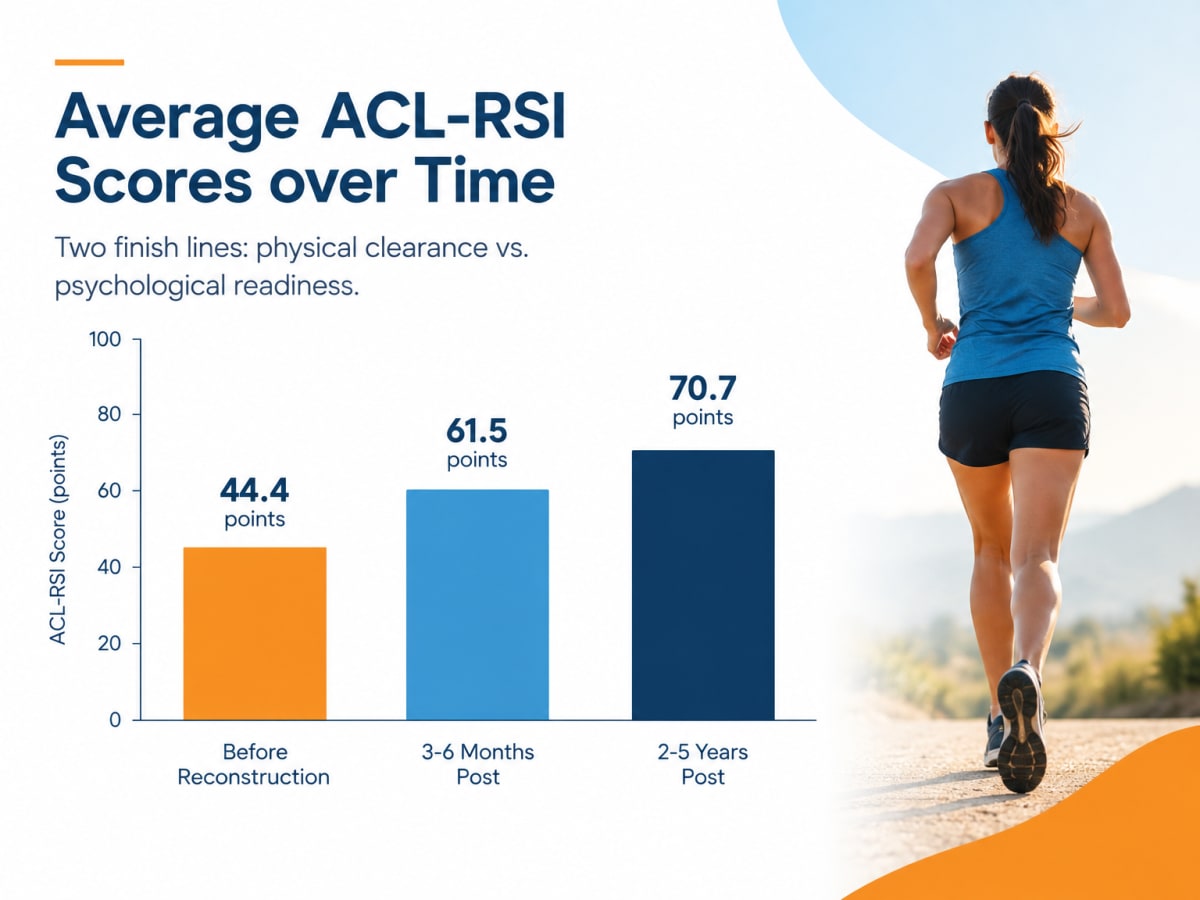
A 2024 meta-analysis tracked how athletes score on the ACL-Return to Sport after Injury scale, a standard measure of confidence, fear, and readiness, at different points after ACL reconstruction. Average scores sat around 44.4 before surgery, climbed to 61.5 at three to six months post-op, and reached 70.7 only at the two-to-five-year mark 6. The evidence quality is mixed and these are averages across many studies, not a promise for your athlete. But the shape of the curve is the point: the mind catches up to the body on a slower clock.
That lag matters because the strongest predictors of actually returning to sport aren’t just quad strength and range of motion. A meta-analysis of 3,744 ACL reconstruction patients found that athletes who returned had higher psychological readiness scores and lower fear-of-movement scores than those who didn’t, even when their knee function tested similarly 5. Association, not proof, but a consistent pattern.
Fear of reinjury and the ‘cleared but not ready’ moment
Picture your basketball guard the first time she’s told she can scrimmage. The brace fits. The physical therapist smiled. She laces up, jogs onto the court, and then flinches the second a defender crowds her space. She comes off saying her ankle feels “weird.” It probably does. But something else is also happening: her brain is running a background program called “don’t let that happen again.”
Fear of reinjury is one of the most consistent psychological signals researchers see after a serious injury. In the meta-analysis of 3,744 ACL reconstruction patients, athletes who did not return to their sport carried higher fear-of-movement scores than those who did, even when their knee tested at similar strength and function 5. The body was ready. The nervous system wasn’t convinced.
You’ll hear it in small ways. A hockey goalie who used to challenge shooters now hangs back in the crease. A soccer midfielder won’t plant and cut on the repaired leg during warm-ups. A tennis player stops going for the second serve. These aren’t excuses, and they aren’t softness. They’re protective instincts doing exactly what instincts are built to do.
Your move here is patience with a floor under it. Don’t push your athlete to “just trust it.” Don’t fill the silence with reassurance that sounds like pressure. Try naming what you’re seeing: “Looked like you held back on that cut. That tracks, your body is still deciding if it’s safe.” Then let the next rep, or the next practice, be the teacher. Confidence after injury is built one honest moment at a time, and your calm is part of the scaffolding.
Athletic identity: an asset and a trap
When being ‘the hockey kid’ makes injury harder
For a lot of athletes, the sport isn’t something they do, it’s who they are. Your kid has been “the hockey kid” since he was five. The travel bag by the door. The nickname from the uncles. The way teachers introduce him at parent conferences. When the knee goes, that whole identity gets jostled at once.
Strong athletic identity cuts both ways. Research on young athletes shows it can fuel motivation and push a kid through hard rehab, but the same intensity is linked to reluctance to report symptoms, playing through pain, and overdoing rehab in ways that backfire 9. A 2025 review of qualitative studies on identity after injury identified both disruption and reconstruction of athletic identity: 17 of 24 studies described athletes feeling cut off from who they thought they were, while 7 traced how identity got rebuilt over time 10.
You’ll hear the disruption in small lines. “I’m nobody if I’m not playing.” “Why am I even going to the rink?” Take those seriously, and don’t rush to argue them away.
How to expand identity without taking the sport away
Here’s the move most parents miss: the goal isn’t to replace the sport, it’s to widen the circle around it. A longitudinal study of rugby players recovering from ACL surgery found that the athletes who came through best went through what researchers called adversity-induced identity expansion, growing into broader person-centered roles alongside the athlete role, not instead of it 11. Coaching younger kids. Picking up a guitar. Getting serious about a class. Becoming the teammate who runs film.
You can seed this at home without making a big announcement. Ask about the parts of your athlete that have been on the back burner. “What have you been curious about lately that we haven’t had time for?” Then follow up on the answer. If your softball pitcher mentions she’s been drawing again, buy the sketchbook. If your soccer midfielder wants to help coach his sister’s U10 team, drive him.
This is where interdependence starts, meaning your athlete learning to lead themselves and knowing who to lean on. You’re not shrinking the sport. You’re making sure there’s a whole person under the jersey when they come back.
The village effect: parents, coaches, teammates, and peers
Recovery is a team sport, even when your athlete can’t suit up. The people around them, you included, shape how this goes in ways that scans and strength tests will never capture. Researchers call this the social piece of the biopsychosocial model, and for pediatric athletes it’s especially load-bearing: a 2025 review on youth injury recovery concluded that integrated care has to account for family relationships, coach relationships, and social support, not just the healing tissue 8.
You’re the anchor, but you’re not the whole village. Your athlete needs the coach who still texts “thinking about you” on game day. The athletic trainer who learns their name. The two or three teammates who save them a seat at the team dinner even when they can’t play. A qualitative study of 27 adolescent athletes recovering from injury found that unsupportive sport cultures and social judgment pushed kids toward concealment and withdrawal, while social support and mental-health literacy at the team and family level protected well-being 12.
Peers who have been through it carry a particular weight. A 2025 randomized trial of 51 injured collegiate athletes tested a six-week peer-support program against low-intensity mental-health education and found larger gains in resilience and lower perceived stress in the peer-support group 13. The sample is small and collegiate, not a guarantee for your 15-year-old. But the mechanism tracks with what parents already notice: an older kid at the rink who’s been through an ACL rebuild can say “this part sucks and it passes” in a way you can’t, and your athlete will believe them.
Here’s what you can do this week. Text the coach and ask for one specific thing: can your athlete still come to practice, sit on the bench in uniform, help run a drill? Ask the athletic trainer if there’s another kid in rehab your athlete could grab lunch with. Keep inviting teammates over without making it a production. You’re building what we’d call interdependence, meaning an athlete who learns to lead themselves and knows exactly who to lean on. One more trusted voice in their corner makes the hard weeks shorter.
What actually helps (and the limits of worksheets alone)
Here’s the honest part. Mental work during injury recovery helps, and it isn’t a magic switch. The research base points to a specific toolkit: a systematic review of psychosocial interventions during musculoskeletal sport-injury recovery found that relaxation, guided imagery, positive self-talk, goal setting, counseling, written disclosure, and modeling videos were associated with better mood, pain management, exercise compliance, or rehab adherence 4. The same review flagged a gap worth knowing about: none of the included studies directly tested whether these tools raised return-to-play rates.
Then came the BANG randomized controlled trial, which put that question to the test. Researchers added a 24-week internet-delivered psychological-support program, built on cognitive behavioral principles, to usual rehab for athletes aged 15–30 recovering from ACL reconstruction. At 12 months, the return-to-sport rate was 36% in the intervention group and 36% in the usual-care group 14. Same number, both sides. A self-directed program bolted onto rehab didn’t move the needle on its own.
Don’t read that as “mental work doesn’t matter.” Read it as a nudge toward how the help actually lands. An app your athlete clicks through alone at 10 p.m. is different from a trusted voice who knows their sport, their teammates, their particular fear of planting the repaired leg. Integrated, person-centered coaching sits alongside PT, your athlete, and you, not inside a login screen. That’s the shape of help that tends to stick.
What to say tonight: scripts, resets, and the drive home
You don’t need a speech. You need a few lines that don’t make the car feel smaller than it already does.
Start with naming, not fixing. Try: “Today looked hard. You don’t have to talk about it unless you want to.” That’s it. Silence after is fine. The mixed-studies review of 942 injured athletes found that emotion, thinking, and behavior all shape how rehab goes, which means your athlete’s quiet is information, not a problem to solve 3. If your softball pitcher does start talking, reflect before you respond: “Sounds like the shoulder felt further behind today than you expected.”
Keep a 30-second reset in your back pocket for the hard moments, the night before PT or the morning of a first practice back. Four slow breaths in through the nose, longer out through the mouth. Then three things they can see, two they can hear, one they can feel. That’s it. Guided imagery, relaxation, and positive self-talk are among the tools researchers have linked to better mood, pain management, and rehab adherence during sport-injury recovery 4. A reset isn’t a cure. It’s a way to get the nervous system off the ceiling for 30 seconds so the next rep is possible.
Three lines worth stealing for tonight:
- “I’m proud of how you showed up today, not how it went.”
- “What would help right now, space, food, or company?”
- “You’re still my kid before you’re any kind of athlete.”
That last one does more work than any pep talk. You’re one more trusted voice in their corner, not the one who has to carry the whole thing.
When to call a licensed professional
Here’s the line a coach can’t cross, and shouldn’t. Mental fitness work, confidence building, resets, and goal setting all sit alongside physical rehab. They don’t replace clinical care when your athlete is struggling in a way that scares you.
A proactive path alongside physical therapy
Here’s the shift worth making: mental fitness isn’t the thing you add when something goes wrong. It’s the thing you build so your athlete has somewhere to stand when it does. Physical therapy rebuilds the knee or the shoulder. Mental performance coaching rebuilds the confidence, the focus, and the identity around it, and it works best when it starts early, not after a crisis.
Think of it the way you think about strength and conditioning. Nobody waits for a torn hamstring to start lifting. The same logic applies here. The five-decade consensus on sport injury psychology points toward building competence, autonomy, relatedness, and confidence as part of the recovery engine itself, not as a separate project 2.
If you want to see what that looks like for your athlete, a free 15 to 20 minute call between them and a Blend coach is the honest first step. Not a sales pitch. A conversation to see if it’s a good fit, with one more trusted voice in their corner.
Support Your Athlete Through Injury Recovery
Talk with a coach about supporting your athlete’s mindset and next steps during recovery.
Frequently Asked Questions
How long does it take for an injured athlete to feel mentally ready to return?
Longer than the body usually takes. In a meta-analysis of athletes recovering from ACL reconstruction, average psychological readiness scores sat around 61.5 at three to six months and only reached 70.7 at the two-to-five-year mark, though the authors note the evidence quality is mixed 6. Your athlete’s timeline is their own, but expect the mind to catch up on a slower clock than the scan.
Is it normal for my athlete to seem angry or withdrawn after an injury?
Yes. A review of 942 injured competitive athletes found that emotion, thinking, and behavior all shift during rehab 3. Flat days, short tempers, quiet car rides, and skipped group chats are part of the wave, not proof something is wrong. Name what you see without trying to fix it, and keep inviting them into normal family moments.
What should I say on the ride home from physical therapy?
Start small. “Today looked hard. You don’t have to talk about it unless you want to.” If they open up, reflect before you respond: “Sounds like the shoulder felt further behind than you expected.” Skip the pep talk. One line worth keeping in your back pocket: “I’m proud of how you showed up today, not how it went.”
My athlete is cleared to play but doesn’t want to. What’s going on?
Clearance and readiness are two different finish lines. In a meta-analysis of 3,744 ACL reconstruction patients, athletes who didn’t return carried higher fear-of-movement scores than those who did, even with similar knee function 5. The body is ready. The nervous system isn’t convinced yet. Don’t push. Give them room, keep the invitations open, and let confidence rebuild rep by rep.
When should I reach out to a licensed professional instead of a coach?
Trust what you’re seeing. If your athlete talks about not wanting to be here, hurts themselves, stops eating or sleeping for days, or sinks into a flatness that doesn’t lift, call your pediatrician or a licensed mental health professional. If safety is in question right now, call or text the 988 Suicide and Crisis Lifeline. Coaching sits alongside clinical care, not in place of it.
Can mental performance coaching start while my athlete is still in physical therapy?
Yes, and earlier tends to help. The five-decade consensus on sport injury psychology points toward building competence, autonomy, relatedness, and confidence as part of the recovery engine itself 2. Mental fitness work runs alongside PT, not after it. A free 15 to 20 minute call between your athlete and a Blend coach is an honest way to see if it fits.
References
- Biopsychosocial approach to sports injury: a systematic review and exploration of knowledge structure. https://pmc.ncbi.nlm.nih.gov/articles/PMC11658233/
- 50 Years of Research on the Psychology of Sport Injury: A Consensus Statement. https://pmc.ncbi.nlm.nih.gov/articles/PMC11258162/
- Psychosocial factors associated with outcomes of sports injury rehabilitation in competitive athletes: a mixed studies systematic review. https://pubmed.ncbi.nlm.nih.gov/26887414/
- Psychosocial interventions help facilitate recovery following musculoskeletal sports injuries: a systematic review. https://pubmed.ncbi.nlm.nih.gov/32186423/
- Patients Who Return to Sport After Primary Anterior Cruciate Ligament Reconstruction Have Significantly Higher Psychological Readiness: A Systematic Review and Meta-analysis of 3744 Patients. https://pubmed.ncbi.nlm.nih.gov/35722814/
- Anterior Cruciate Ligament Return to Sport after Injury Scale (ACL-RSI) Scores over Time After Anterior Cruciate Ligament Reconstruction: A Systematic Review with Meta-analysis. https://pubmed.ncbi.nlm.nih.gov/38689130/
- The utility of psychological readiness scales in predicting return to sport: a systematic review. https://pubmed.ncbi.nlm.nih.gov/41185037/
- The Psychology of Sports Injuries in Children and Adolescents: Psychosocial, Developmental, and Recovery Aspects to Injury. https://pmc.ncbi.nlm.nih.gov/articles/PMC12562419/
- Athletic Identity and Sport Injury Processes and Outcomes in Young Athletes: A Supplemental Narrative Review. https://pubmed.ncbi.nlm.nih.gov/39449485/
- Athletic identity and sport injury: a systematic review and meta-aggregation. https://pubmed.ncbi.nlm.nih.gov/41437404/
- Psychosocial experiences of competitive rugby players on the “long, long journey” to recovery following ACL ruptures and reconstruction. https://pubmed.ncbi.nlm.nih.gov/38551139/
- A qualitative study exploring factors linked to adolescent athletes’ mental health during sports injury. https://pubmed.ncbi.nlm.nih.gov/42093759/
- The effect of peer support on psychological rehabilitation in injured collegiate athletes: the mediating roles of resilience and perceived stress. https://pubmed.ncbi.nlm.nih.gov/41112547/
- Adding Self-directed Psychological Support to Usual Rehabilitation Following Anterior Cruciate Ligament Reconstruction Did Not Increase Return-to-Sport Rates at 12 Months. Results From the BAck iN the Game (BANG) Randomized Controlled Trial. https://pubmed.ncbi.nlm.nih.gov/42063300/