

Key Takeaways
- Sport itself isn’t the villain — pressure load, team culture, early specialization, and injury-linked identity are the four specific places where young athletes quietly get worn down.
- Elite-environment research shows roughly 34% of current elite athletes report anxiety or depression symptoms 4, and early single-sport specializers show higher burnout rates than multi-sport peers 5.
- The highest-leverage parent moves are small and repeatable: six words on the ride home, a weekly question about who’s good to be around, and a protected off-season window.
- Focus next on building the person under the uniform toward interdependence, and keep clear lines where coaching ends and licensed care begins — including concussion clearance 1and 988 for crisis moments.
The quiet ride home: what sport can quietly cost a young athlete
You know the ride. The game ended an hour ago. Your athlete’s bag is slumped against the passenger door, the Gatorade bottle is sweating in the cupholder, and the only sound is the turn signal. You open your mouth to say something — anything — and close it again. The quiet is louder than the game was.
If you’re searching for the negative effects of sports on mental health, you probably didn’t start with a research question. You started with a moment. A dugout meltdown. A slammed bedroom door after tryouts. A kid who used to beg for extra reps and now says, flat as a pancake, that practice is “fine.” Something is off, and you want to understand what sport might be costing your athlete before you decide what to do about it.
Here’s the honest frame for the next 10 minutes of reading: sport itself is not the villain. The way sport is often delivered to a 14-year-old — year-round, high-stakes, identity-fused, under-recovered — can quietly wear down confidence, sleep, joy, and a kid’s relationship with themselves. That damage is real, and it’s also specific. Pressure load. Team culture. Early specialization. Injury and identity. Each of those has a different fingerprint and a different parent move.
This article walks you through what to watch for, what the research actually says, and what you can do tonight — starting with the person in the passenger seat, then the athlete.
Where sport actually hurts: a parent’s map of the real risks
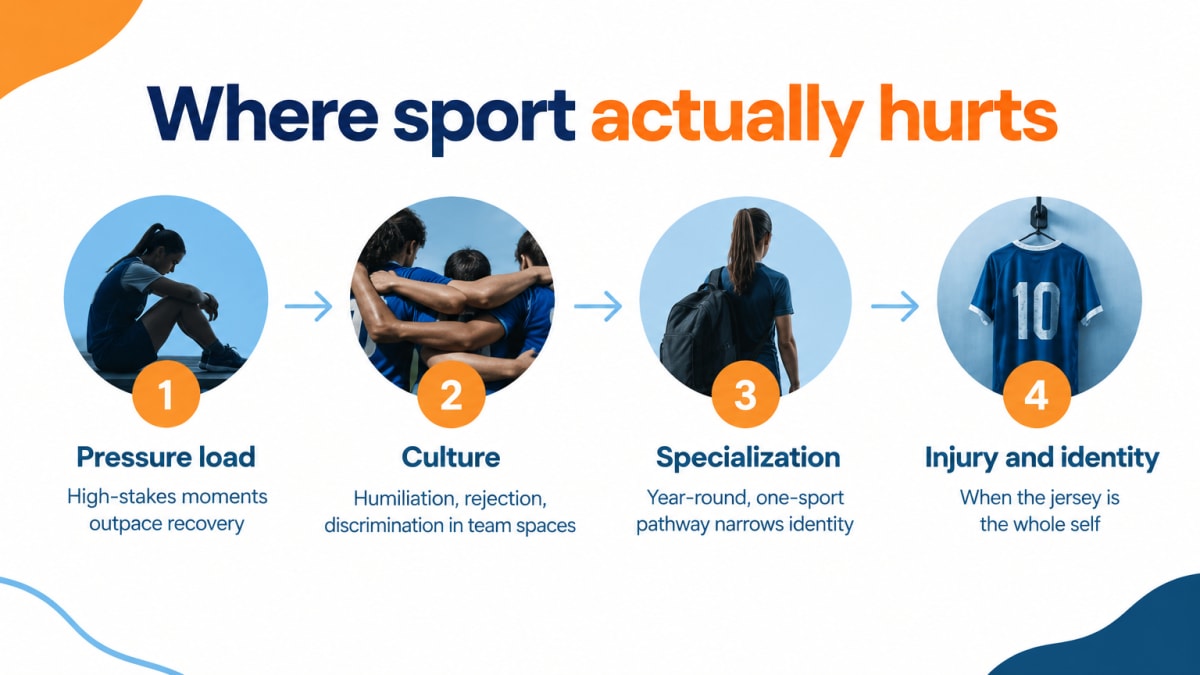
Before you can decide what to do, it helps to know where the damage usually comes from. Sport doesn’t erode a kid’s mental wellness in one dramatic blow. It wears down in four specific places, and once you can name them, you can see them coming on a Tuesday afternoon instead of a Saturday night.
Here’s the map the rest of this article follows.
Pressure load. The weight of every at-bat, every face-off, every serve feeling like a tryout. When the volume of high-stakes moments outpaces a young athlete’s ability to recover between them, something gives — usually sleep, appetite, or the joy that got them into the sport in the first place.
Culture. This is the one parents see least and athletes feel most. Researchers who study elite sport environments describe psychological harms like humiliation, rejection, broken confidentiality, and discrimination tied to gender, sexuality, ethnicity, or physical status 3. Those aren’t rare outliers. They’re the texture of locker rooms, group chats, and sideline moments that your athlete may never bring home.
Specialization and load. The year-round, one-sport pathway. Travel ball in the fall, showcase in the winter, select in the spring, camp in the summer. The body gets worked and the identity gets narrow at the same time.
Injury and identity. A rolled ankle, a concussion, a benching that lasts three games. For a kid whose whole sense of self is wrapped in the jersey, the real injury is often to who they think they are without it.
You’ll notice something these four have in common: none of them are your athlete’s fault, and none of them are permanent. They’re conditions, not verdicts. Conditions are the kind of thing you can actually influence — by adjusting the schedule, choosing the environment, asking better questions on the ride home, and building the person underneath the uniform so the athlete has something to stand on when sport gets hard. The next sections walk through each one with what to watch for and what to try tonight.
Pressure overload: when every at-bat starts to feel like a tryout
Pressure isn’t the problem. Pressure is the point of competitive sport — it’s part of what grows a kid. The trouble starts when the pressure stops turning off. When the ride to the 7 a.m. game feels like a job interview. When your softball player replays a strikeout three days later in the kitchen. When your hockey player’s hands shake lacing skates for a Tuesday practice because last Saturday’s shift still lives in his chest.
That’s pressure load. It isn’t one big game; it’s the stacking of them without enough quiet in between. The nervous system doesn’t get a chance to come down, and over weeks and months the body starts giving signals the mind can’t anymore — shortened sleep, snappier moods, a stomach that hurts on game day, a kid who used to eat two plates picking at one.
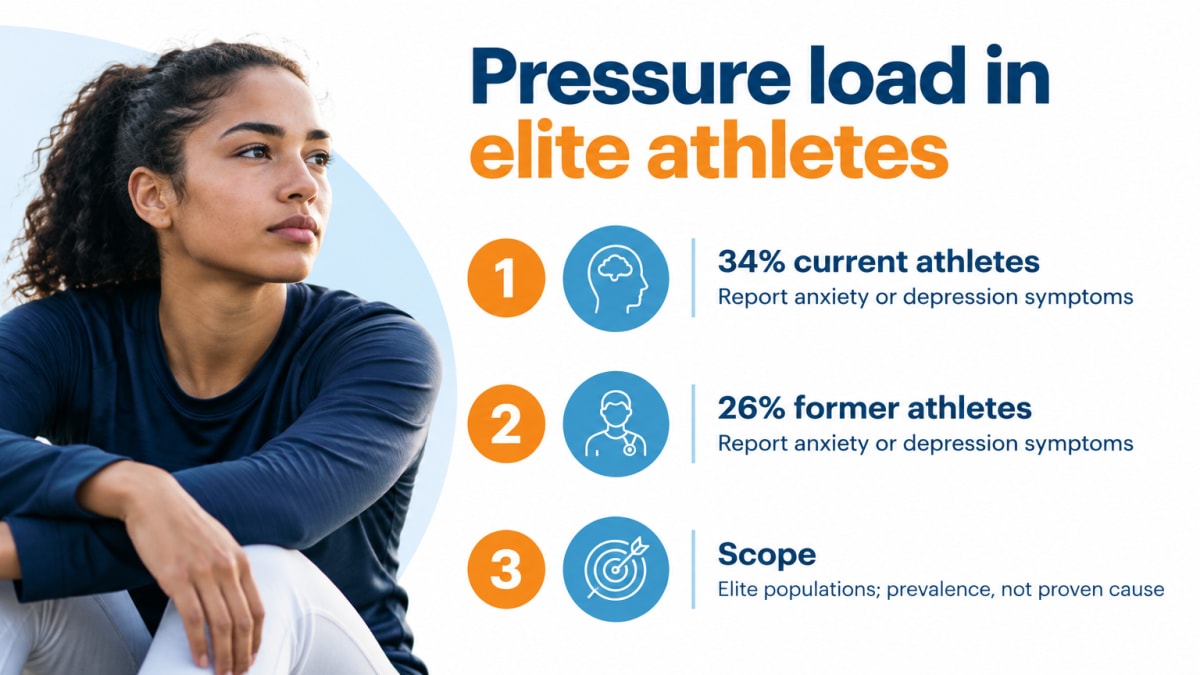
The research on high-performance environments is sobering here, and worth stating with its scope intact. A systematic review and meta-analysis of elite athletes found that about 34% of current elite athletes report symptoms of anxiety or depression, with roughly 26% reported among former elite athletes 4. Those are prevalence estimates in elite populations, not evidence that sport caused the symptoms, and they don’t directly describe your 13-year-old at the rec field. But they tell you something real: environments built around constant evaluation are commonly accompanied by this kind of psychological weight. The 14-year-old on a top travel team is closer to that environment than most parents realize.
What makes pressure load heavier for a young athlete is identity fusion. When “I had a bad game” and “I am bad” live in the same sentence in a kid’s head, every at-bat starts to feel like a tryout for who they are. The scoreboard stops being a scoreboard and becomes a verdict.
Burnout and the year-round pathway: when one sport becomes the whole life
There’s a specific look on a 13-year-old’s face when the equipment bag comes out on a Sunday morning and the body remembers it hasn’t actually stopped moving since August. Shoulders drop half an inch. The yes is a syllable shorter than it used to be. The kid who used to sprint to the car now takes the long way.
That’s not laziness. That’s a nervous system telling you the tank is empty, and the tank is empty because the pathway your family got nudged onto doesn’t really have an off-season anymore. Fall ball bleeds into winter clinics. Winter clinics feed spring select. Spring select hands off to summer travel and a July showcase. One sport, twelve months, and the quiet assumption that falling behind in October costs a spot in April.
The research here is worth sitting with. A study of NCAA athletes found that burnout was more common among those who had specialized early in a single sport than among their multi-sport peers — 10.5% versus 7.0%, with an odds ratio of 3.76 5. That’s an observational finding in a college population, not a prophecy about your 14-year-old, and the authors are careful to note that training volume, sport type, and motivation all play a role. But the direction of the signal is hard to ignore: the kids who gave everything to one sport earliest were the ones most likely to run out of gas later.
Burnout in a young athlete rarely announces itself. It shows up as a kid who stops asking about the next game. Who leaves the glove in the car for three days. Who gets quieter at the dinner table on practice nights. Who starts getting sick more often during the season than between seasons. The joy that used to be the engine becomes a thing they’re trying to find on purpose, and that search is exhausting on its own.
A parent move for this week: look at the calendar with your athlete, not for them. Count the weeks between now and their next real break — a full stretch, two weeks or more, with no practices, no lessons, no “optional” skills sessions. If you can’t find one in the next four months, that’s the conversation. Not whether to quit. Whether to protect a window where the body gets quiet and the person underneath the uniform gets to show up for a while. Multi-sport seasons, a true off-season, or even a Sunday that’s actually off — those aren’t signs of a kid who isn’t serious. They’re how a young athlete stays in love with the thing long enough to be good at it.
Culture harms: humiliation, exclusion, and the locker room nobody sees
Here’s the part your athlete probably won’t tell you about on the ride home. The group chat that went quiet when she walked over to look. The nickname that stopped being funny around tenth grade. The coach who called out your son in front of the whole bench for a missed assignment, voice carrying across the rink. The teammate who shared something private — a bad game, a crush, a family thing — in the locker room on Thursday.
Researchers who study elite sport environments describe psychological harms embedded in sport cultures that include humiliation, rejection, sexual harassment, broken confidentiality, and discrimination tied to sexuality, gender, ethnicity, or physical status 3. That framework was built around elite teams, but any parent who has spent a season on a competitive youth sideline can see the same patterns in miniature. The locker room is not neutral ground. Neither is the group chat, the bus ride, or the Snapchat story that only certain kids are tagged in.
What makes culture harm so hard to spot is that your athlete usually absorbs it in silence. Kids who have been laughed at, left out, or singled out by a coach rarely come home and announce it. More often, they get quieter. They stop mentioning certain teammates. They start inventing reasons to skip the team dinner. They play fine on Saturday and then can’t sleep Sunday night. The sport looks like the problem because the sport is where it’s happening, but the real wound is social — a kid learning, week by week, that the people around them aren’t a safe place to be fully themselves.
A parent move for this one is slower than a ride-home line. It’s a standing question, asked without an agenda, maybe once a week: “Who’s been good to be around on the team lately?” Not “how was practice,” not “did coach say anything.” Who. That question tells your athlete you care about the room, not just the box score. Over time, the answers start to tell you something — who they trust, who they’re avoiding, which adult actually sees them. If the names start disappearing or the shrug becomes the whole answer, that’s a signal worth staying with. You don’t have to fix the culture of a team to protect your kid inside it. You do have to know what it actually feels like in there.
Identity collapse after an injury or a benching
A rolled ankle in the 62nd minute of a soccer match. A hairline fracture on a hockey wrist that lands the kid on the bench with a cast and a clipboard. A varsity baseball coach who, after three cold at-bats, moves your junior down to JV for the rest of the spring. The physical injury heals on a schedule a doctor can print out. The other injury — the one to who your athlete thinks they are — doesn’t come with a timeline.
For a lot of 12-to-18-year-olds, the uniform isn’t something they wear. It’s something they are. “Soccer player” has been the first word out of their mouth at every new school since fourth grade. The group text, the Saturday schedule, the parents they sit next to in the stands, the kid they are at breakfast — all of it runs through the sport. Pull the sport out for six weeks and a lot of what felt like personality turns out to have been a role. That’s identity collapse, and it looks less like sadness and more like a kid you don’t quite recognize wandering the house in sweatpants at 4 p.m.
You’ll see it in small things first. The jersey stays in the laundry basket for a week. They won’t go watch the team they can’t play with. Group chat notifications pile up unread. Sleep slides later. The sentence “I’m just tired” starts covering a lot of ground. A benched kid often grieves harder than an injured one, because there’s no cast to point to — just the quiet verdict that someone decided they weren’t enough right now.
A parent move for this stretch: give the person something to be besides the athlete, on purpose. Ask what they want to try while the body is healing or the depth chart is sorting itself out — a cooking night, a job application, a Saturday with a cousin, a book, learning to drive the back roads with you. Small things. You’re not replacing the sport. You’re reminding your athlete that there’s a whole person under the jersey who was interesting to you before the first tryout and will be interesting to you long after the last one. That reminder is the ground they stand on when they come back — and they often do come back lighter, because they know they don’t have to.
Concussion aftermath: where coaching ends and medical care begins
A head hits the ice. A soccer player goes up for a header and lands on the back of a skull. A catcher takes a backswing to the mask. The next few minutes are the ones that matter most, and the next few weeks tell you what kind of recovery you’re actually in.
The part that catches most parents off guard comes later. Concussion recovery isn’t only about headaches, light sensitivity, and whether your kid can tolerate a math worksheet. Updated guidance from the National Athletic Trainers’ Association uses a biopsychosocial frame that puts mental health alongside academics, rest, physical activity, treatment, and return-to-sport decisions as part of concussion care 2. In plain words, the mood shifts, the irritability, the anxiety about going back, the sadness of sitting out — those aren’t side notes. They’re part of what’s being treated.
Here’s where coaching has a real role, and where it clearly doesn’t. A mental performance or wellness coach can walk alongside your athlete during a medically guided recovery — helping them stay connected to the team while sidelined, keeping identity from collapsing into “injured kid,” building a reset routine for the first scary scrimmage back. A coach does not diagnose a concussion, grade its severity, manage symptoms, or decide when it’s safe to return. Those are medical decisions, every time.
If your athlete took a hit this season and the headaches cleared but something still feels off — the fuse is shorter, sleep is strange, the kid who loved the sport is suddenly dreading it — loop the healthcare provider back in before you loop in anyone else. The person your athlete was before the hit is worth the extra appointment.
Warning signs on the ride home, in the kitchen, and before practice
Most of what tells you something is off won’t happen during the game. It’ll happen in the three places where your athlete thinks nobody’s really watching — the car, the kitchen, and the ten minutes before they have to walk out the door.
On the ride home. The quiet that used to feel like decompression starts to feel like a wall. Short answers that used to be “we won” or “I hit two” shrink to “fine.” Your athlete picks a fight over the radio or the route. The post-game appetite — the burrito stop, the drive-thru fries — stops being interesting.
In the kitchen. Dinner gets picked at on practice nights. Water goes untouched. The kid who used to tell you about the funny thing a teammate did now scrolls through dinner. Sleep slides later, mornings get harder, and the stomachache before a Saturday game becomes a weekly thing instead of a once-in-a-while thing.
Before practice. The bag doesn’t come down from the stairs until you ask twice. Cleats take fifteen minutes to find. There’s a new reluctance in the body — a slower walk to the car, a longer bathroom stop, a quiet “do I have to.”
None of these on their own is a verdict. Two or three of them, stacking across two or three weeks, is a conversation worth having gently and soon.
Build the person first: a proactive path toward interdependence
Everything in this article points to the same move, and it’s not the one most parents expect. The proactive path isn’t a tougher kid or a better strength coach. It’s building the person first, and letting the athlete sharpen on top of that foundation. The jersey comes off eventually, every season and someday for good. What’s underneath it is what your kid actually lives in.
There’s a word for what you’re aiming at: interdependence. It sits in the middle of two extremes a lot of young athletes get stuck between — the lonely toughness of “I’ve got to handle this on my own” and the over-reliance of “somebody tell me what to do.” Interdependence means your athlete can lead themselves — regulate a bad inning, reset before a tryout, name what they need — and knows exactly who to lean on when the moment is bigger than they are. A village behind them, not above them. You’re one voice in that village. A good coach is another. A teammate’s parent, an aunt, a strength coach, a trusted teacher — a few more. Your athlete gets to be the center of their own circle instead of the project at the middle of yours.
What that looks like day to day is quieter than it sounds. It’s a kid who can say “my head’s not right today” before practice instead of melting down after. A kid who knows a 30-second reset — slow breath, feet on the ground, one short phrase they’ve picked themselves — and uses it between pitches without being told. A kid who separates “I had a bad game” from “I am bad” because they’ve heard the person-first message at home enough times that it’s finally theirs.
You don’t have to build this alone. A mental performance and wellness coach can be another trusted voice in your athlete’s corner — someone who works on the person first, then sharpens the athlete, and who never steps between you and your kid. If any of this article has felt like a mirror, a free 15-to-20-minute consultation call between your athlete and a Blend coach is a low-pressure way to see if it’s a fit. No promises, no pitch. Just a conversation.
If you coach a team or lead a program
A note here for the coach, athletic director, or club board member who clicked through from a parent’s text. The rest of this article speaks to parents on purpose, but the room you run is where a lot of what parents are worried about actually gets decided.
Researchers studying elite sport describe psychological safety as a condition where athletes can raise a concern — about a hit, a teammate, a coach, their own head — without fearing humiliation, rejection, broken confidentiality, or discrimination 3. That standard scales down to a 14-and-under hockey bench. If the kids on your roster can’t tell you something is wrong without paying a social price, you won’t hear about it until it’s bigger than you can help with.
Three concrete moves.
- Build a quiet channel for athletes to flag concerns — a text line, an assistant coach, something that isn’t the group chat.
- Make your concussion protocol boring and non-negotiable: suspected hit means out that day, medical clearance before return, no exceptions for playoffs 1.
- Protect a real off-season on the team calendar so kids who want to play another sport, or no sport, aren’t quietly punished for it in the depth chart next fall.
When to call a licensed professional
Coaching has a lane, and it’s a real one. But there are moments where the right next call isn’t a coach — it’s a licensed clinician. If your athlete talks about hurting themselves, says life isn’t worth it, or you see sudden changes in eating, sleep, or substance use that scare you, that’s a clinical moment. Call your pediatrician or a licensed mental health professional the same week. If the danger feels immediate, call or text 988, the Suicide & Crisis Lifeline. It’s free, 24/7, and built for exactly this.
The same rule holds after a head injury. A suspected concussion needs medical evaluation and clearance before return, every time 1. A coach walks alongside recovery. A clinician makes the call.
Help Your Athlete Reset After Pressure
Use a free 15–20 minute call with your athlete and a coach to explore a steadier path through pressure.
Frequently Asked Questions
How do I know if sports are hurting my athlete’s mental health or if it’s just a bad week?
One rough week is usually just a rough week. What you’re watching for is a pattern — two or three signs stacking across two or three weeks. Sleep sliding later, appetite dropping on practice nights, shorter answers in the car, a new reluctance before the bag goes in the trunk. If the kid you knew in July has been quieter and heavier since September, that’s worth a gentle conversation, not a panic.
Should I pull my kid from their sport if they’re showing signs of burnout?
Not as a first move. Pulling the plug can feel like a punishment to an athlete whose identity is wrapped in the jersey. Start smaller. Protect a real off-season window on the calendar, cut one “optional” session a week, and ask your athlete what part of the sport they still love. Burnout often eases when the volume drops and the joy gets room to breathe. If it doesn’t, that’s the next conversation.
Is year-round single-sport specialization really that risky for a 12-to-18-year-old?
The signal is real. A study of NCAA athletes found burnout was more common among early specializers than multi-sport peers, 10.5% versus 7.0%, with an odds ratio of 3.76 5. That’s an observational finding in a college population, so it’s a signal, not a sentence. For a 14-year-old, the practical read is this: a true off-season and a second sport or hobby aren’t signs of being uncommitted. They’re how kids stay in the game.
What do I say on the ride home after a tough game or a benching?
Try six words: “I loved watching you play today.” That’s the whole sentence. No notes, no “but next time,” no silent processing of the error in the third. Save the coaching for a walk tomorrow, if your athlete wants it at all. What you’re doing is separating the person from the performance — telling your kid your view of them doesn’t move with the box score. Repeated over a season, that lands.
How is a mental performance coach different from a therapist?
A coach works on the person and the athlete — confidence, focus, resets, identity under the uniform, how to lead yourself and lean on your village. A therapist is a licensed clinician who assesses and treats mental health conditions. They’re different lanes, and good ones respect each other. If your athlete is dealing with serious distress, safety concerns, or a diagnosed condition, that’s clinical territory. A coach can walk alongside, not replace it.
When should I call a licensed professional instead of a coach?
Call a licensed professional when your athlete talks about hurting themselves or says life isn’t worth it, when eating, sleep, or substance use changes in ways that scare you, or when distress keeps growing instead of easing. If danger feels immediate, call or text 988, the Suicide & Crisis Lifeline. After any suspected concussion, a qualified healthcare provider — not a coach — evaluates and clears return to sport 1. When in doubt, call.
References
- Responding to a Sports-related Concussion. https://www.cdc.gov/heads-up/response/index.html
- National Athletic Trainers’ Association Bridge Statement. https://pmc.ncbi.nlm.nih.gov/articles/PMC10976337/
- Psychological Safety for Mental Health in Elite Sport: A Framework. https://pmc.ncbi.nlm.nih.gov/articles/PMC10978613/
- Occurrence of mental health symptoms and disorders in current and former elite athletes: a systematic review and meta-analysis. https://pubmed.ncbi.nlm.nih.gov/31097451/
- Association of sport specialization with the incidence of injuries and burnout in NCAA athletes. https://pubmed.ncbi.nlm.nih.gov/33719607/