

Key Takeaways
- Anger in competition is a signal that an athlete cares more than their current skills can carry, not a character flaw to scold away.
- Every blowup runs on two engines, body arousal and the story in the athlete’s head, and useful regulation has to address both levers 3.
- More games alone will not sand down the eruptions; a 2025 meta-analysis found no statistically significant pooled effect of sport on adolescent anger, though a non-contact subgroup did show benefit 4.
- A trainable 30-second reset, notice, name, distance, refocus, gives athletes a reachable tool, with self-distanced talk shown in a small lab study to reduce aggressive responses 1.
When the helmet hits the dugout wall
You watched it from the bleachers. Third strikeout of the day, and the helmet comes off hard enough to crack against the dugout wall. The umpire looks over. A teammate glances away. Your stomach drops because you know what the next three hours look like: the slammed car door, the one-word answers, the dinner nobody eats.
Here is the short version before anything else. Your athlete’s anger is almost never about the pitch, the ref, or the kid who missed the assignment. It is a signal that the gap between how much they care and the skills they have to carry that caring just got too wide. The job is not to shut the intensity down. It is to help them notice it sooner, understand what is underneath it, and run a reset they can actually use between innings, shifts, or points.
That silent car ride is brutal. You are not imagining it, and you are not failing.
What’s actually happening when your athlete erupts
Anger is a signal, not a defect
When your soccer midfielder shoves a cone across the sideline after a turnover, your first instinct is probably to label it: attitude problem, bad sport, needs to control her temper. That label is tidy. It is also usually wrong.
Anger in competition is a competitive emotion, not a character flaw. Some athletes even experience it as fuel, and research on elite athletes notes that cognitive factors like self-confidence and problem solving are linked to better anger control, not the absence of anger itself 2. The eruption is telling you something: your athlete cared more than she had skill to carry. The pass mattered. The spot in the starting eleven mattered. The look from the coach mattered.
Treating the anger like a defect to be scolded out of her shuts the signal down without changing what caused it. Treating it like information opens a different door. You stop asking “what is wrong with you” and start asking “what just got too big to hold.”
The two levers under every blowup: body and meaning
Every competitive blowup has two engines running at the same time, and if you only pull on one, the other keeps the fire going.
The first engine is the body. Heart rate climbs. Breath goes shallow and high in the chest. Shoulders lock up. Hands grip the stick or the racket a little tighter. By the time your hockey player is on the bench after a bad shift, his arousal is already past the line where clean thinking is possible. The second engine is meaning. His brain is running a story about what the shift meant: I let the line down. Coach is going to bench me. Everyone in the stands saw that.
A theoretical model of competitive emotion describes exactly this: emotions in sport are shaped by both the appraisal an athlete makes of the situation and the physiological arousal running through the body, and useful regulation can target either lever, through reappraisal, lowering perceived stakes, breathing, relaxation, or refocusing on task-relevant cues 3.

What’s usually under the anger: fear, perfectionism, fatigue
Anger is loud. What is actually driving it is almost always quieter.
Underneath the slammed helmet is usually fear of letting people down: you, the coach, a teammate who kept giving her the ball, the grandparents who drove in for the tournament. Underneath the snapped stick is often perfectionism, the private rule that one mistake equals a ruined day. Underneath the shutdown on the bench is sometimes embarrassment that she cannot look at anyone yet. And underneath all of it, more often than you think, is plain fatigue. Fifth game of the weekend. Up at 5 a.m. for the drive. Half a granola bar between pool play and bracket.
Your athlete rarely has the vocabulary for any of that in the moment. What comes out is heat, because heat is what she can access when she is twelve or fifteen or seventeen and her nervous system is lit up. Your job later is not to interrogate it. It is to help her put better words to what showed up as anger.
Why ‘he’ll grow out of it’ isn’t a plan
The hope is understandable. More reps, more games, more time in the uniform, and the blowups will sand themselves down. He is twelve. He is fifteen. He is a sophomore. He will mature out of it.
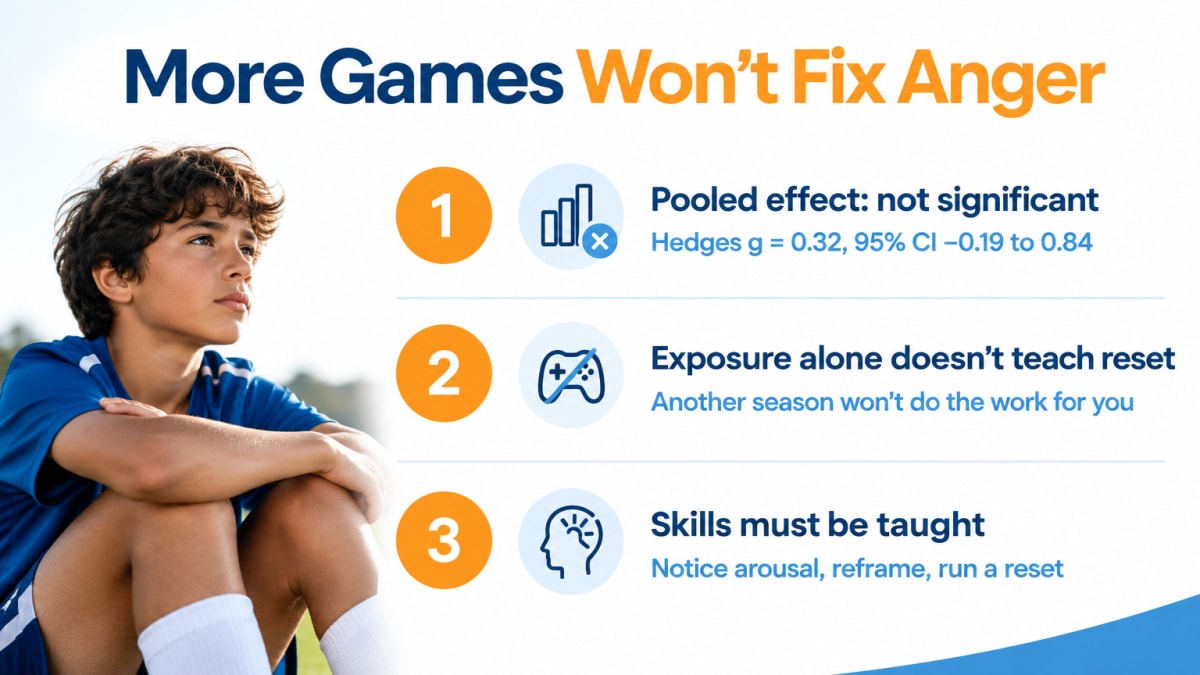
The evidence does not back that hope up. A 2025 systematic review and meta-analysis of sports interventions in adolescents found that the pooled effect on anger was not statistically significant, with a Hedges’ g of 0.32 and a 95% confidence interval of −0.19 to 0.84 4. In plain English: across the studies pooled together, putting adolescents into sport programs did not reliably move the anger needle. A non-contact subgroup did show a significant anger-reduction effect, which hints that the type of sport and the way it is coached matter, but the headline is honest and uncomfortable: more baseball, more hockey, more soccer, by itself, is not an anger plan 4.
That matters for how you spend the next six months. If you are counting on another travel season or another year of varsity to teach your softball catcher how to reset after a passed ball, you are counting on something the research cannot promise. Skills get taught. They do not accumulate from exposure alone.
The good news tucked inside that number: when athletes are given explicit tools to notice arousal, reframe the moment, and run a short reset, you stop waiting on time to do work that time was never going to do. That is where the rest of this article points.
Reading the triggers before the blowup lands
Common triggers across sports: the strikeout, the bad call, the benching
If you watch enough games from the same bleacher seat, you start to see the pattern. The blowup rarely comes out of nowhere. It arrives on the heels of the same handful of moments, dressed up in different uniforms.
For your baseball or softball player, it is usually the strikeout looking, the error in the field with the parents watching, or the pitch that gets squeezed on a full count. For your hockey player, it is the whistle that goes the other way, the shift that ends with a minus, or the healthy scratch nobody warned him about. For your soccer midfielder, it is the yellow card she thinks she did not earn, the sub pulled at the sixty-fifth minute, or the teammate who waved her off a run. For your tennis player, it is three unforced errors in a game. For your golfer, it is a three-putt on seventeen when the round was finally coming together. For your basketball guard, it is the second foul in the first quarter and a seat on the bench.
Different sports, same families of triggers: a mistake she cannot undo, a judgment call she cannot appeal, a loss of control over her role on the day. Learn your athlete’s two or three, and you stop being surprised.
Early warning signs you can spot from the stands
The eruption is the last thing you see. The warning signs usually show up two or three minutes earlier, and once you know the tells, they are hard to miss.
Watch the body first, because the body goes before the mouth does. Shoulders ride up toward the ears. Jaw sets. Breath turns short and high in the chest. Your tennis player starts bouncing the ball nine, ten, eleven times before a serve instead of her usual three. Your hockey player skates back to the bench and sits with his helmet still on, staring at the glass. Your softball catcher yanks her mask off hard between innings and will not look at the dugout.
Then watch the small social cuts. He stops talking to the kid next to him. She waves off a coach’s fist bump. He slams the gate instead of pushing it. These are not character flaws. They are the signal from an already-rising nervous system that your athlete is close to the edge, and that the reset in the next section needs to happen now rather than after.
The 30-second reset your athlete can run tonight
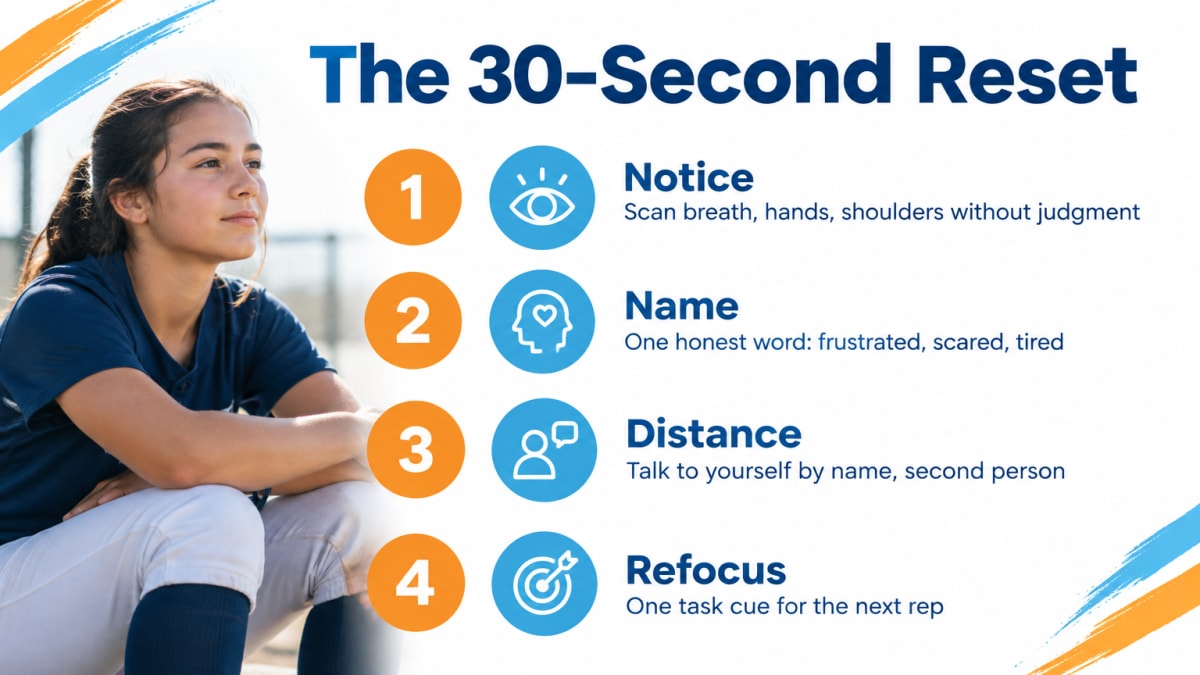
Here is the skill. Short enough to run between pitches, between shifts, between points. Four moves, roughly thirty seconds, trainable at the kitchen counter tonight.
Notice. Your athlete scans the body first. Where is the breath sitting? How tight are the hands on the bat, the stick, the grip? Shoulders up or down? No judgment, just a quick read of the gauge.
Name. One word for what is actually there. Not “I’m fine.” Try “frustrated,” “embarrassed,” “scared,” “tired.” Naming is small and it does real work. It takes a storm of heat and gives it an edge the mind can hold.
Distance. This is one brief move with promising experimental support. Instead of thinking “I just blew that,” your athlete talks to herself by name, in the second or third person: “Okay, Maya, you missed that one. What does the next pitch need?” In a controlled laboratory study of 40 competitive athletes, taking that self-distanced perspective during provocation reduced negative affect and aggressive behavior compared with staying inside the first-person spiral, with a modest effect size (d = 0.33) 1. Honest scope: it was a laboratory task, not a live game, and the authors are careful about that. But the move is brief, costs nothing, and plugs into the moments competition hands your athlete constantly.
Refocus. One task-relevant cue for the next rep. “See the ball deep.” “Feet first on the forecheck.” “Soft hands on the putter.” The cue has to be about the next action, not the last one.
Practice it cold, on the couch, with no stakes. Then practice it warm, after a hard workout. The reset your athlete can actually reach for in the dugout is the one her body has already rehearsed when nothing was on the line.
What to say (and not say) on the car ride home
The first five minutes: silence, water, and one honest sentence
The parking lot is not the classroom. Your athlete just walked off the field with his nervous system still redlining, and the first words out of your mouth will either lower the temperature or lock it in. Resist the urge to debrief. Resist the urge to fix.
Hand him the water bottle. Start the car. Let the first few minutes be quiet. Silence feels unnatural when you have been sitting on worry for two hours, but it gives his body a chance to come down from the arousal that was running the show on the bench 3. You are not ignoring what happened. You are letting the engine cool.
When you do speak, one honest sentence is plenty. Something like, “That was a hard one. I’m glad you’re in the car.” No analysis. No bright side. No question that requires him to perform an answer while he is still catching his breath.
Separating the person from the performance
Here is the sentence that quietly does the heaviest lifting over an entire season: your love for her is not on the scoreboard. She needs to hear it in a way she can feel, not as a slogan, and the car ride is where that gets built or eroded one game at a time.
Practically, that means separating two conversations that most parents accidentally braid together. There is the person conversation: how she is doing, whether she slept, whether she ate, how her friendships on the team are holding up. Then there is the athlete conversation: the read on the play, the adjustment for next week, the technical piece. Both matter. They do not belong in the same five minutes.
Lead with the person. “Are you hungry? Rough one out there. I love watching you compete.” That last line lands because it is about her, not her stat line. The athlete conversation can wait.
The conversation that waits until tomorrow
The real talk, the one about what triggered the blowup and what the reset could look like next time, does not happen in the car. It happens the next morning over eggs, or on the drive to school, or at the kitchen counter after practice the following day.
By then her body is settled, the story in her head has softened, and she can hear a question without reading it as an attack. Try something open: “When the ump squeezed that pitch, what was going through your head?” Listen longer than feels comfortable. Then, together, pick one small thing to try at the next game, a notice-and-name cue, a breath on the walk back to the circle, a word she says to herself by name. One thing. That is how skills get built, and that is how the car ride stops being the hardest part of the weekend.
Building the skill off the field
Confidence and problem-solving as anger protection
The quietest form of anger protection is not a breathing drill. It is the stack of small wins your athlete can point to when the game turns on him.
A systematic review of elite-athlete mental health found that while direct research on anger is thin, cognitive factors like self-confidence and problem solving show up as associated with better anger control 2. That tracks with what you probably see at the rink or on the pitch. The kid who trusts his second effort, who has a plan for the next shift, who has rehearsed what to do when the first option is taken away, has somewhere for his mind to go when a play falls apart. The kid without that stack has only the mistake.
Build the stack between games. Short film sessions where your basketball guard narrates one read she made well. Practice reps where your golfer plays the recovery shot, not just the perfect one. Confidence is not a pep talk. It is evidence, collected on purpose, that she has solved hard moments before and can solve the next one.
Sleep, fuel, and the fatigue you keep underestimating
Half of what looks like a temper is actually a tired kid with low blood sugar.
Think about the schedule a 14-year-old travel player runs: 5 a.m. wake-up, two games before lunch, a protein bar and a Gatorade standing in for a meal, a bracket game at 7 p.m. By the third game, the body that was supposed to run the reset is running on fumes. Appraisal gets sharper and more negative, arousal spikes faster, and the gap between trigger and blowup collapses 3.
You cannot coach your way around sleep debt and empty tanks. Earlier bedtimes on game-day eves. Real food in the cooler. A hard look at the weekends with five games in two days. Fatigue is not the whole story, but it is a bigger chapter than most parents want it to be.
When to bring in one more trusted voice
What a coach adds that a parent can’t
You can be a wonderful parent and still not be the right person to teach your athlete the reset. That is not a failure. That is physics. You are too close, and so is she. The car ride is where love lives. The skill work usually needs a little more room.
A mental performance coach gives your athlete someone whose only job in the room is her inner game. There is no scoreboard between them, no dinner to get on the table, no second kid in the back seat. She can say the embarrassing thing out loud, the one she will not say to you because she does not want you to worry. A coach also brings a vocabulary and a plan: notice, name, distance, refocus, trained week over week until it is reflex 1, 3.
Think of a coach as one more trusted voice in her corner. Not a replacement for you. The goal is interdependence, which just means an athlete who can lead herself and knows who to lean on. You, her coach, a teammate, a village.
Warning signs that need a licensed professional
Coaching is not therapy, and some moments ask for a different kind of help. Knowing the difference protects your athlete.
Mental performance coaches work on skills: the reset between pitches, the self-talk after an error, the confidence stack built in the film room. A licensed professional is who you want when the pattern crosses into territory coaching cannot reach. Watch for a few specific things.
- Aggression that puts him or someone else at risk, like throwing a bat near a teammate or a fight that leaves marks.
- Rage that spills far outside the field: broken drywall at home, scaring a sibling, driving dangerously after a loss.
- A clear shift in the person you know, lasting weeks, not days, in sleep, appetite, friendships, school.
- Any mention of hurting himself or anyone else.
If you coach or run a team
A quick scope shift here, because this one is for the head coach, the club director, or the parent who ended up running the dugout: the climate you build on your bench shapes how often blowups happen in the first place.
Research on adolescent sport programs is honest about this. More games alone did not reliably move the anger needle, and interventions that worked tended to teach skills explicitly rather than hoping exposure would do it 4. That means your practice plan needs minutes for the reset the way it has minutes for conditioning. Thirty seconds at the end of a drill where every player names one word for how that rep felt. A team cue for after a turnover. A rule that nobody debriefs a mistake until the next whistle.
Set the standard yourself first. When you lose it on an official, your roster learns that is the move. When you run your own reset in front of them, they learn that one instead.
A free call to see if it’s a good fit
If you recognized your athlete somewhere in this article, the next step is small. A free fifteen to twenty minute call between your athlete and a Blend coach, in person in Scottsdale or Phoenix or virtually from anywhere, to see if the chemistry is right and whether the reset work makes sense for her season. No pressure, no pitch. Just a conversation about what the dugout, the bench, or the car ride has been looking like, and whether one more trusted voice in her corner would help.
Help Your Athlete Reset After Anger
Talk with a coach about helping your athlete regulate emotions and find a steadier response under pressure.
Frequently Asked Questions
Is it normal for my teenager to get this angry during games?
Yes. Anger shows up in competition because your athlete cares. Some athletes even experience it as fuel, and cognitive factors like self-confidence and problem solving are linked to better anger control, not the absence of anger 2. What matters is whether she can notice it, name it, and reset. If the eruptions put her or others at risk, that is when the signal needs a different kind of help.
Will my athlete grow out of the blowups if they just keep playing?
Probably not on his own. A 2025 meta-analysis of sports interventions in adolescents found the pooled effect on anger was not statistically significant overall, though a non-contact subgroup did show a significant anger-reduction effect 4. More games alone did not reliably move the needle for most sport contexts. What did help was explicit skill-building: noticing arousal, reframing the moment, and running a short reset trained week over week. Time is not the teacher here. Practice is.
What should I say in the car right after a meltdown?
Less than you think. Hand her the water bottle, start the car, and let the first few minutes be quiet so her body can come down 3. When you do speak, keep it short and about the person: “That was a hard one. I love watching you compete. You hungry?” Save the read on the play, the triggers, and the reset plan for the next morning.
How do I know when it’s bigger than coaching can handle?
Watch for a few specific things. Aggression that puts him or someone else at risk. Rage that spills far outside the field, like broken drywall or scared siblings. A clear shift in sleep, appetite, friendships, or school lasting weeks. Any mention of hurting himself or anyone else. If you hear that last one, do not wait. Call or text the 988 Suicide and Crisis Lifeline and bring in a licensed professional.
Can a Blend coach work with my athlete if we don’t live in Scottsdale or Phoenix?
Yes. Blend coaches work in person in Scottsdale and Phoenix and virtually with athletes anywhere. A free fifteen to twenty minute call between your athlete and a coach is the simplest way to see if the chemistry is right and whether the reset work fits her season. No pressure, no pitch, just a conversation.
References
- Self-Distancing as a Strategy to Regulate Affect and Aggressive Behavior in Athletes: An Experimental Approach to Explore Emotion Regulation in the Laboratory. https://pmc.ncbi.nlm.nih.gov/articles/PMC7819956/
- The Mental Health of Elite Athletes: A Narrative Systematic Review. https://pmc.ncbi.nlm.nih.gov/articles/PMC4996886/
- Toward a Theory of Emotions in Competitive Sports. https://pmc.ncbi.nlm.nih.gov/articles/PMC8716387/
- Impact of sports interventions on aggressive behavior among adolescents: a systematic review and meta-analysis. https://pmc.ncbi.nlm.nih.gov/articles/PMC12634051/