
Key Takeaways
- Athlete burnout shows up as three overlapping patterns: exhaustion that sleep doesn’t fix, growing distaste for a sport they once loved, and a shrinking sense of accomplishment that lingers for weeks.
- A hard week needs rest, overtraining needs a physician, and burnout needs a shift in how your athlete relates to the sport and themselves—mixing them up leads to the wrong response.
- Drivers cluster around training load and sleep debt, how a kid specializes rather than whether they specialize, and an identity so tied to sport that every bad game feels like a verdict.
- Recovery starts tonight with one sentence on the ride home, protected sleep, and a second thing they love, then widens into a village of supportive coaches and trusted voices around them 1.
The quiet ride home that tells you something has shifted
You know the drive. The gear bag thumps into the backseat, the door shuts a little too hard, and your athlete pulls the hood up before you’ve even left the parking lot. You ask how it went. You get “fine.” You try a joke. Nothing. The radio fills the space you used to fill with the postgame breakdown they couldn’t wait to give you.
One quiet ride is a bad game. Three or four in a row, plus a kid who used to beg for extra reps and now drags their cleats to the car, is something else. That something else has a name. Researchers call it athlete burnout, and it looks different from a rough week or a tired body. It’s a slow fade in how your athlete feels about the sport they used to love, and in how they feel about themselves inside it.
This piece is for you. The parent of a 12-to-18-year-old who’s starting to wonder if the kid in the passenger seat is okay. You didn’t cause this, and you’re not stuck with it. Let’s walk through what’s actually happening and what you can do tonight.
What athlete burnout actually is (and what it isn’t)
The three dimensions researchers keep finding
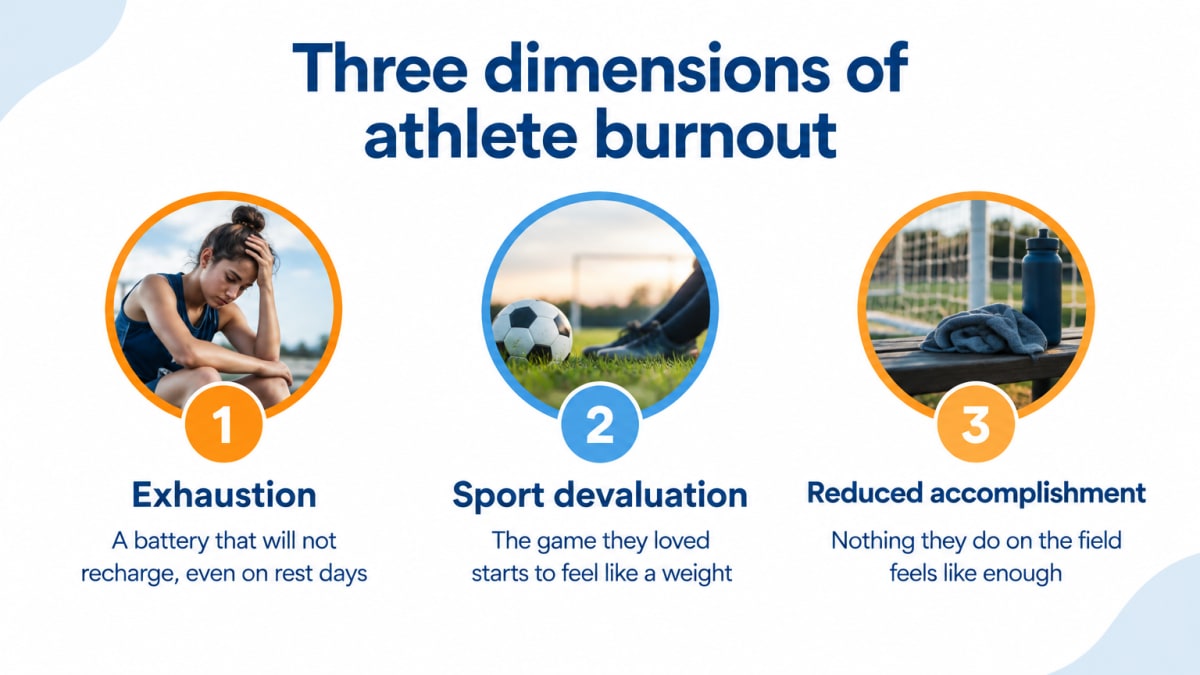
Burnout in sport isn’t one feeling. It’s three, stacked on top of each other, and the research keeps finding the same three in study after study. A scoping review of 29 studies covering 8,022 intercollegiate athletes helps map what burnout actually looks like inside an athlete’s head and body 1. It gives you a vocabulary your athlete probably doesn’t have yet.
- Emotional and physical exhaustion
- Not “tired after a double-header” tired. More like a battery that doesn’t recharge even on an off day. Your softball player sleeps ten hours and still drags herself to the kitchen.
- Sport devaluation
- The sport they loved starts to feel like a chore, then like a weight. Your hockey player who used to watch Oilers highlights at breakfast now shrugs when you mention the game. The thing that lit them up quietly stops lighting them up.
- Reduced sense of accomplishment
- No matter what they do on the field, it doesn’t feel like enough. Your soccer midfielder scores and says, “I should’ve had two.” Your golfer shoots a personal best and critiques every putt on the drive home.
One of these can show up in any hard season. When all three settle in at the same time and stay for weeks, that’s the pattern researchers call burnout.
A hard week, overtraining, and burnout are not the same thing
Here’s where a lot of parents get stuck. Your athlete has a lousy stretch, and you start Googling at midnight, and suddenly every article tells you something different. Let’s draw clean lines between three things that get blurred.
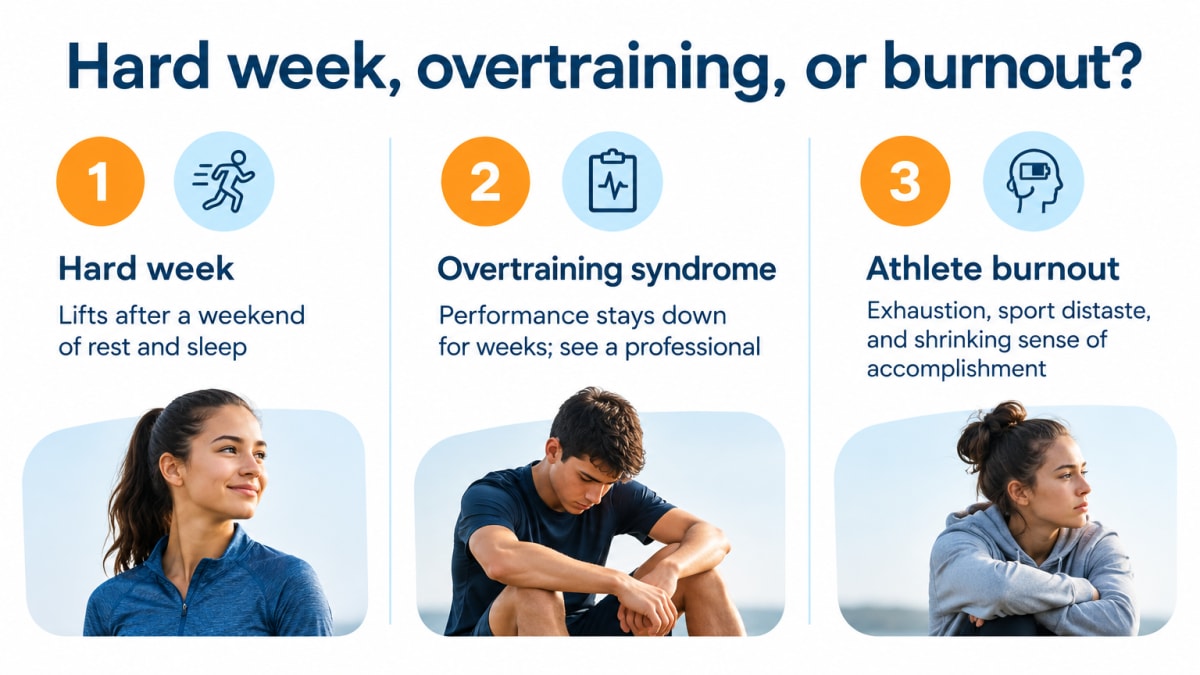
A hard week is a hard week. Two bad games, a tough practice, a fight with a teammate, finals coming up. Your athlete is cranky and tired. Give it a weekend, a full night of sleep, and a Sunday morning that doesn’t involve a bag check, and most of it melts. If the kid who was quiet Friday is laughing at the breakfast table Saturday, you’re probably in hard-week territory.
Overtraining syndrome is a different animal. It’s a medical picture, not a motivation problem. A clinical review of overtraining describes it as decreased performance that persists despite weeks to months of recovery, along with mood disturbance and no other clear cause 5. Your athlete rests, backs off, sleeps, and still can’t hit the times, lift the weights, or feel right. That’s a conversation for a licensed professional, not a pep talk.
Athlete burnout is the three-dimensional pattern we just walked through: exhaustion that won’t lift, a growing distaste for the sport they loved, and a shrinking sense of accomplishment. It can overlap with overtraining, but it doesn’t require it. Your athlete can be burning out without ever being physically pushed past their limit.
Signs to watch for in your 12–18-year-old
What exhaustion, devaluation, and shrinking confidence look like at home
Burnout rarely announces itself. It leaks out in the small stuff, the stuff you’d miss if you weren’t the one packing the lunches.
Exhaustion that sleep doesn’t fix. Your athlete goes to bed at 9 and still can’t get out of bed at 7. The morning smoothie sits half-finished. They nap after school on days they didn’t even have practice. Their body is doing the math on recovery, and the numbers aren’t adding up. You might also notice shorter fuses: snapping at a younger sibling over the remote, slamming a bedroom door over something that didn’t used to matter.
Devaluation that sounds like indifference. The jersey that used to come out of the laundry basket first now sits at the bottom. They stop watching their sport on TV. They don’t pull up highlights on their phone. When you ask about the game Saturday, you get a shrug instead of a plan. The thing that was their thing is becoming just a thing they do.
Shrinking confidence that hides as perfectionism. They stop celebrating. A good play gets dismissed. A hard practice gets replayed as a failure. They start saying “I’m just not that good” in a voice that isn’t fishing for reassurance; it’s a conclusion. This one hurts to watch, because the kid who used to tell you about every assist is now editing themselves down to nothing.
One of these on its own is a Tuesday. Three of them, humming in the background for a few weeks, is worth your attention.
Sport-specific tells: the pitcher, the defender, the golfer, the goalie
Burnout wears a different jersey depending on the sport. Knowing what it looks like in your athlete’s game helps you spot it before the coach does.
The pitcher who stops asking for the ball. Your baseball or softball player used to lobby to close out the inning. Now they’re hoping the coach picks someone else. They warm up slowly. They shake off signs they used to love throwing. The arm might be fine; the want-to is what’s quietly leaving.
The defender who stops tracking back. Your soccer center-back or outside mid used to sprint 60 yards to break up a counter. Now they jog. They let the winger go. On the ride home they’ll tell you their legs were tired, and maybe they were, but tired legs don’t usually come with that flat tone.
The golfer who stops practicing short game. The driver still comes out of the bag because driving is fun. The wedges and the putter sit untouched. The grind that used to be their edge, chipping in the backyard until dinner, has quietly disappeared.
The goalie who stops talking. Hockey and lacrosse goalies live on communication. When a goalie goes silent on the ice, when they stop calling out screens or shots low, something inside the pads has gone quiet too.
The basketball player who stops shooting. Your girls’ varsity guard passes up open looks she used to take without thinking. The hesitation isn’t a slump. It’s a kid who’s stopped trusting herself.
If one of these feels familiar, you’re not overreacting. You’re paying attention.
What’s actually driving it
Training load, sleep debt, and the 6 a.m. tournament calendar
Look at the week. Not the Saturday game. The whole week. Monday skills, Tuesday practice, Wednesday lift, Thursday practice, Friday travel, Saturday pool play, Sunday bracket. Add two hours of homework a night, a part-time job for the older kids, and a phone that lights up at midnight with group chats about the next tournament.
Teenagers need substantial sleep, and most athletes on this kind of calendar aren’t getting it. The 6 a.m. call time for a tournament in Mesa means they were up at 4:45 to tape ankles and eat a bagel in the car. By Sunday afternoon, their body isn’t recovering from a game; it’s recovering from a season crammed into 72 hours.
Burnout grows in that gap between what you’re asking a young body to do and what it’s getting back in sleep, food, and quiet. The game didn’t break them. The calendar did. Before you look anywhere else, pull up the week on your phone and count the hours between the last whistle and the next alarm. If that number keeps shrinking, you’ve found one of your drivers.
Specialization: a more honest look at the evidence
You’ve heard the warning. Pick one sport too early and you’ll burn your kid out. It’s the headline every parent gets forwarded, and it’s not entirely wrong, but it’s not the whole story either.
A meta-analysis comparing adolescent athletes who specialized in one sport with those who sampled several found that specializers reported higher reduced accomplishment, more exhaustion, and more sport devaluation. The mean differences were 0.87 for reduced accomplishment, 0.46 for exhaustion, and 0.41 for sport devaluation 4. That’s a real signal. Kids who play one thing year-round do, on average, look more worn down on all three burnout dimensions than kids who move between sports with the seasons.
Then it gets more interesting. A study of NCAA Division I student-athletes using the Athlete Burnout Questionnaire looked at when college athletes had specialized. Specializing before age 15 was not associated with significantly different burnout symptoms than specializing at age 16 or later 2. And a six-year longitudinal study tracking kids from seventh through twelfth grade found that early specialization was linked with greater injury and burnout risk in many sports, but not uniformly across all of them 3.
So here’s the honest read. Specialization is a risk factor, not a verdict. A kid who loves one sport, plays it hard, has a coach who protects rest, takes real off-seasons, and does something else with their body in the gaps can thrive on one sport. A kid grinding the same movement patterns 11 months a year with no off-ramp is in a different situation. The question isn’t whether your athlete specialized. It’s whether the way they specialize leaves any room for their body, their brain, and the rest of their life.
Identity, injury history, and when sport becomes the whole self
Ask your athlete who they are. If the only answer is their sport, you’ve found another driver.
When a kid’s whole identity is “the goalie” or “the pitcher,” every bad game isn’t a bad game. It’s a referendum on who they are. A missed save isn’t a missed save; it’s evidence they’re not who they thought they were. That’s exhausting in a way training never is, and it corrodes the sense of accomplishment that researchers keep finding at the heart of burnout.
Injury layers on top of this. In the NCAA Division I student-athlete study, athletes with an injury history reported significantly greater reduced accomplishment than athletes without one 2. A high ankle sprain in October isn’t just a physical setback. It pulls your athlete out of the one place they feel like themselves and leaves them watching from the bench, wondering if they’ll come back the same. The body heals faster than the story they tell themselves about the body.
You can’t un-love the sport for them, and you shouldn’t want to. What you can do is make room for the rest of the person. Ask about the book they’re reading. Notice the sketch on their notebook. Remember the friend they used to see on Sunday mornings before Sunday mornings became tournament mornings. The person underneath the uniform is who comes back from burnout. The uniform doesn’t do that work on its own.
What to say tonight and over the next two weeks
One sentence for the ride home and a 30-second reset before a game
“I love watching you play.”That’s it. No critique of the third-inning at-bat. No breakdown of the back-post goal she gave up. No “next time, you’ve got to…” Just the sentence, said once, in a normal voice, then let the quiet sit.
If your athlete opens up, listen more than you talk. If they don’t, that’s fine too. You’ve just told them the one thing a tired kid needs to hear: the person in the driver’s seat still sees them, not their stat line.
For the 30-second reset before a game, give your athlete something they own. Three slow breaths in through the nose, four counts out through the mouth. Then one sentence they say to themselves:“I’ve done this before.”That’s the whole thing. It fits in a batter’s box, between faceoffs, on the first tee, before a free throw. Short enough to actually use. Theirs, not yours.
Protect sleep, loosen the grip, bring back a second thing they love
Over the next two weeks, pick three things and hold the line.
Protect sleep like it’s a position on the roster. Phones out of the bedroom at 10. Lights off by 10:30 on school nights. If a 6 a.m. tournament is on the calendar Saturday, Friday night is not for group chats or film sessions. You will not win this one perfectly, and that’s okay. Win it four nights out of seven and you’re already changing the week.
Loosen your grip on the drive home. No postgame coaching from the front seat. The coach coaches. You parent. When you blur the two, your athlete has nowhere to just be a kid in a car with a parent who’s glad to see them.
Bring back a second thing they love. Not another sport. Something that has nothing to do with a scoreboard. The guitar in the closet. The sketchbook. Pickup basketball with a friend who doesn’t play her travel sport. Sunday pancakes with their grandfather. One hour a week, protected. The person underneath the athlete needs oxygen.
Rebuilding the person underneath the athlete
The village: supportive coaching, trusted voices, and interdependence
Recovery from burnout isn’t a solo project, and it isn’t a parent project either. It’s a village project. The scoping review of 29 studies and 8,022 intercollegiate athletes keeps pointing at the same conditions associated with lower burnout: supportive coaching, perceived social support, sport-specific gratitude, and self-determined motivation 1. Translated into your kitchen, that means your athlete needs more than one adult in their corner, and they need to feel like the choices inside the sport are theirs.
Start with the coach. Not every coach is the right coach for a tired kid, and that’s worth noticing honestly. A supportive coach asks how your athlete is doing before they ask what your athlete did last weekend. If your current coach can have that conversation, loop them in. If they can’t, your athlete still needs someone who can.
Then add a second voice outside the house. A great high school teacher. An uncle who played in college. A mental performance coach who works on confidence and composure the way a strength coach works on the posterior chain. The point isn’t to add another adult barking instructions. The point is interdependence — an athlete who can lead themselves and knows who to lean on. You stay the parent. Someone else gets to be the one more trusted voice who talks about pressure, identity, and the quiet stuff on the ride home that your athlete can’t quite say to you yet.
When to bring in a licensed professional
The same line applies when performance keeps falling despite weeks or months of rest, paired with mood changes and no clear physical cause. That picture fits overtraining syndrome and belongs with a physician who knows athletes 5. Getting the right help early isn’t failure. It’s one more trusted voice in the village.
If you coach a team or run a program
Shifting audience for a minute: if you’re a coach, athletic director, or club director reading this over a parent’s shoulder, the research gives you a short list worth taping to your clipboard. The scoping review of intercollegiate athletes keeps surfacing the same conditions associated with lower burnout that you can actually build into a program: supportive coaching, perceived social support, sport-specific gratitude, and self-determined motivation 1.
Translated to a Tuesday practice, that looks like asking how your athletes are before you ask what they ran last weekend. It looks like building real off-ramps into the calendar, not just lighter weeks you cancel the first time a tournament gets added. It looks like giving your players a voice in warmups, captains’ meetings, and how hard Thursday goes. Coach the coaches on your staff to do the same, and bring in a mental performance voice who works alongside you, not around you. A program that protects the person tends to keep the athlete longer.
A proactive path forward
Burnout isn’t a verdict on your athlete or on you. It’s a pattern, and patterns can shift. The quiet car ride can become a conversation again. The jersey can come out of the laundry first again. It won’t happen in a weekend, but it can start tonight with one sentence, protected sleep, and a Sunday morning that isn’t a bag check.
If you want one more trusted voice in the village, a mental performance coach can work alongside you, not between you and your athlete. Blend offers a free 15 to 20 minute call between your athlete and a coach to see if it’s a good fit, in person in Scottsdale and Phoenix or virtually anywhere. The person comes first. The athlete sharpens from there.
Help Your Athlete Find Their Way Back
Talk through what you’re seeing and explore a supportive next step for your athlete.
Frequently Asked Questions
How is athlete burnout different from just being tired after a hard season?
A hard season leaves your athlete tired. A weekend of real sleep and a Sunday off the calendar brings them back. Burnout is a pattern that sits for weeks: exhaustion that rest doesn’t fix, a growing distaste for the sport they used to love, and a shrinking sense of accomplishment no matter what they do on the field.
My athlete says they want to quit. Does that mean they’re burned out?
Not automatically. Wanting to quit can mean a bad coach, a bad fit, a friend who left the team, or a kid who’s genuinely ready to try something else. Ask what the sport feels like, not whether they want to stay. If the answer is heavy, flat, and has been for a while, burnout is worth considering alongside their choice.
Is early specialization the reason my kid is burning out?
It’s a risk factor, not a verdict. On average, specializers report more exhaustion, more sport devaluation, and lower accomplishment than kids who sample sports 4. But plenty of specialized athletes thrive when the schedule protects rest, real off-seasons exist, and coaches build in autonomy. Look at how your athlete trains, not just what they picked.
What should I say on the ride home after a rough game?
Try one sentence: “I love watching you play.” Say it once, in a normal voice, and let the quiet sit. Skip the breakdown of the third inning, the missed assignment, or what they should do next time. The coach coaches. You parent. A tired kid needs to know the person driving still sees them, not their stat line.
How long does it take an athlete to recover from burnout?
There’s no clean timeline. Some athletes feel lighter in a few weeks once sleep, autonomy, and a second thing they love come back into the week. Others need a full off-season to rebuild the person underneath the uniform. Watch the three dimensions: when exhaustion lifts, the sport feels interesting again, and small wins land, you’re on the way back.
When should we bring in outside help, and what kind?
A mental performance coach can work on confidence, composure, and identity alongside you. If your athlete talks about hurting themselves, stops eating, or can’t sleep for weeks, call a licensed mental health professional and reach the 988 Suicide and Crisis Lifeline by call or text. Persistent performance decline with mood changes and no clear cause belongs with a physician 5.
References
- A Scoping Review of Intercollegiate Athlete Burnout. https://journals.ku.edu/jis/article/download/24228/22568
- A Measure of Burnout in Current NCAA Student-Athletes. https://pmc.ncbi.nlm.nih.gov/articles/PMC9518709/
- Changes in Sports Participation, Specialization, and Burnout From 7th to 12th Grade: Final Results From a 6-Year Longitudinal Study. https://pmc.ncbi.nlm.nih.gov/articles/PMC10916788/
- Comparing Burnout in Sport-Specializing Versus Sport-Sampling Adolescent Athletes: A Systematic Review and Meta-analysis. https://pmc.ncbi.nlm.nih.gov/articles/PMC7052469/
- Overtraining Syndrome: A Practical Guide. https://pmc.ncbi.nlm.nih.gov/articles/PMC3435910/