
Key Takeaways
- Athletic identity is how much your kid defines themselves through sport, and it tends to show up as drive and belonging rather than damage when a wider self stays intact 2.
- The tipping point isn’t intensity, it’s exclusivity: when sport becomes the only room in the house, a bad play has no student, sibling, or friend self to bounce off of 8.
- Injury and the last whistle hit hardest when identity, friendships, and future plans all live in the same locker room, so protect roles, outside interests, and non-sport futures early 6, 11.
- Focus next on widening the circles around the athlete: one protected non-sport thing each week, a friendship off the roster, and honest questions that don’t start with the game.
The quiet car ride home starts here
You know the ride. Helmet in the back seat, cleats still on, and your athlete staring out the passenger window like the game is still playing behind their eyes. You try one safe question. You get one word back. The rest of the drive is just road noise.
Athletic identity is the piece of your kid that treats sport as part of who they are, not just something they do on Saturdays. That part can be a gift. It drives commitment, belonging, and a willingness to work hard for something that matters 1. It can also take a bad shift, a strikeout, or a missed penalty kick and turn it into a verdict on the whole person.
This guide walks you through what athletic identity really is, where it quietly tips from fuel to weight, and what you can actually say and do, starting on tonight’s drive home.
What athletic identity actually means
Athletic identity is the degree to which your kid defines themselves through the athlete role. Not just what they do on Tuesday nights or Saturday mornings, but how they introduce themselves at a new school, what they picture when they imagine their future, and what they feel like a loss of when a season ends. If your daughter says “I’m a volleyball player” before she says anything else about herself, that’s athletic identity doing its work.
Researchers don’t treat it as a fixed label stamped on a kid at age ten. A 2023 systematic review of 54 studies on identity work in athletes describes it as something your athlete is constantly building, repairing, strengthening, and sometimes rewriting through their relationships, their stories about themselves, and the big moments sport throws at them 1. A hockey tryout, a growth spurt that changes their position, a coach who sees them differently than the last one, a torn ACL, a graduation: each of these can shift how your kid holds the athlete piece of themselves.
It’s also measurable. A meta-analysis covering 101 studies and 20,498 athletes using the Athletic Identity Measurement Scale confirms this is a real, trackable part of who someone is, with meaningful ties to intrinsic motivation and commitment 2. In other words, when sport feels like part of your athlete’s identity, it tends to show up as drive, not just as time on a schedule. The question isn’t whether your kid has an athletic identity. They do. The question is how much room there is around it for everything else they’re becoming.
Why a strong athlete self is not the enemy
Somewhere along the way, athletic identity got a bad reputation. You read a headline about burnout or overuse injury and suddenly the message is: don’t let your kid love it too much. That’s not quite right, and it’s worth saying clearly before the harder parts of this guide.
When your athlete feels like a hockey player, a soccer midfielder, a pitcher, a golfer, that identity is doing real work for them. It’s giving them a reason to get up at 6 a.m. for a tournament. It’s giving them a crew of teammates who save them a seat on the bus. It’s giving them a place where effort pays off in a way that algebra class rarely does. The same meta-analysis of 101 studies and 20,498 athletes that confirms athletic identity is measurable also found that it correlates with intrinsic motivation and commitment at r = 0.51, a sizable link, while associations with harder outcomes stayed modest and varied widely from study to study 2. Translation: sport-as-identity shows up most clearly as drive, not damage.
Youth research points in a more mixed direction, with a wrinkle worth naming. A systematic review of athletes under 22 reported that stronger athletic identity may buffer some kids against burnout during ordinary participation, but may also increase depression risk among injured athletes, and the authors caution that the youth evidence base is small and inconsistent 3. The takeaway isn’t that your kid shouldn’t care about their sport. It’s that what the identity does for them often depends on what else is in the room with it.
When sport becomes the whole self
Here’s the tipping point you’re watching for: not whether your athlete cares about their sport, but whether anything else is still allowed to count. The both/and from the last section matters here. Strong identity plus a wider self is fuel. Strong identity with nothing around it is pressure your kid can’t put down.
You can feel this shift in small moments. The eighth-grade basketball player who skips the birthday party because she has to be fresh for Sunday’s game, even though the party was the one thing she looked forward to all month. The sophomore pitcher who won’t go to the family dinner because he had a rough bullpen and can’t be around people. The freshman midfielder who starts answering “how was your day” with only the practice report. Sport hasn’t become part of who they are. Sport has become the whole room.
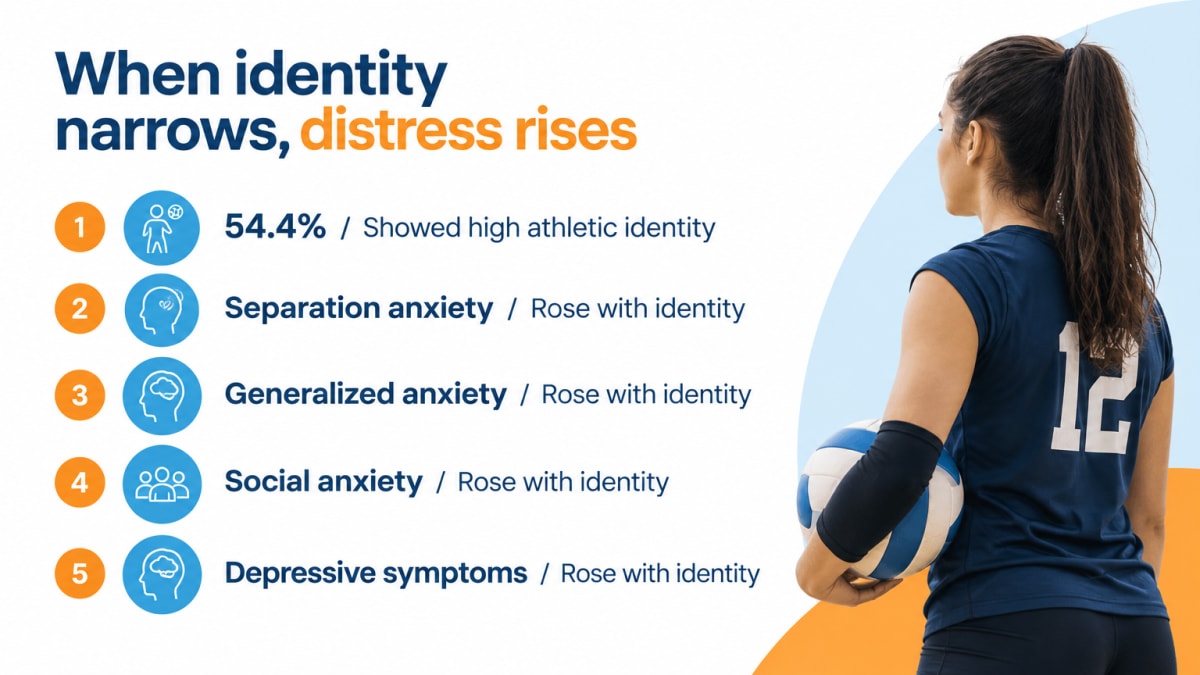
A 2025 cross-sectional study of 149 female adolescent volleyball players, with a mean age of about 16, offers a useful snapshot of what this can look like in one specific group. Researchers classified 54.4% of those players as having high athletic identity, and higher athletic identity was correlated with greater separation anxiety, generalized anxiety, social anxiety, and depressive symptoms 8. The study is cross-sectional and limited to one sport and one gender, so it can’t tell us that strong identity caused the distress or that distress caused the strong identity. It can tell us that for these specific players, caring deeply and struggling emotionally were showing up in the same athletes, often enough to notice.
Read that carefully, because the headline here is not “girls who love volleyball are anxious.” The headline is that when sport becomes the only room in the house, there’s no quiet corner to go to when the game gets loud. Your kid loses a cushion. A bad set in practice doesn’t bounce off the student self or the sister self or the friend self because those selves have gotten smaller while the athlete self got bigger.
What this looks like at your dinner table isn’t dramatic. Your athlete just has less to say that isn’t about the sport. They turn down things they used to enjoy. They talk about future-them only in uniform. The relationship with self, the inner voice they use when nobody’s watching, starts to sound exactly like their post-game stat line. That’s the moment to pay attention. Not to pull them out of the sport, but to notice what else used to be in there and whether it’s still getting any air.
How to spot identity foreclosure in your own kid
Identity foreclosure is the clinical name, but the plain-language version is simpler: your athlete has locked in the answer to “who am I” before they ever really asked the question. A 2017 review defines it as commitment to the athlete role without much exploration of other occupations, interests, or futures 12. The commitment itself isn’t the problem. It’s the missing exploration around it.
You can hear it before you see it. The ninth-grade pitcher who answers every “what do you want to do with your life” question with “play college ball,” and has no backup sentence. The sophomore golfer who shrugs at an art elective because it “won’t help my game.” The travel soccer kid who used to light up about marine biology and now only lights up about club tryouts. None of those moments are alarming on their own. Together, they tell you the door to other versions of your kid has quietly closed.
A few things to notice over the next few weeks:
- Does your athlete have interests, friendships, or future plans that exist completely outside the sport, or does everything trace back to it?
- When something goes wrong at practice, does their mood for the whole evening go with it?
- If you asked them to describe themselves without using their sport, could they?
A high athletic-identity score by itself doesn’t prove foreclosure; the tell is whether exploration ever happens 12.
If a lot of this sounds like your kid, you haven’t failed them. You’ve just spotted something early enough to do something about, and the next few sections are where that work starts.
The injury week: when a body setback hits the whole person
The MRI results come back on a Tuesday. Your soccer player tore her ACL in a weekend tournament, and by Wednesday morning she’s not just a kid with a hurt knee. She’s a kid who can’t go to practice, can’t ride the bus with her teammates, can’t wear her warmups in the hallway on game day. The crutches are the small problem. The bigger one is that the part of her that felt most like herself just got put on a shelf for nine months.
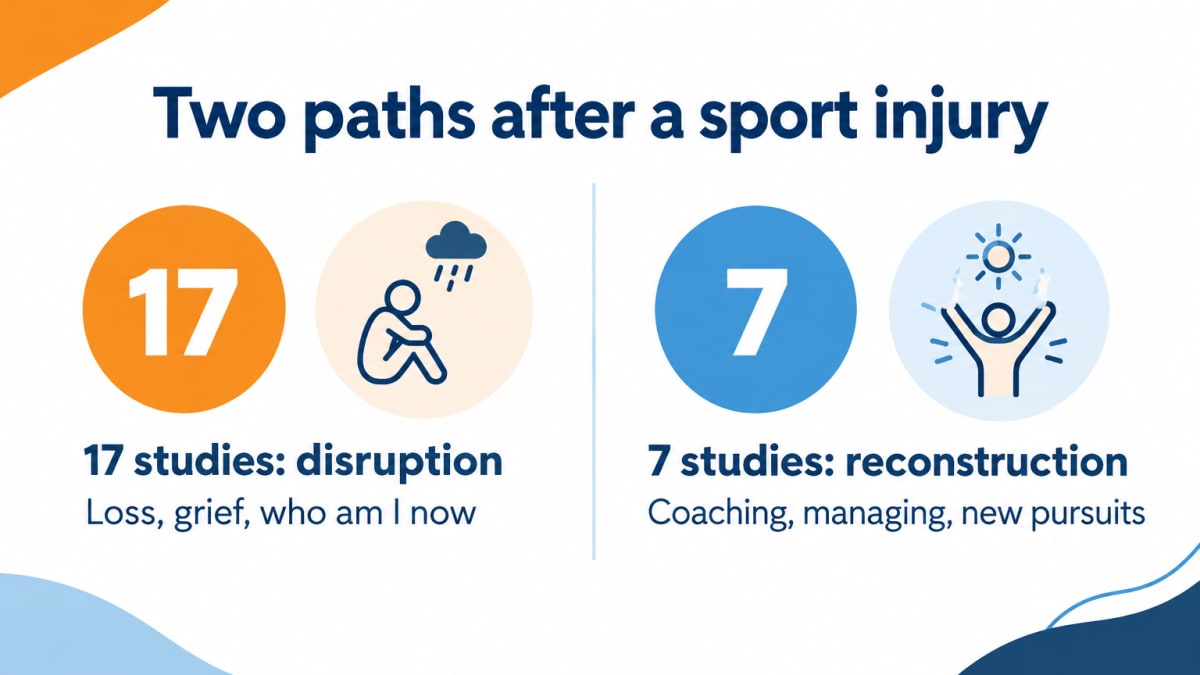
This is where athletic identity shows its weight. When sport is one piece of a wider self, an injury hurts and heals. When sport is most of the self, an injury can feel like your kid got erased for a while. A 2025 systematic review that pulled together 24 qualitative studies on athletic identity after sport injury found both experiences in the research: 17 of the studies centered on identity disruption, the loss and grief and “who am I now” of being sidelined, and 7 centered on identity reconstruction, where athletes rebuilt a sense of self through coaching younger kids, managing the team, volunteering, or picking up a new sport they could still do 6. Both are real. Which one your athlete ends up living through is partly about what you and their coaches build around them in the first few weeks.
The disruption looks like what you’d expect, just quieter than you might guess. Your hockey player stops asking about the team’s weekend games because hearing the score feels worse than not knowing. Your gymnast skips the group chat. Your baseball kid starts sleeping until noon because mornings used to be lifts and now mornings are nothing. A 2024 narrative review on young athletes and injury notes that the same intensity that makes a kid push through rehab can also make the weeks between surgery and return feel like a long sentence 7. The drive is still there. It just has nowhere to go.
Reconstruction is the quieter miracle, and it usually starts with somebody giving them a job. The sidelined hockey captain who runs the whiteboard during practice. The injured dancer who choreographs for the younger group. The soccer player who shows up to every game in street clothes and keeps the stats. These aren’t consolation prizes. They’re ways of saying: the team is still yours, your eye for the game still matters, the part of you that is a competitor still gets to show up this week. Ask the coach what role is available. Ask your athlete which one they’d actually want. Then show up to the game they’re not playing in like it still counts, because for them, it does.
The safety stakes: when ‘I am my sport’ gets in the way of reporting
There’s a quieter risk inside a strong athlete self, and it shows up in the moments your kid doesn’t tell you about. The headache after a hit along the boards. The ding during Friday night football. The elbow that’s been barking for a month. When sport is who your athlete is, admitting something is wrong can feel like admitting part of themselves is broken, so they don’t.
A 2019 study of 205 NCAA Division I football athletes found that players with stronger athletic identity were less likely to intend to report concussion symptoms during a game or within 24 hours after one, while players with stronger academic identity leaned the other way 13. A larger 2024 study across collegiate sports found the same identity-to-reporting link, but with an important wrinkle: the effect ran through what the athletes thought their teammates and coaches would think, and through how confident they felt actually speaking up 14. Translation for your kitchen table: your athlete’s willingness to say “my head hurts” is shaped less by their helmet and more by the room they walk into after they take it off.
How to protect the whole person around the athlete
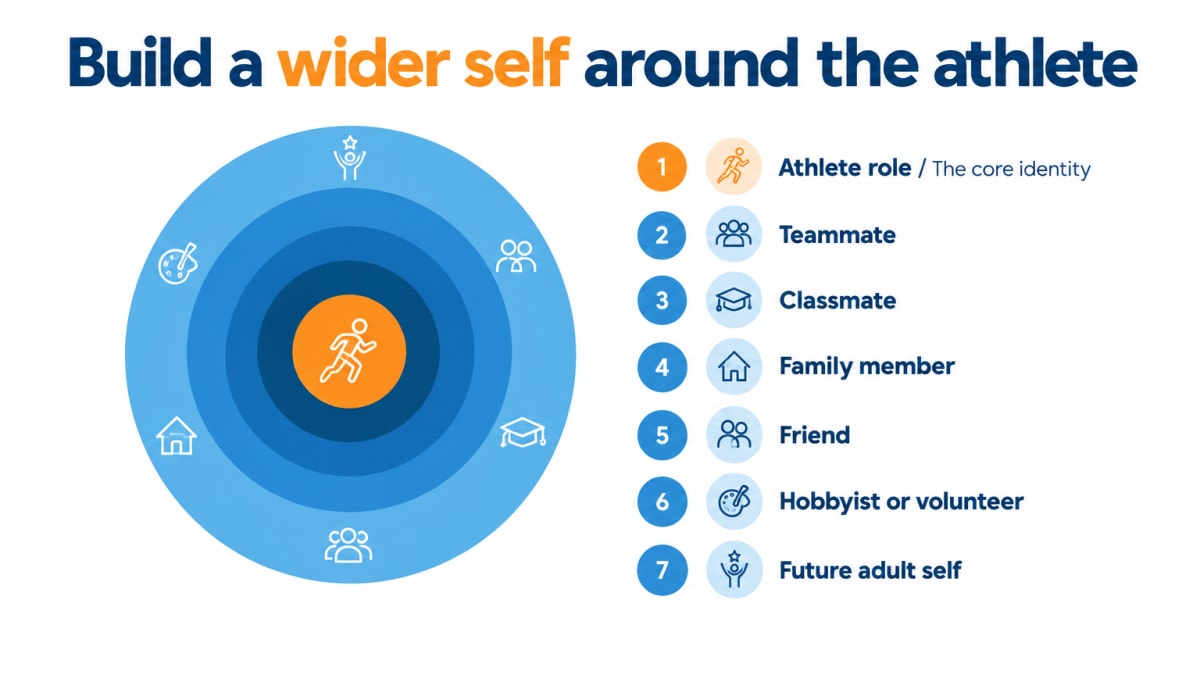
Here’s the good news about everything you just read: you don’t have to shrink the sport to protect your kid. You just have to make sure the sport isn’t the only room in the house. A 2024 review that applied social identity theory to athlete mental health argues exactly this. Athletes who hold onto multiple meaningful group memberships, team and school and family and friendship and faith and whatever else lights them up, carry more psychological resources into pressure moments and more belonging through transitions like injury, deselection, or graduation 5. The athlete role sits in the middle. The wider self sits around it.
Picture it as concentric circles. Pitcher at the core. Then teammate, then classmate, then daughter and sister, then the kid who plays guitar on Sunday afternoons, then the volunteer at the Scottsdale animal shelter, then the future adult who is already a little bit curious about marine biology or engineering or film. None of those outer rings replace the pitcher. They catch her when the pitcher has a bad outing.
Here’s what building that wider self actually looks like in a normal week:
- Protect one non-sport thing on the calendar every week and treat it like a game, meaning you don’t skip it for extra reps.
- Keep at least one friendship alive that has nothing to do with the roster.
- Ask your tennis player about her history class on the drive to practice, not just her serve.
- Let your hockey kid take the Thursday night off to be at his sister’s choir concert, and sit next to him while he claps.
- When he introduces himself to a new coach, notice whether the sport comes first, second, or alone, and over time, help him add a second sentence.
Your job isn’t to pull your athlete back from the thing they love. It’s to make sure there are other people, other rooms, other versions of them still getting watered while the sport grows. That’s what interdependence looks like in practice: a kid who can lead themselves on the field and knows who to lean on off of it, with a village around them, not a single floodlight pointed at the mound.
Words you can actually use tonight
You don’t need a script. You need three or four honest lines that keep the door open when your athlete is still too hot or too quiet to really talk. Here are a few that work on the drive home, at the dinner table, and in the hallway outside their room.
In the car, after a tough one. Try: “I love watching you play. You want music or quiet?” That’s it. You’ve said the one thing they most need to hear, you’ve handed them control of the next twenty minutes, and you’ve signaled you’re not about to coach them from the front seat. If they want to talk, they’ll start. If they don’t, the ride isn’t a second loss.
A 30-second reset for after a bad play or a bad game. Four slow breaths in through the nose, longer out through the mouth. Feet flat on the floor. One sentence out loud or in their head: “That play is done. Next one is mine.” It’s not magic. It’s a way to help them regulate their body so their brain can catch up. Teach it on a calm Tuesday, not in the parking lot after a loss.
At dinner, any night. Ask one question that has nothing to do with the sport. “What made you laugh today?” “Who did you sit with at lunch?” You’re not avoiding the game. You’re reminding your kid, and yourself, that there’s a whole person at that table.
Planning for the last whistle while they’re still playing
Every athlete gets a last game. Some get it in a hospital room after a torn labrum. Some get it on a Tuesday in April when the varsity coach doesn’t call their name. Most get it on a senior night with a bouquet and a slideshow, and then a Monday that doesn’t have practice on it for the first time in a decade. The question isn’t whether that day comes. It’s whether your kid has anything else to walk toward when it does.
The research here is actually hopeful. A 12-year longitudinal study of 290 Swiss elite athletes found that athletic identity generally softened after sport ended, but the paths varied widely depending on how exclusive the identity had been and whether retirement was chosen or forced 9. A separate 12-year longitudinal study of 290 former junior elite athletes connected earlier career satisfaction and the voluntariness of the transition to later self-esteem, suggesting that stepping away from sport is a developmental shift, not an automatic crisis 10. A 2023 scoping review of life-after-sport programs puts it plainly: the athletes who struggle most are the ones whose identity, friendships, and future plans all lived inside the same locker room 11.
So treat the last whistle like a college application. Start years early. On the Sunday after a tournament, ask your junior what she might study if volleyball weren’t on the table, and let the answer be “I don’t know” without rushing to fill it. Help your hockey sophomore shadow someone whose job has nothing to do with ice. Keep one summer week every year for something that isn’t a camp with a stick in it. When your senior walks off the field for the last time, you want her to be sad about the game ending, not scared about who she is on Monday morning. That’s the difference preparation makes.
When to bring in more support
A coach, a Blend-style mental performance coach, or a trusted adult can go a long way. But some moments ask for a licensed professional, and knowing the difference is part of your job as a parent. Watch for changes that stick around for more than a couple of weeks: sleep that won’t settle, appetite that drops off, withdrawal from the people and things they usually love, or talk that scares you. The NCAA’s mental health guidance is clear that formal evaluation and care belong with licensed mental-health providers, not coaches of any kind 4. If your athlete ever mentions wanting to hurt themselves, call or text 988, the Suicide and Crisis Lifeline, right then. Bringing in more support isn’t a verdict on your parenting or their toughness. It’s one more trusted voice in their corner.
A note for coaches and club directors seeing this across a roster
Shifting audiences for a moment: if you coach a team or run a club, you’re seeing this across twenty kids at once, and the pattern is probably clearer to you than it is to any one parent. Here’s what to do with that view:
- Build a reporting culture where pulling yourself out is treated as a competitor move, not a weak one, because team norms shape what athletes feel safe saying out loud 14.
- Protect roles for injured players so they stay inside the group while they heal 6.
- Ask once a season what each kid wants to study, build, or try that has nothing to do with your sport, and remember the answers.
You’re one more trusted voice in a village that includes their parents, their teachers, and the adults who’ll still be in their corner after the last whistle.
Help Your Athlete Be More Than Sport
Talk through how sport fits your athlete’s sense of self and what support could look like.
Frequently Asked Questions
Is a strong athletic identity bad for my kid?
No. A strong athlete self is tied to drive, belonging, and commitment, and a review of 101 studies covering 20,498 athletes found its clearest link was to intrinsic motivation and commitment 2. The risk isn’t intensity. It’s exclusivity. The question to ask is whether anything else about your kid is still getting air.
How do I know if my athlete’s identity is too wrapped up in their sport?
Watch for a few weeks. Does their mood for the whole evening rise and fall with practice? Can they describe themselves without naming the sport? Do their friendships, interests, and future plans all trace back to the roster? A locked-in answer to “who am I” without any exploration around it is the signal researchers call identity foreclosure 12.
What should I say on the ride home after a tough game?
Keep it short and warm. “I love watching you play. You want music or quiet?” That’s it. You’ve opened the door, handed them control of the next twenty minutes, and signaled you’re not about to coach from the front seat. If they want to talk, they’ll start. If they don’t, the drive isn’t a second loss.
My athlete just got hurt and seems like a different kid. Is that normal?
Yes, and it has a name. A 2025 review of 24 qualitative studies on identity after sport injury found disruption in 17 of them: grief, withdrawal, a quiet “who am I now” 6. Give it a few weeks, keep them inside the team through a role they’d actually want, and show up to games they can’t play in.
How do I help my athlete build a wider self without taking away from the sport?
Protect one non-sport thing on the calendar every week and treat it like a game. Keep a friendship alive that has nothing to do with the roster. Ask about history class, not just the serve. Research applying social identity theory to athletes argues that multiple meaningful group memberships act as a cushion through pressure, injury, and transitions 5.
When should I bring in outside support beyond a coach?
When changes stick around for more than a couple of weeks: sleep that won’t settle, appetite that drops, withdrawal from people and things they usually love. NCAA guidance is clear that formal evaluation belongs with a licensed mental-health professional, not a coach of any kind 4. If your athlete ever mentions wanting to hurt themselves, call or text 988 right then.
References
- Identity Work in Athletes: A Systematic Review of the Literature. https://pmc.ncbi.nlm.nih.gov/articles/PMC10611030/
- The Athletic Identity Measurement Scale: A Systematic Review with Meta-Analysis from 1993 to 2021. https://pmc.ncbi.nlm.nih.gov/articles/PMC9497853/
- Athletic Identity in Youth Athletes: A Systematic Review of the Literature. https://pmc.ncbi.nlm.nih.gov/articles/PMC8305814/
- Mental Health Best Practices. https://www.ncaa.org/what-we-do/health-safety-and-performance/mental-health/best-practices/
- Understanding and Improving Athlete Mental Health: A Social Identity Approach. https://link.springer.com/content/pdf/10.1007/s40279-024-01996-4.pdf
- Athletic identity and sport injury: a systematic review and meta-aggregation. https://link.springer.com/article/10.1186/s40359-025-03902-7
- Athletic Identity and Sport Injury Processes and Outcomes in Young Athletes: A Supplemental Narrative Review. https://pmc.ncbi.nlm.nih.gov/articles/PMC11503344/
- Athletic identity, anxiety, and depression in moderate to highly specialized female adolescent volleyball players. https://pmc.ncbi.nlm.nih.gov/articles/PMC11996862/
- Leaving elite sport, abandoning athletic identity? Development and predictors of athletic identity post-retirement. https://link.springer.com/article/10.1007/s12662-023-00934-2
- Retirement from elite sport and self-esteem: a longitudinal study. https://pmc.ncbi.nlm.nih.gov/articles/PMC10197962/
- Adaptation to life after sport for retired athletes: A scoping review of existing reviews and programs. https://journals.plos.org/plosone/article/file?type=printable&id=10.1371/journal.pone.0291683
- Athletic identity foreclosure. https://pubmed.ncbi.nlm.nih.gov/28813333/
- Relationship of athletic and academic identity to concussion reporting intentions. https://pubmed.ncbi.nlm.nih.gov/31014920/
- Predictors of Concussion Symptom-Reporting Intention Among Collegiate Athletes. https://pmc.ncbi.nlm.nih.gov/articles/PMC11611375/
- AOSSM Early Sport Specialization Consensus Statement. https://ncaaorg.s3.amazonaws.com/ssi/injury_prev/SSI_AOSSMEarlySportSpecializationConsensusStatement.pdf