

Key Takeaways
- Fatigue in young athletes lives in three overlapping layers — physical load, sleep debt, and mental or emotional load — and the first skill is noticing which one is loudest right now.
- Experimental studies of sleep-deprived athletes show measurable drops in explosive power, speed, and endurance while rating the same effort as harder, and sleep-intervention research finds that extending nighttime sleep or adding naps outperforms sleep-hygiene education alone 4.
- The car ride home is for decompression, not film review: three slow breaths and a short sentence like ‘I love watching you play’ do more than any recap of the game.
- If a protected sleep floor, quieter car rides, and a weekly sideways question still leave your athlete flat after three weeks, it’s time to bring one more trusted voice into their corner.
The quiet ride home after a tournament weekend
You know the ride. Three games in two days, a 6 a.m. ice time or a doubleheader that ended under the lights, and now your athlete is slumped against the window with earbuds in. You ask how they’re feeling. You get a shrug. Maybe a grunt. The gear bag they used to sprint toward is dragging across the parking lot like it’s full of bricks.
You’ve seen tired before. This feels different. The warmups looked slow. The fuse is shorter at home. A teacher mentioned a missing assignment. And somewhere in your chest, a quiet question has started showing up: Is this just a hard stretch, or is something building?
Here’s the honest answer, and it’s the one most sports-parent articles skip: fatigue in a young athlete is rarely only about the legs. It’s a signal from the whole person — body, sleep, schedule, and the stuff they haven’t said out loud yet. The parents who respond well don’t push through it or panic about it. They read it.
That’s what this guide is for. You’ll learn what fatigue actually looks like at this age, how to tell which layer is loudest right now, and what to do this week — including the words that work in the car, when the earbuds come out.
What fatigue in athletes actually means
When you hear “fatigue,” you probably picture tired muscles. Sore quads after a soccer tournament. A pitching arm that needs ice. That’s part of it, but it’s not the whole picture — and treating it like it is will send you looking in the wrong drawer.
Fatigue in athletes is better understood as the body and mind’s response to everything your athlete is carrying: the training itself, how hard that training feels, how much they’re sleeping, what’s happening at school, who they sat with at lunch, the group chat, the coach who benched them Tuesday. Sports medicine researchers call this a mix of external load (the measurable stuff — distance, speed, repetitions, pitch counts, shifts) and internal load (how the athlete’s body and mind are actually responding — perceived exertion, heart rate, mood, soreness). The consensus is that you can’t understand one without the other, and no single number — not a Whoop score, not a Garmin readiness ring — tells the full story on its own 1.
For a parent, that reframe matters. It means a “low recovery” number on a wrist strap and a kid who’s dragging might point to the same thing, or to completely different things. It means two 14-year-old hockey players can skate the exact same practice and come home in two different states.
A simpler way to hold it: fatigue in a young athlete usually lives in three overlapping layers — physical load, sleep debt, and mental and emotional load. Each one leaves its own fingerprints. Learning to spot which layer is loudest right now is the first real skill of a sports parent, and it’s the one the rest of this guide is built on.
The three layers of fatigue parents can learn to read
Physical load: when the legs, not the kid, are the problem
Start here, because this layer is the easiest to spot and the easiest to adjust. Physical fatigue is what happens when the training load — the actual miles, swings, shifts, sprints, and reps — outpaces what your athlete’s body has had time to absorb. A soccer midfielder who played a club game Saturday and a school game Monday. A softball catcher squatting through a Saturday doubleheader. A hockey forward on a travel weekend with three games and a 5 a.m. hotel lobby call.
The fingerprints are physical and relatively honest. Warmups look slower than usual. Sprint times drift. The first step is late. There’s soreness that lingers two days instead of fading in one. Appetite might spike, or disappear. Minor stuff — a tweaked ankle, a sore shoulder — stops healing on its own schedule.
Here’s the part parents miss: physical fatigue after a hard week isn’t a problem. It’s the point. The body only gets stronger by being stressed and then allowed to recover. The problem is when stress keeps stacking without the recovery piece — another tournament added, a lifting session jammed into an off day, a position change that doubles the running load.
What to look at this week: how many hard days in a row your athlete has had, and whether there’s a true easy day or full day off anywhere in the next seven. If the honest answer is no, the legs aren’t broken. The schedule is.
Sleep debt: the recovery layer most families underestimate
If physical load is the layer families overestimate, sleep is the one they underestimate. Not because parents don’t care about sleep — you do — but because the youth sports schedule quietly makes it almost impossible. The 6 a.m. ice time means a 4:45 alarm. The travel tournament means a hotel room with three teammates and a group chat that doesn’t quiet down until midnight. The Tuesday night practice ends at 9, dinner is at 9:45, homework starts at 10:15, and you’re still asking why your 15-year-old can’t get out of bed Wednesday.
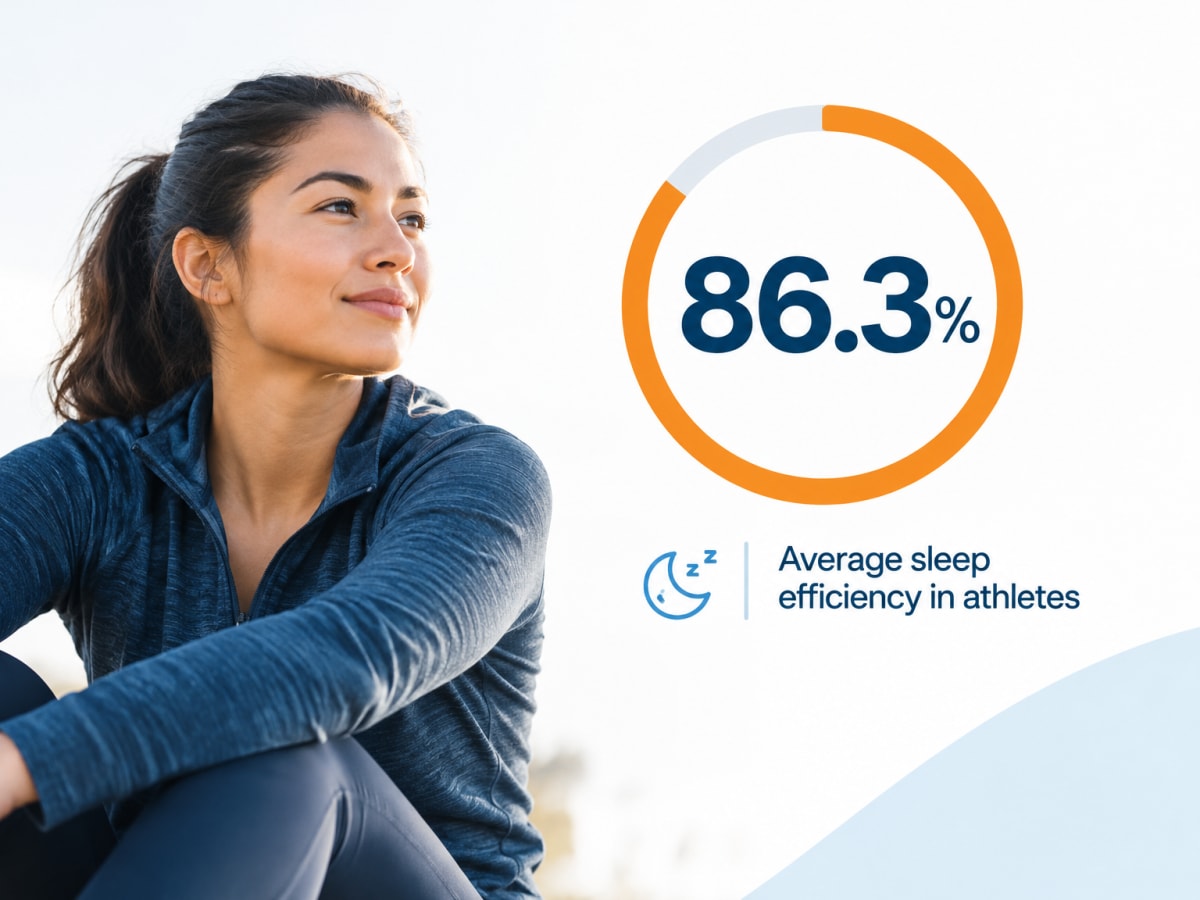
Here’s the research in plain terms. Across 81 studies of athletes, the average was 7.2 hours of sleep per night, with sleep efficiency — the portion of time in bed actually spent asleep — averaging 86.3%. During heavy training phases, sleep duration dropped by roughly 36 minutes compared to preseason 2. That’s largely adult and elite-athlete data, not a target for a 14-year-old, and the point isn’t the exact number. The point is that even the people whose job is to sleep well often don’t, and the hardest stretches of training are when sleep slips the most — exactly when the body needs it most.
For a teenager, who biologically needs more sleep than an adult, that gap gets bigger fast. And when sleep is short, training feels harder. Experimental studies of sleep-deprived athletes show drops in explosive power, speed, motor control, aerobic endurance, and muscular strength, along with higher ratings of perceived exertion — meaning the same practice literally feels heavier. These findings come from acute sleep-deprivation protocols and shouldn’t be read as a one-to-one match for every athlete’s chronic sleep pattern, but they illustrate the direction things move when sleep slips 3. That’s the “everything feels like a lot” your athlete can’t quite explain.
Signs to watch for this week: later bedtimes creeping in by 15 or 20 minutes at a time, groggy mornings that caffeine barely touches, a kid who falls asleep in the car on short drives, weekend “catch-up” sleep of ten or eleven hours. None of these are failures. They’re the body telling you the debt is real and growing.
The fix isn’t a lecture about screens. It’s protecting a nighttime floor — the hour your athlete needs to be in bed, lights out, on school nights — and treating it like a non-negotiable, the way you’d treat practice attendance.
Mental and emotional fatigue: the layer that shows up in the car
This is the layer that confuses parents the most, because it doesn’t look like fatigue. It looks like attitude. A tennis player who used to walk off the court analyzing her serve now shrugs and says “I don’t care.” A golfer who used to want to hit a bucket after a bad round goes straight to his room. A basketball guard who was captain-material in October is picking fights with his sister in January. You keep asking if he’s okay. He keeps saying he’s fine.
Mental and emotional fatigue is what builds when the pressure your athlete is carrying — expectations from a coach, a spot on the depth chart, grades, a group chat, a parent who means well but comments on every rep in the car — never gets a real release valve. The body might be fine. The nervous system is cooked.
What it looks like in a 12-to-18-year-old: a shorter fuse at home, flat affect at games they used to love, dropping away from friends outside the sport, overreactions to small corrections, a sudden drop in effort that reads as laziness but isn’t. Sometimes it’s the quiet kid who gets quieter. Sometimes it’s the easygoing kid who starts snapping. You know your athlete’s baseline. Trust the drift from it.
You don’t have to diagnose any of this. You just have to notice it, and then do something small and non-threatening with what you notice. The next section is about telling these three layers apart when they’re overlapping, which they almost always are.

How fatigue drags down performance and recovery
Here’s what fatigue actually does when it stacks up. The first thing to go isn’t strength. It’s the fast stuff — the explosive first step, the quick hands, the reaction time that lets a shortstop pick a short hop or a soccer winger beat a defender to the ball. In experimental sleep-deprivation studies, athletes consistently show measurable drops in explosive power, speed, motor control, aerobic endurance, and raw strength, while rating the same effort as noticeably harder than when they’re fresh 3. That’s why your athlete can run the same drill they’ve run a hundred times and look a half-second slow. The watch says it. Their body already knew.
The second thing fatigue does is slow recovery itself, which is where the loop gets dangerous. A tired body doesn’t absorb training the same way. Sleep is when tissue rebuilds, memory consolidates, and the nervous system resets. When sleep drops during the heaviest training stretches — which it almost always does — the hole gets deeper on exactly the weeks the body needs it filled.
The third thing is harder to measure and matters most for a 14-year-old: judgment and composure thin out. The field looks faster. Small mistakes feel bigger. A missed pass turns into two. The kid who normally shakes off a bad at-bat sits in it for three innings. Performance drops aren’t just physical; the mental edge dulls at the same time the legs do.
That’s the real cost of ignored fatigue — not one bad game, but a quiet slide where training stops producing gains, recovery stops closing the gap, and your athlete starts feeling like they’re working harder to get less. The good news: it’s readable. The next section is about telling which layer is driving it.
Reading the signals: is this training, sleep, or something heavier?
Most weeks, the three layers overlap. Your athlete is a little behind on sleep, had a hard practice block, and got left out of a group chat on Thursday. The trick isn’t picking one layer. It’s noticing which one is loudest right now, and whether the pattern is pointing toward adaptation or decline.
Here’s an illustrative piece of research to hold. A 26-week study followed a small group of adolescent sprinters through intensified training. Roughly 35% showed increasing fatigue with performance drops, while 65% improved both fatigue and performance across the same block. The clearest difference between the two groups wasn’t talent or training volume. It was sleep efficiency and sleep quantity during the hardest weeks 6. The sample was small and sport-specific, so the exact split won’t map onto every team or age group, but the direction is useful: the kids who adapted were sleeping better. The kids who slid were not.
You don’t need a lab. You need a simple weekly read in three moves.
Notice. Over the past seven days, where has your athlete slipped most — bedtimes, warmup energy, or tone at home? Pick the loudest one. That’s your starting layer.
Ask. One low-stakes question that fits the layer. For sleep: “What time did you actually fall asleep last night?” For body: “What’s sore that wasn’t sore last week?” For the mental and emotional layer: “What’s been the heaviest part of this week — not the hardest, the heaviest?”
Adjust. Change one thing for seven days. A protected bedtime. A real off day. A no-coaching car ride. If the loudest signal eases, you read it right. If it doesn’t, you’ve learned something too — and it’s time to look at the next layer, or bring in another trusted voice.
What helps this week: resets, scripts, and small changes
Protect sleep before you optimize anything else
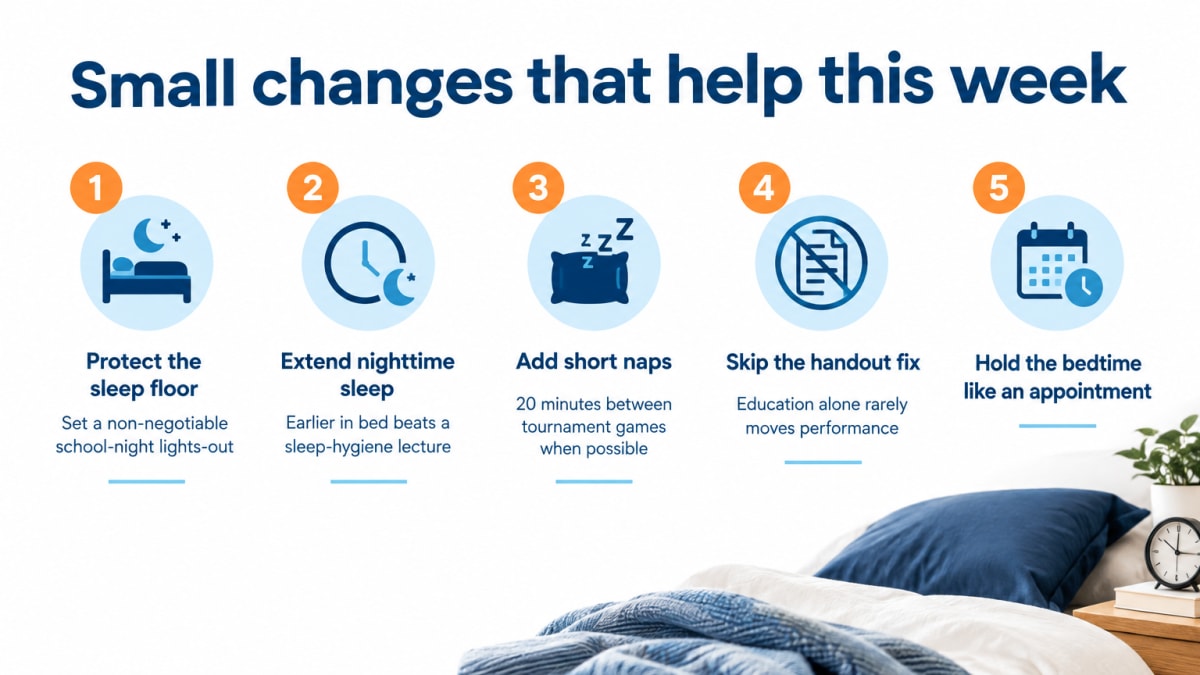
If you only change one thing this week, change the sleep floor. Not the perfect bedtime. Not a whole sleep-hygiene overhaul. Just the latest acceptable “lights out” on a school night, and then hold that line like you’d hold a doctor’s appointment.
Here’s why the floor matters more than the lecture. When researchers compared sleep strategies in athletes, the interventions that actually moved physical and cognitive performance were the simple ones: extending nighttime sleep and adding naps. Sleep-hygiene education by itself — the handout about screens and caffeine — didn’t reliably change performance outcomes, even when athletes technically slept a little more 4. In elite-sport reviews, education helped athletes get more sleep quantity, but the behavioral piece — actually being in bed earlier — is what carried the weight 5. Translation for your house: a protected bedtime beats a lecture about phones every time.
What that looks like for a 14-year-old hockey player with a Tuesday 9 p.m. practice: dinner prepped before you leave, homework triaged into “tonight” and “first period free,” phone out of the room by a set time, lights out at a time you both agreed to on Sunday — not negotiated at 10:45 Tuesday. For a softball doubleheader weekend, build in a 20-minute nap between games if the schedule allows. Naps count. They’re not a sign of weakness; they’re a tool the research keeps pointing to 4.
You’re not optimizing. You’re protecting the floor. Everything else gets easier from there.
A 30-second reset and words that work on the ride home
The car is the hardest room in the house. Shoulder to shoulder, no eye contact required, and your athlete is already bracing for the review. Here’s the move: don’t review. Reset first, talk later — if at all.
Try this 30-second reset before you pull out of the lot. Hand your athlete the water. Say one sentence: “Before we go, three slow breaths — in through your nose, out through your mouth, longer out than in.” Do it with them. Don’t make it a thing. The longer exhale nudges the nervous system down a gear, which is what both of you actually need before anyone says a word about the game.
Then the first words out of your mouth matter. Skip the recap. Skip “you looked a little flat out there.” Try one of these instead:
- “I love watching you play.”
- “Rough one. You hungry?”
- “I’m glad that’s done. What sounds good for dinner?”
That’s it. No coaching. No questions about the error in the fifth. If they want to talk, they’ll start. Most of the time, a 13-year-old who just lost a tennis match or missed a penalty kick needs the car to be a decompression chamber, not a film room.
You can always coach later. Tuesday at breakfast is a different conversation than Saturday at 9:47 p.m. with the stadium lights still in their eyes.
A weekly check-in question for a kid who grunts
You don’t need a sit-down. You need one good question, asked sideways, once a week — while you’re driving, cooking, or walking the dog. Side-by-side beats face-to-face for a teenager almost every time.
Pick one of these and rotate:
- “What was the heaviest part of this week — not the hardest, the heaviest?”
- “On a scale of 1 to 10, how full is your tank right now?”
- “If you could skip one thing on your schedule next week with zero consequences, what would it be?”
The grunt is fine. The shrug is fine. You’re not fishing for a feelings monologue. You’re planting a question your athlete can answer in their own time — sometimes right then, sometimes three days later when they wander into the kitchen at 10 p.m.
What you’re listening for: the same answer two or three weeks in a row. “Everything,” repeated, is data. So is “practice,” when practice used to be the best part of their day. That’s the signal that the layers are stacking, and it might be time to bring one more voice into their corner.
When to bring one more trusted voice into their corner
Here’s the moment to pay attention to. The sleep floor is in place. The ride home is quieter and kinder. You’ve asked the sideways question for three Sundays in a row. And your athlete is still flat — still shrugging, still dragging the bag, still saying “I’m fine” in a tone that doesn’t match the word.
That’s not a failure. That’s information. It means the layers have stacked past what a schedule change and a better bedtime can carry on their own, and your athlete could use one more voice in their corner — someone who isn’t you, isn’t the coach writing the lineup, and isn’t a teammate.
What you’re looking for isn’t a diagnosis. It’s a coach who starts with the person and then sharpens the athlete — the kind of trusted voice who can help a 15-year-old soccer player name what’s heavy, build small resets they’ll actually use, and strengthen the mental fitness piece the way a strength coach builds the physical. The goal isn’t dependence on anyone. It’s interdependence — your athlete learning to lead themselves, with a village of people who have their back. You stay the parent. The coach is one more voice, not a replacement for yours.
For the quieter version — the kid who’s just carrying too much — a free 15- to 20-minute call between your athlete and a Blend coach is a low-pressure way to see if it’s a good fit. No commitment. Just a conversation.
Help Your Athlete Reset and Recover
Talk with a coach about your athlete’s fatigue and a supportive path forward.
Frequently Asked Questions
How can I tell the difference between normal training fatigue and something more serious in my teen athlete?
Normal training fatigue eases with a true rest day and a solid night of sleep. The pattern to watch is fatigue that doesn’t lift after a lighter week, paired with a drop in performance, mood changes, or withdrawal from things they used to enjoy. If the same signals keep showing up for two or three weeks running, that’s your cue to look past the legs and bring in another trusted voice.
How much sleep does my high school athlete actually need during a heavy training or tournament stretch?
Teenagers biologically need more sleep than adults, and heavy training stretches are exactly when they get less. Research across 81 athlete studies found athletes averaged only 7.2 hours, with duration dropping about 36 minutes during heavy training 2. For a 14-to-18-year-old, aim higher. Protect a non-negotiable school-night bedtime, add a 20-minute nap between tournament games when the schedule allows, and treat weekend catch-up sleep as useful information, not laziness.
My athlete says they’re just tired, but they’re also snappy and withdrawn. Is that mental fatigue?
Often, yes. Mental and emotional fatigue rarely announces itself. It shows up as a shorter fuse, flat affect at games they used to love, and “I’m fine” in a tone that doesn’t match the word. The body might be okay; the nervous system is cooked by pressure that never got a release valve. Don’t push them to open up. Ask one sideways question a week and listen for the same answer repeating.
Should I trust the numbers on my athlete’s Whoop or Garmin to tell me if they’re overtrained?
Use them as one input, not the answer. Load-monitoring experts are clear that fatigue is multidimensional — external load like distance and reps, plus internal load like perceived exertion and mood — and no single wearable metric tells the full story 1. A “low recovery” score matters more when it lines up with slower warmups, poor sleep, or a shorter fuse at home. Trust the pattern across your athlete’s body, mood, and week.
What should I say on the ride home after a rough game or practice?
As little coaching as possible. The car is for decompression, not film review. Try three slow breaths together before you pull out, then one short sentence: “I love watching you play,” or “Rough one. You hungry?” Skip the recap, skip the “you looked flat.” If your athlete wants to talk, they’ll start. Tuesday breakfast is a different conversation than Saturday night with the stadium lights still in their eyes.
When is it time to bring in a coach focused on the mental side, not just the physical?
When you’ve protected sleep, quieted the car, and asked the weekly check-in question for three Sundays running — and your athlete is still flat. That’s not failure; it’s information that the layers have stacked past what a schedule change can carry. A coach who starts with the person and then sharpens the athlete adds one more trusted voice in their corner. If anything feels heavier than fatigue, reach a licensed professional or the 988 Suicide & Crisis Lifeline.
References
- Monitoring Athlete Training Loads: Consensus Statement. https://pubmed.ncbi.nlm.nih.gov/28463642/
- Deconstructing athletes’ sleep: A systematic review of sleep characteristics, measurement, and recommendations. https://pmc.ncbi.nlm.nih.gov/articles/PMC8343120/
- Effects of sleep deprivation on sports performance and perceived exertion in athletes and non-athletes: A systematic review and meta-analysis. https://pmc.ncbi.nlm.nih.gov/articles/PMC11996801/
- The Impact of Sleep Interventions on Athletic Performance: A Systematic Review. https://pmc.ncbi.nlm.nih.gov/articles/PMC10354314/
- Sleep interventions in elite sport – a systematic review. https://pmc.ncbi.nlm.nih.gov/articles/PMC11824781/
- Evidence That Sleep Is an Indicator of Overtraining during the Intensified Training Phase in Adolescent Sprinters. https://pubmed.ncbi.nlm.nih.gov/33884272/