

Key Takeaways
- Scottsdale groups meet across distinct pockets — Old Town bounded by Chaparral, Earll, 68th, and Miller 10, the Shea corridor, the Airpark, and south of Indian Bend — so drive time across the city’s 185 square miles should shape which room you choose 8.
- Weekly small-group sessions trade some individualization for peer normalization and repeated reps, lowering the stigma and confidentiality barriers that keep most teenage athletes from seeking help in the first place 4.
- Coaching handles performance anxiety, confidence crashes, and phone stress, while persistent low mood, disordered eating, self-harm, or panic calls for a pediatrician, licensed therapist, or 988 14.
What a Scottsdale athlete walks into on a Tuesday night
It’s 6:45 p.m. in a room off Scottsdale Road. Your kid walks in with turf still in their socks, phone in one hand, water bottle in the other. There are seven other athletes already there — a club soccer midfielder, two lacrosse players, a swimmer who just finished a long-course set, a volleyball setter, a junior golfer, and a softball catcher. They don’t all know each other. Half of them look at the floor.
The coach starts with one question on the whiteboard: What showed up for you this week? No one answers right away. Then the swimmer says something about a bad set. The lacrosse kid says tryouts are next week and he hasn’t slept. Your athlete, who told you “it was fine” in the car on the way over, says the group chat after Saturday’s game got ugly and they’ve been checking it on loop.
That’s the room. Eight teenagers who all play different sports, all under a different flavor of pressure, learning they’re not the only one who thinks like this.
Scottsdale has the youth-sport density to make a room like this fill up. The Scottsdale Sports Complex alone is a 71-acre tournament facility serving soccer, lacrosse, football, and rugby 1, and the city partners with youth organizations running soccer, baseball, softball, rugby, and lacrosse programs that pull in thousands of local kids each season 2. The athletes are here. What’s often missing is a weekly place where they practice the mental side of the sport, together, with language they can actually use on Saturday.
Why the group format fits teenage athletes better than you’d expect
Here’s the thing most parents miss when they first look into mental fitness for their athlete: a 1:1 session, as valuable as it can be, puts your kid alone in a room with an adult, being asked to talk about the hardest stuff. For a lot of teenagers, that’s the exact setup that makes them clam up. The group is different. In the group, somebody else goes first.
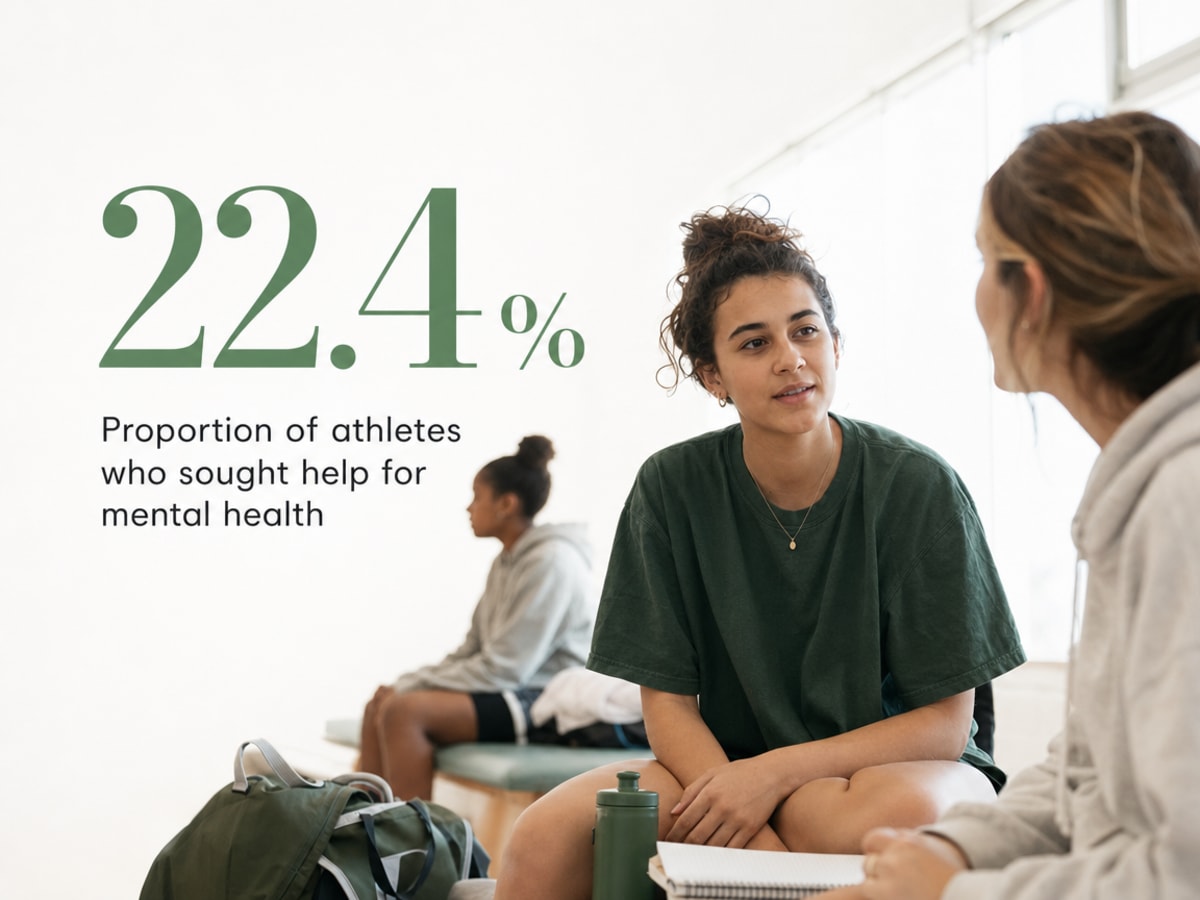
That matters more than it sounds. In a 2024 meta-analysis pooling 22 studies of athlete help-seeking, only about 22.4% of athletes had actually sought help for a mental health concern — with a 95% confidence interval of 16.2% to 30.2%, and real variation across sports, ages, and settings 4. The barriers the researchers named weren’t mysterious:
- stigma
- fear of being deselected from a team if they spoke up
- concerns about who would find out
- low mental health literacy
- bad past experiences with services 4
Those are the exact walls a room of peers starts to lower. When the swimmer admits they’re scared of their next meet, the barrier for your kid to say something honest drops by half.
The evidence on sport-based group programs for adolescents is still developing, but it’s pointing in a consistent direction. Reviews of mental-health-literacy programs delivered to young athletes have found promising gains in knowledge, symptom recognition, resilience, and intention to help a teammate who’s struggling 13, 3. These are precisely the skills a teenager uses in a locker room, a group chat, or the car ride home — not just in a therapist’s office.
There’s also something the group does that a solo session can’t: it normalizes the conversation itself. Your athlete learns that the lacrosse kid two chairs down also replays missed shots at 11 p.m. The volleyball setter also feels sick before tryouts. The golfer also hates the way the group chat makes them feel. None of that gets fixed in one night. But the moment your kid realizes they’re not broken and not alone, the mental skills work actually starts to stick.
And a quiet benefit for you as a parent: because the group builds shared vocabulary — words like reset, trigger, pre-performance routine, recovery — you suddenly have language to use at home that doesn’t feel like a lecture. The group doesn’t just teach your athlete. It gives your family something to talk about besides stats and playing time.
Inside a weekly session: what skills actually get built
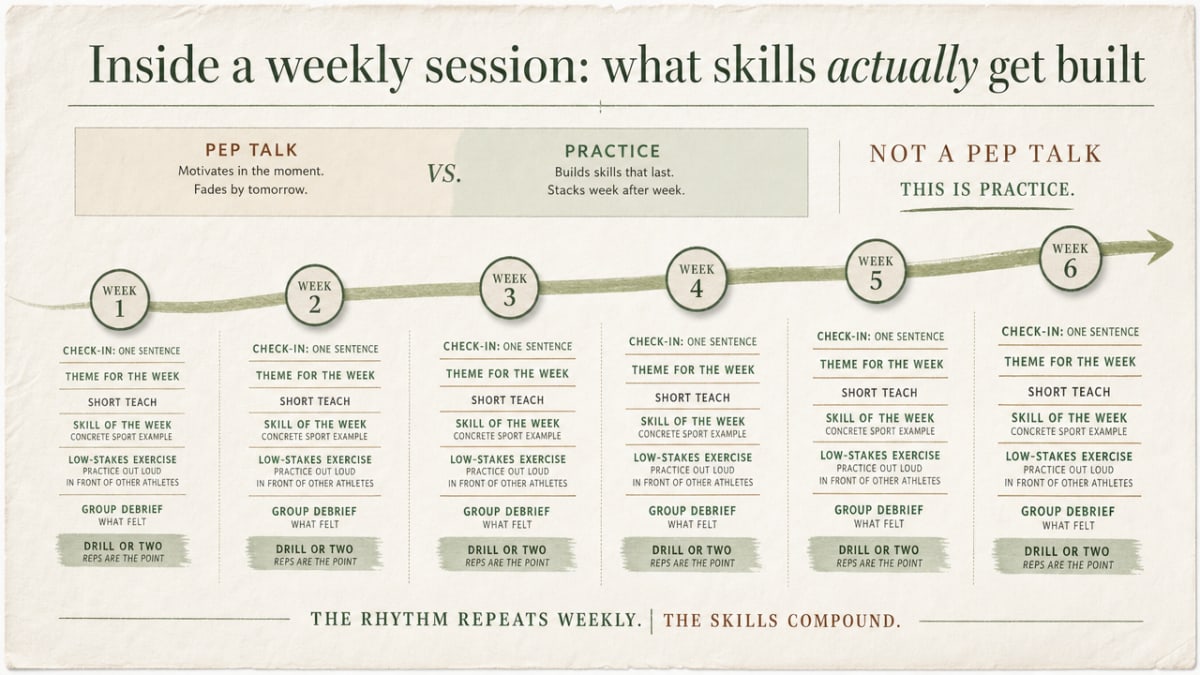
Most parents picture a mental skills session as a kind of pep talk — a coach telling kids to “believe in themselves” and sending them home. That’s not what happens. A good group session looks closer to a practice: there’s a theme for the week, a short teach, a drill or two the athletes work through together, and reps. The reps are the point. Just like your kid doesn’t learn to shoot by hearing about shooting, they don’t learn to reset after a bad play by hearing about resets. They have to practice it, out loud, in front of other athletes who are doing the same thing.
The session has a rhythm:
- Open with a check-in — what showed up this week, in one sentence.
- Teach the skill of the week with a concrete example from a sport in the room.
- Run a short exercise where athletes try the skill in a low-stakes way.
- Debrief as a group: what felt awkward, what clicked, what they’ll try before Saturday.
- Close with one commitment each.
Forty-five to sixty minutes, every week, same room, same faces.
A sample six-week arc
A typical arc moves from awareness to application:
- Week one is awareness — noticing what your mind actually does before, during, and after competition.
- Week two is self-talk — catching the sentence that runs on loop after a mistake and learning to change it.
- Week three is the pre-performance routine — a repeatable sequence an athlete runs before a serve, a free throw, a tee shot, a first whistle.
- Week four is focus under pressure — what to do with your attention when the game speeds up.
- Week five is recovery — how to come down after competition instead of carrying it into Sunday dinner.
- Week six is identity beyond sport — the quiet one that matters most, especially during tryout and recruiting seasons.
That kind of education-first, sport-based structure is where the evidence is pointing for adolescents. A 2025 systematic review of sport-based mental health awareness programs for ages 11–17 pulled six studies with sample sizes from nine to 816 participants and found positive effects on knowledge, symptom recognition, resilience, and intentions to help a teammate 13. The research is still developing, but the direction is clear: short, structured, sport-contextualized skill work moves the needle on exactly the capacities your athlete needs.
How peer accountability shows up between sessions
What happens between Tuesdays is where the group earns its keep. The commitment each athlete makes at the end of a session isn’t abstract. It’s something like: I’ll run my pre-serve routine the first three games this weekend. Or: When the group chat gets loud after a loss, I’ll put the phone in the kitchen for an hour. They write it down. They text the group when they do it. They tell the group what happened the next week — including when it didn’t work.
That’s the part a 1:1 session can’t replicate. When the lacrosse player admits he forgot his routine the entire first quarter, it gives your athlete permission to admit the same thing. When the softball catcher reports that putting the phone away actually helped, it lands differently than hearing it from a parent. Reviews of youth-sport interpersonal programs involving coaches and parents have found small to medium effects on anxiety, enjoyment, and the task-focused climate kids experience 5. The group doesn’t replace what you do at home. It gives your athlete a second room of people — their age, their world — practicing the same skills alongside them.
1:1, small group, or team workshop: picking the format that matches the kid
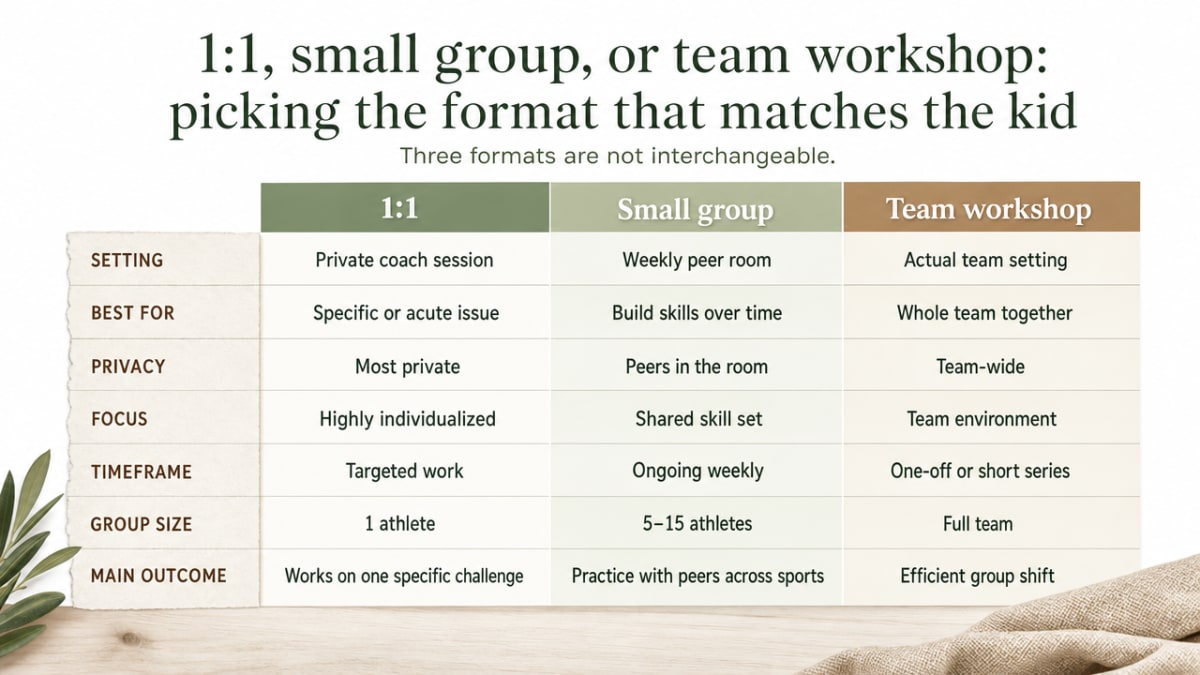
Three formats dominate the mental fitness space, and they’re not interchangeable:
- A 1:1 session gives your athlete private time with a coach to work on something specific — a slump, a confidence crash, a routine that keeps falling apart on the biggest serves.
- A small group of five to fifteen puts your athlete in a weekly room with peers across sports, building a shared skill set over time.
- A team workshop drops a coach into your kid’s actual team for a one-off or short series — the whole softball squad together, the whole U15 lacrosse club.
Each format produces something different. The 1:1 is the most individualized and the most private; it’s the right call when the issue is specific, acute, or when your athlete simply won’t open up with peers in the room yet. The team workshop is the most efficient way to shift a team culture in one afternoon — it’s useful when the problem is the environment itself, like a locker room where no one talks about pressure. The small group is the one most parents underestimate. It trades some individualization for peer normalization, repeated reps across weeks, and the chance to practice saying honest things out loud in front of other athletes.
The parent- and athlete-facing evidence base points to what group formats tend to produce: gains in mental health literacy, reduced stigma, better signposting (knowing where to turn when something is wrong), and more confidence to support a teammate — outcomes that are difficult to build inside a single private session 12. For a teenager who’s quietly struggling but would rather die than sit alone with an adult and talk about it, the small group is often the door that actually opens.
A quick way to read the trade-offs:
| Dimension | 1:1 Coaching | Small Group (5–15) | Team Workshop ||—|—|—|—|| Peer normalization | Low | High | Moderate (same team, same dynamics) || Individualization | High | Moderate | Low || Cost efficiency per athlete | Low | High | Highest || Weekly skill reps | Strong | Strong | Limited (one-off or short series) || Shared language your athlete can use at home | Minimal | Strong | Moderate || Best when | Issue is specific or acute | Athlete needs peers and a weekly rhythm | Team culture itself needs a reset |
If your athlete is withdrawn, won’t say much in the car, and plays a sport where “being mental” is still treated like a weakness, start with the small group. If they’re already working through something specific with you — recruiting anxiety, a persistent pre-game stomach — pair the group with occasional 1:1 sessions. If the issue is the whole team’s climate, bring a workshop to the team. The formats are tools, not tiers.
Where coaching ends and clinical care begins
This is the question most parents sit with privately, and it deserves a plain answer. Group mental fitness coaching is education and skill-building — awareness, self-talk, routines, focus, recovery, identity. It’s proactive, it happens in a room with peers, and it’s taught the way a strength coach teaches lifting technique. It is not diagnosis. It is not treatment. It is not a substitute for a licensed clinician when one is needed.
The IOC consensus statement on athlete mental health draws this line clearly: mental-health symptoms and disorders are common among athletes, validated screening and monitoring are recommended, and when symptoms meet clinical thresholds, psychotherapy, medication, or other professional care is what’s indicated — not a weekly skills group 14. Coaching is upstream work. Clinical care is for when the water’s already rising.
So how do you tell which door this week? Here’s a working guide, not a diagnosis.
Coaching is likely the right room when your athlete is dealing with performance anxiety before games, confidence crashes after mistakes, over-identification with their sport, phone and comparison stress, pre-tryout nerves, trouble shifting out of competition mode, or a vague sense that the mental side is leaking into their play. These are normal, trainable, and respond well to shared language and weekly reps.
A good group coach will tell you the same thing, and will have referral pathways ready. The two doors aren’t in competition. Plenty of Scottsdale athletes work with a therapist and attend a weekly group — one handles what’s clinical, the other builds the everyday skills. You don’t have to choose a lane. You just have to know which one you’re in right now.
The Scottsdale pressures nobody puts on the recruiting brochure
You already know the surface version of this. Your athlete plays in a city with real resources — tournament fields, year-round weather, strong clubs, serious coaches. What the brochure doesn’t say is that the same density that makes Scottsdale great for development also makes it a pressure cooker. The parking lot at the Scottsdale Sports Complex on a Saturday morning tells you everything: 71 acres of fields running back-to-back games, parents watching from camp chairs, kids who’ve already played two tournaments this month 1. The city partners with youth organizations across soccer, baseball, softball, rugby, and lacrosse that collectively run thousands of local athletes through each season 2. Your kid isn’t a hobbyist. Neither is anyone they’re competing against.
Two pressures sit underneath almost everything a Scottsdale athlete brings into a group session. One is external — the tryout and recruiting treadmill. The other is internal and portable, running on a phone in their pocket. Both are worth naming out loud, because the mental skills your athlete practices on a Tuesday night are, in large part, built to meet exactly these two forces.
Club tryouts, recruiting timelines, and the D1 story
Here’s what happens in a lot of Scottsdale households around April and May: tryout dates get posted, group chats start speculating about teams, and your athlete goes quiet. Not sulky quiet — strategically quiet. They’re calculating. They’re deciding how much to tell you.
The pressure isn’t just making a team. It’s the story they’ve absorbed about what making or not making a team means. In a city where “D1 prospect” gets thrown around at 13, your athlete has heard, from somewhere, that their worth as a player — and sometimes as a person — is tied to this week’s roster. A systematic review of coach- and parent-development programs in youth sport found small to medium effects on anxiety, enjoyment, and the task-focused climate kids experience when the adults around them get support too 5. The implication for you is quieter than it sounds: the story your athlete is telling themselves about tryouts is not fully their own, and the room they practice in matters.
In group, that story gets picked apart with peers. Someone else is cutting weight for a travel team. Someone else didn’t get the call last year. Your kid is not the only one carrying this.
Phones, group chats, and the comparison tax
The second pressure doesn’t take a day off. The team group chat lights up after every game. The club’s Instagram posts highlight reels. Recruiters’ names show up on TikTok. Your athlete watches a 14-year-old in Florida commit to a school they’ve dreamed about since they were nine, and then they go to practice.
Call it the comparison tax. It’s the quiet cost of being a competitive teenage athlete with a phone — a low, constant hum of am I behind? that no amount of good coaching from you can turn off from the outside. A 2024 systematic review of athlete help-seeking found that stigma and confidentiality concerns are two of the biggest barriers to kids actually talking about what the phone is doing to them 4. They won’t volunteer it at the dinner table. They might say it in a room where the swimmer two chairs over just admitted the same thing.
In group, your athlete learns a concrete skill: boundaries around the phone that they chose, not ones you imposed. That’s the version that sticks past Sunday.
Finding a group near you: Old Town, Shea, Airpark, and south of Indian Bend
Scottsdale is 185 square miles and more than 244,000 residents 8, which means “groups in Scottsdale” can mean a dozen different drives depending on where your athlete goes to school and which club they play for. A room off Old Town is a different proposition than a room near the Airpark. Worth thinking about before you commit to a weekly Tuesday.
If you’re in Old Town or just outside it — the area bounded by Chaparral Road to the north, Earll Drive to the south, 68th Street to the west, and Miller Road to the east 10— you have the shortest reach to the compact, mixed-use core. Groups that meet near here tend to pull athletes from Arcadia-adjacent neighborhoods, the Shea corridor, and families who already drive into Old Town for practice or school pickup.
Southern Scottsdale, south of Indian Bend Road, is its own pocket. The Indian Bend Wash path runs about 11 miles with more than 24 underpass and bridge crossings 11, and a lot of athlete families use it as everyday infrastructure — biking to a field, running after school, walking the dog between tournaments. A group that meets near this corridor is often the most convenient for south-of-Shea households.
The Shea corridor and the Scottsdale Airpark serve families farther north — DC Ranch, Grayhawk, the foothills. Drives from the Airpark area down to Old Town on a Tuesday at 6 p.m. are not nothing. If you live up here, ask about a north-side group or a virtual option before you sign up for a south-side room your kid will dread driving to.
Virtual sessions matter more than they used to. A room with eight athletes on screens is not the same as a room in person — the peer effect is a little quieter — but it beats skipping. For families splitting between North Scottsdale and the Sports Complex on Saturdays 1, a hybrid schedule often works: in-person when the week allows, virtual when it doesn’t. Ask any group you’re considering what their in-person and virtual mix looks like, and whether your athlete can switch week to week.
What parents actually do while the group meets
Here’s something nobody tells you up front: you’re not sitting in the room. On purpose. The group only works if your athlete knows this is their space, not a place where they’re performing for you or editing what they say so it doesn’t get back to the dinner table. For a lot of parents, that’s harder than it sounds. You’ve been the one driving to tournaments, filling out the forms, watching from the sideline. Stepping back feels like stepping away.
It’s not. You’re still in the ecosystem — just in a different seat.
Most well-run groups give parents three things while the session runs:
- a short monthly or every-other-week parent touchpoint (sometimes a 20-minute call, sometimes a brief written update) covering the themes being taught,
- a plain-language guide to the shared vocabulary your athlete is learning, and
- clear signposting for when something you’re seeing at home belongs in a different conversation.
That last piece matters. The parent-facing research is blunt about it: not knowing where to turn is itself one of the biggest barriers families face when a young athlete is struggling 12. A good group closes that gap for you on purpose.
At home, your job gets smaller and more specific. Ask one open question on the drive home — what’s one thing from tonight you might try this week? — and then let the answer be short. Don’t quiz. Don’t coach the coaching. If your athlete uses a word they learned in group — reset, trigger, routine — use it back without making a thing of it. When they tell you the lacrosse kid said something that stuck with them, resist the urge to extract the lesson. The lesson is already landing.
And when adults around youth athletes get a little support of their own, the climate kids actually experience improves — small to medium effects on anxiety, enjoyment, and task focus, across coach- and parent-development studies 5. You don’t have to become a sports psychologist. You just have to stay in the ecosystem, informed and un-centered, while your athlete does the work in a room that’s theirs.
How to try a session this month without overcommitting
You don’t have to sign up for a season to find out if this works for your kid. Most reputable groups let you start with a single session or a short trial run — a two- or three-week window where your athlete attends, you get a brief parent orientation, and then you decide together.
A few things worth asking before the first Tuesday:
- What’s the weekly theme structure, and can you see the arc for the next six weeks?
- Who’s in the room — age range, sports, group size?
- What’s the coach’s background, and how do they handle something that crosses from skills work into clinical territory 14?
- How are parents looped in without being centered — a short update, a vocabulary sheet, a monthly call?
Then let your athlete go. On the drive home, ask one question. Not three. Anything from tonight you want to try this week? If they say “maybe” and change the subject, that counts. If they come back the next Tuesday without a fight, that counts more. If after three weeks they’re using the group’s language without flagging it, you have your answer. Blend MH’s small group program is one place to start that conversation.
Start Building Your Athlete’s Mental Fitness Today
Begin a supportive coaching journey tailored to your athlete’s unique pressures and mental wellness needs.
Frequently Asked Questions
How is group coaching different from therapy for my athlete?
Group mental fitness coaching is education and skill-building — awareness, self-talk, pre-performance routines, focus, recovery — practiced weekly with peers. Therapy is clinical care delivered by a licensed provider for diagnosable conditions, with assessment and treatment planning. The IOC consensus statement draws this line clearly: when symptoms cross clinical thresholds, psychotherapy or medical care is indicated, not a skills group 14. Many Scottsdale athletes use both. They are not in competition.
What age or skill level is a good fit for group mental fitness coaching?
Most groups serve athletes roughly 11 to 17, which lines up with the age range where sport-based mental-health literacy programs show promising gains in knowledge, resilience, and help-seeking intentions 13. Skill level matters less than you’d think — a club starter and a developing varsity player face similar internal pressure. What matters more is whether your athlete is competing seriously enough that the mental side is affecting how they play, train, or recover.
Will my kid actually open up in a room with other athletes?
Probably not in week one, and that’s fine. The group doesn’t require your athlete to spill. It asks them to listen while a peer goes first. Research on athlete help-seeking identifies stigma, confidentiality concerns, and fear of being deselected as the biggest barriers to talking 4. A room of same-age athletes dismantles those slowly. By week three or four, most kids say one honest thing. That counts.
How involved are parents during the group sessions?
You’re informed, not in the room. Most groups offer a short orientation, a vocabulary guide, and periodic updates on themes being covered — enough to reinforce language at home without hovering. Research on coach- and parent-development programs shows small to medium effects on youth-athlete anxiety and enjoyment when adults get their own support 5. Your job: ask one open question on the drive home and let the answer be short.
Where in Scottsdale do groups meet, and is virtual an option?
Groups meet across the city — near Old Town (bounded by Chaparral, Earll, 68th, and Miller) 10, along the Shea corridor, in the Airpark, and south of Indian Bend. With more than 244,000 residents spread across 185 square miles 8, drive time matters. Virtual sessions exist and work, though peer effect is a little quieter on screen. Many families run a hybrid schedule: in-person when the week allows, virtual when it doesn’t.
How do I know if my athlete needs coaching or clinical care right now?
Coaching fits performance anxiety, confidence crashes, phone and comparison stress, tryout nerves, or over-identification with sport. Clinical care fits persistent low mood lasting weeks, disordered eating, self-harm, panic, substance use, or any mention of not wanting to be here — call your pediatrician, a licensed therapist, or 988 14. Not knowing which door is itself a documented barrier for parents 12. A good coach will tell you honestly which room this is.
References
- Scottsdale Sports Complex. https://www.scottsdaleaz.gov/parks/find-a-park/scottsdale-sports-complex/
- Sports Field Partner Youth Organizations. https://www.scottsdaleaz.gov/youth-teen-programs/sports-field-partner-youth-organizations
- Promoting mental health among young males in sporting contexts: A systematic review. https://pubmed.ncbi.nlm.nih.gov/37866686/
- Athlete mental health help-seeking: A systematic review and meta-analysis of rates, barriers and facilitators. https://pubmed.ncbi.nlm.nih.gov/38128709/
- The effects of interpersonal development programmes with sport coaches and parents on youth athlete outcomes: A systematic review and meta-analysis. https://pubmed.ncbi.nlm.nih.gov/37993028/
- Sports and Fitness | Active People, Healthy Nation. https://www.cdc.gov/active-people-healthy-nation/php/tools/sports-and-fitness.html
- Copy of 2024 Adolescent Mental Health Report I. https://www.azdhs.gov/documents/prevention/womens-childrens-health/adolescent-health/2024-adolescent-mental-health-report.pdf
- Scottsdale. https://www.scottsdaleaz.gov/docs/default-source/scottsdaleaz/about/scottsdale-overview-2024-25.pdf?sfvrsn=9db4e840_2
- DEMOGRAPHICS. https://www.scottsdaleaz.gov/docs/default-source/scottsdaleaz/about/scottsdale-demographics-2024.pdf
- Old Town Scottsdale Character Area Plan. https://www.scottsdaleaz.gov/long-range-planning/character-area-plans/old-town-scottsdale-character-area-plan
- Paths & Trails | City of Scottsdale. https://www.scottsdaleaz.gov/outdoor-activities/paths-trails
- An updated systematic review of interventions to increase awareness of mental health and well-being in athletes, coaches, officials and parents. https://pmc.ncbi.nlm.nih.gov/articles/PMC9118780/
- A systematic review of sport-based adolescent mental health awareness programmes. https://pmc.ncbi.nlm.nih.gov/articles/PMC11949344/
- Mental health in elite athletes: International Olympic Committee consensus statement. https://pubmed.ncbi.nlm.nih.gov/42580854/