


Key Takeaways
- A real mental health assessment for a Scottsdale athlete runs across the season — preseason baseline, in-season check-ins, post-injury review, and off-season reset — not a single intake and a score.
- Three local service doors look similar but aren’t: clinical screening, diagnostic evaluation, and sport mental fitness coaching. Warning signs point to clinical first; performance pressure fits coaching, often alongside care.
- Arizona law generally requires parent consent before screening a minor in nonclinical settings like a club facility or trainer’s room, and telehealth consent requires on-camera identity verification 9.
- Before scheduling, compare providers on the screening tool used and age adaptation, in-network status and current wait time, injury and return-to-play attention, and what referral looks like if a screen flags something.
What you’re really watching for when your athlete starts to shift
You know your athlete. You know the version of them who bounces out of bed for a 6 a.m. lift, who narrates every goal from the back seat, who texts their group chat the second a bracket drops. So when something changes, you feel it before you can name it. The quiet drive home after a loss that used to be a debrief. The phone turned face-down on the kitchen counter. The brace left in the hallway for a week. A shorter fuse. A longer nap. A tryout they suddenly don’t want to talk about.
Noticing a shift is hard. Acting on it is harder. Both are okay.
Here is what matters before you call anyone: the signs you’re watching for are almost never about sport performance alone. Adolescent mental health lives at the intersection of school, peers, identity, family, injury history, and what happens on a screen at 11 p.m. The CDC’s national youth data make that plain, linking mental health shifts to experiences well outside the field of play 2. Your athlete’s missed goal is rarely the story. The story is the week around it.
So track patterns, not single days. Sleep that keeps slipping. Appetite that drops or spikes. Withdrawal from teammates they used to text constantly. New fear around a healed injury. A flatness that doesn’t lift after a win. Any mention of not wanting to be here.
You don’t need a diagnosis to take the next step. You need a clear read on what you’re seeing and a sense of which door to open. The rest of this guide walks you through both, with Scottsdale specifics and Arizona rules you’ll want in hand before you schedule anything.
Assessment is a season, not a single appointment
If you walked into a clinic once, filled out a questionnaire, got a score, and walked out — that’s a snapshot. It’s useful. It’s not an assessment of your athlete.
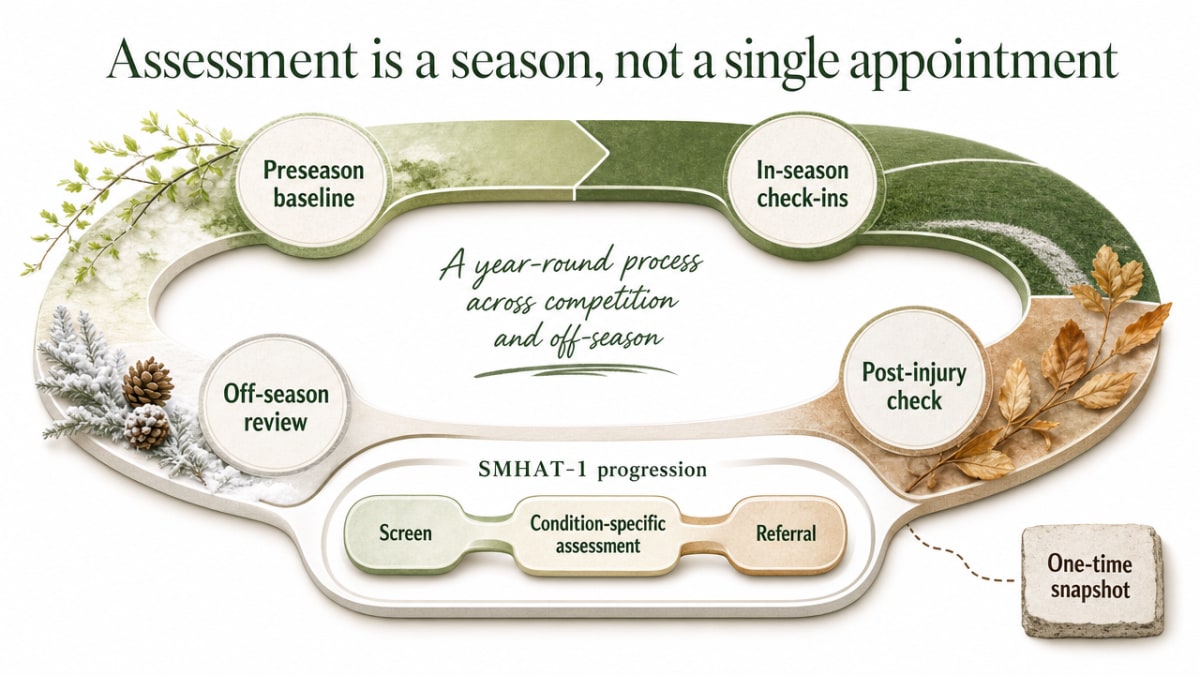
A real mental health assessment for a young athlete looks more like the way their physical fitness gets tracked: preseason baseline, in-season check-ins, a hard look after an injury, and a reset in the off-season. The British Journal of Sports Medicine lays this out plainly. Clinical surveillance for athletes should be done prospectively and systematically across the season, including competitive and off-season periods, not as a one-time event 1. The point isn’t to catch your athlete on their worst day. The point is to notice how they move across months.
The structured tool many sports clinicians reference, the Sport Mental Health Assessment Tool (SMHAT-1), works in a progression that’s worth understanding as a parent. It starts with a validated distress screen — a general read on how your athlete is doing. If that screen flags something, it moves into condition-specific assessment: depression, anxiety, sleep disturbance, alcohol and drug misuse, eating disorders. If those flag, it moves to referral for a clinician who can actually diagnose and treat 1.
Read that again, because it matters: screen, then assess, then refer. A screen is a question. A diagnosis is an answer. They are not the same step.
Here’s what that rhythm can look like across your athlete’s year:
- Preseason baseline. Before August two-a-days or the fall club schedule picks up, you get a read on sleep, mood, appetite, confidence, and how they’re feeling about going back. This is the version of your athlete you’ll compare everything else to.
- In-season check-ins. Short, repeated. Not every week. Think of them like the physical trainer’s weekly load check — a quick pulse during the stretch where travel, grades, and tryouts stack up.
- Post-injury check. Any injury that pulls them out for more than a couple of weeks deserves its own look. More on that later in the guide.
- Off-season review. The quiet months are where a lot shows up. No practice to distract, no game to point at. If something was humming under the surface, you’ll see it here.
This rhythm does something a one-shot appointment can’t. It separates a bad week from a trend. Your athlete can have a rough stretch after a loss or a breakup or a bad grade and still be fundamentally okay. They can also look fine on tryout day and be struggling for months. Repeated check-ins catch both.
If a provider in Scottsdale is offering you a single intake and a report, ask what the follow-up looks like. Ask when they’d want to see your athlete again, and what would trigger an earlier visit. The answer tells you whether you’re buying a snapshot or a season.
Three doors, and which one to open first
When you start calling around in Scottsdale, you’ll hear three different kinds of services described in similar language. They are not the same thing. Knowing which door you’re walking through saves you time, money, and a lot of second-guessing.
Door one: clinical screening. This is a licensed clinician — a psychologist, counselor, or physician — using a validated questionnaire to flag whether something warrants a closer look. In the sport-specific version, that progression starts with a general distress screen and moves into condition-specific questions on depression, anxiety, sleep, substance use, and eating patterns before any referral is made 1. A screen tells you whether to keep looking. It does not label your athlete.
Door two: diagnostic evaluation. This is the longer appointment, usually a clinical psychologist or psychiatrist, where a positive screen gets worked up into an actual diagnosis — or ruled out. This is where treatment decisions get made: therapy, medication, a specific care plan. You end up here because a screen pointed this direction, not because you walked in off the street guessing.
Door three: sport mental fitness coaching. This is nonclinical work focused on the mental side of performance — confidence, focus, pressure, recovery habits, identity around sport, bouncing back after a hard loss. A coach is not diagnosing anything. They’re building skills, the way a strength coach builds strength. Good coaching includes repeated check-ins on how your athlete is doing, which is part of why it pairs well with clinical care rather than replacing it.
Which door first? If you’re seeing warning signs — persistent sadness, withdrawal, sleep collapse, any talk of self-harm — door one or door two. Start clinical. If your athlete is fundamentally okay but struggling with the mental weight of competing, door three is a strong starting point, and a good coach will tell you plainly when something belongs with a clinician instead.
You can also walk through more than one door. A lot of Scottsdale families do.
Age matters: why a tool built for 16-and-up isn’t right for a 12-year-old
Here’s a detail that gets lost in a lot of parent conversations: the Sport Mental Health Assessment Tool you may hear a club director or trainer mention — SMHAT-1 — was primarily developed for athletes older than 16 6. That doesn’t make it useless for younger kids. It does mean a straight copy-paste onto your 12-year-old isn’t the right move.
A 12-year-old reads questions differently than a 17-year-old. They interpret words like “anxious” or “hopeless” through a narrower vocabulary and a different sense of time. A rough week can feel like forever. A good day can erase the memory of a bad month. They may also answer the way they think you want them to answer, especially if you’re sitting in the room.
The International Olympic Committee’s consensus work on this is direct: screening and support for younger athletes has to reflect developmental stage, school demands, family dynamics, and the fact that many common mental-health conditions start showing up early 7. Translation for your call list — ask the Scottsdale provider two questions. What tool are they using, and how have they adapted it for your athlete’s age? If the answer is vague, or if it sounds like the same form everyone fills out, keep looking. A seventh-grader and a high-school junior don’t need the same questionnaire, and they don’t need the same conversation after it.
Arizona rules every Scottsdale parent should know before scheduling
Before you book anything, know the ground you’re standing on. Arizona has specific rules about who can screen a minor’s mental health, where that screening can happen, and how insurance interacts with the care you’re actually trying to get. These aren’t fine-print trivia. They change which provider you call and what happens the day of the appointment.
Two things trip up Scottsdale parents most often. The first is the gap between a clinical office and anywhere else — a trainer’s room, a club facility, a Zoom link from your kitchen. The second is the gap between having insurance that looks good on paper and actually getting an appointment that moves things forward for your athlete. Both are worth a few minutes before you dial.
Consent, nonclinical settings, and telehealth identity checks
Telehealth has its own wrinkle. If you’re giving consent over a video call — which happens often with out-of-town specialists or busy family schedules — the provider is required to verify your identity 9. That usually means an ID check on camera before the session starts. It can feel clunky. It’s the law working the way it’s supposed to.
Ask any Scottsdale provider two things upfront: where the screening happens, and how they handle consent if it’s not in their office.
Insurance adequacy and what it does and doesn’t buy you
Coverage on paper is not the same as a timely appointment. In the Arizona Department of Health Services 2024 Adolescent Mental Health Report, 79.2% of adolescents statewide in the 0–199% federal poverty-level group had adequate health insurance 13. That’s a meaningful floor for low-income families — and it still doesn’t tell you whether a specific in-network provider in Scottsdale has openings this month, takes your plan, or is the right fit for your athlete’s age.
Before you schedule, ask the provider three questions: are they in-network with your plan, what’s the current wait for a new patient assessment, and what happens if a screen flags something that needs a referral. The last question is the one most families skip.

Injury, fear of reinjury, and the quiet part of return-to-play
The brace in the hallway tells one story. The silence at dinner tells another. When your athlete goes down — ACL, concussion, stress fracture, a shoulder that won’t stay put — the physical rehab plan gets built fast. The mental side usually doesn’t.
A systematic review of injury and mental health in athletes 19 and younger lays out what deserves attention during rehab and return-to-sport: anxiety, depressive symptoms, sleep problems, fatigue, fear of reinjury, reduced confidence, quality of life, and psychological readiness to compete again 8. That list is the quiet part. It’s also the part that decides whether your athlete steps back on the field the same kid, or a more cautious, more anxious version who flinches on contact and loses the step that made them good.
Fear of reinjury is the one most parents underestimate. The knee is cleared. The scan is clean. The physical therapist signs off. And your athlete pulls up on a cut they used to make without thinking. That isn’t laziness or lost conditioning. It’s a brain protecting a body that remembers.
Build an injury check into the assessment rhythm. A short conversation at the two-week mark. Another when they’re cleared for non-contact. Another before full return. Ask about sleep, dreams about the injury, how they feel watching their team play without them, and what the first full-speed rep felt like. If their answers get smaller and flatter as return gets closer, that’s a flag worth raising with a clinician, not a sign to push harder.
You don’t have to run this alone. A good return-to-play plan in Scottsdale pulls together the orthopedist, the athletic trainer, and someone paying attention to the mental side. If one of those seats is empty, fill it before cleared becomes a word that only describes the body.
The group chat after a bad game: social media as an assessment input
You know the pattern. The team loses. The phone comes out before the cleats come off. By the time you’re pulling into the driveway, your athlete has read the group chat, scrolled the highlight reel someone else posted, and seen the one teammate’s story that didn’t mention the game at all. None of that happened on the field. All of it is now part of what you’re assessing.
Social media isn’t a side issue in a young athlete’s mental health read. It’s an input. The U.S. Surgeon General’s advisory on social media and youth mental health is careful here: platforms can offer real benefits, and the current evidence isn’t strong enough to call them sufficiently safe for children and adolescents 4. That’s the frame to carry into your own house. Not panic. Not permission. Pattern recognition.
What’s worth watching, specifically for an athlete: the stretch right after a loss or a bad individual performance, late-night scrolling that pushes bedtime past the point sleep can recover, comments on their own posts, direct messages they won’t open in front of you, and the quiet comparison to teammates who seem to be getting recruited faster. Any assessment conversation worth having should include a question about what the phone looked like in the 48 hours after a hard game. The answer is often where the real shift lives.
School, identity, and the life your athlete lives when the cleats come off
Your athlete is not just an athlete. They are a sophomore with a chemistry test on Thursday, a kid whose best friend just switched clubs, a teenager figuring out who they are when nobody’s keeping score. The field is one room in a much bigger house. Any assessment worth doing walks through the whole house.
The CDC’s youth data make the overlap concrete: high-school students who experienced racism showed higher rates of poor mental health, suicide risk, and substance use 2. That matters here. Scottsdale’s own demographic report puts about one in five residents as a person of color 14, which means a non-trivial share of local athletes are carrying experiences at school, on the roster, and online that never show up in a performance review. If a provider only asks about practice and games, they are missing most of the picture.
Ask about the things that live outside the uniform. Grades slipping or spiking. A friend group that shifted. How they talk about their body when they’re not in gear. Whether they still see themselves as more than their sport — because when that identity narrows to one thing, a bad season starts to feel like a bad self. Keep the house in view, not just the field.
The Arizona crisis ladder, in the order you’d actually use it
If your athlete says something that stops the air in the room — about not wanting to be here, about hurting themselves, about a plan — you don’t need to decide what kind of appointment to book. You need numbers you can dial right now. Keep this list where you can find it at 11 p.m., not just at 11 a.m.
Call 911 or go to the nearest emergency department if there’s imminent danger — a weapon, a plan with means, an active attempt. That’s the top of the ladder. Nothing else beats it.
988 Suicide and Crisis Lifeline. Call or text 988. It routes to trained counselors and connects into Arizona’s crisis system. AHCCCS has been building out 988 capacity and the handoffs that follow a call, so a contact at midnight doesn’t end when the call does 11.
Arizona’s statewide crisis line: 1-844-534-HOPE (text 4HOPE). This connects to local mobile crisis teams who can come to your house instead of making you drive somewhere during the hardest hour of your week 10.
Teen Lifeline: 602-248-TEEN. Peer-staffed, built for teenagers who want to talk to someone closer to their age. Save it in your athlete’s phone, not just yours.
How Scottsdale actually works: fields, trolleys, and getting to the appointment
The logistics of actually getting your athlete to an assessment can quietly tank the whole plan. Scottsdale is long. Practice is in the north. School is in the middle. The provider you want to see is in Old Town. Thursday is a 6 a.m. lift.
A few local notes that help. Many Scottsdale club athletes train at the Scottsdale Sports Complex, a 71-acre venue at 8081 E. Princess Drive that hosts soccer, lacrosse, football, and rugby 15. If your athlete practices up there, a provider in central or south Scottsdale means a lot of driving — stacking an appointment onto the back of practice is often more realistic than carving out a separate trip. For families who don’t want to rely on one car, Scottsdale’s transit plan runs nine fixed routes, one express route, four trolley routes, and a Thunderbird Park-and-Ride with 450 spaces 16. The trolleys cover Old Town and central corridors well. North Scottsdale is thinner — plan around that, not against it.
Telehealth solves a lot of this when it fits. Just remember the identity-verification piece from the consent conversation applies the same way whether you’re in your kitchen or in the car.
A grounded first move this week
You don’t have to solve this by Sunday. You just have to make one move.
If what you’re seeing scares you — talk of self-harm, a sudden collapse in sleep, withdrawal that feels different — call 988 or Arizona’s statewide line at 1-844-534-HOPE and ask what to do next 10. You don’t need the right words. They have them.
If what you’re seeing is a shift, not a crisis, do two small things this week. Write down what you’ve noticed over the last month — sleep, mood, phone, appetite, practice, friends. Then call one provider and ask how they screen young athletes, how they adapt their approach for your athlete’s age, and what the follow-up looks like after a first appointment.
That’s the whole first move. One list. One call. You already know your athlete. Blend MH and the right local team can help you read what you’re seeing.
Start Your Athlete’s Mental Fitness Journey Today
Gain clear next steps to support your athlete’s mental health and performance in Scottsdale.

Frequently Asked Questions
What’s the difference between a mental health screening and a diagnosis for my young athlete?
A screening is a question. A diagnosis is an answer. Screening uses a short, validated questionnaire to flag whether something needs a closer look — in the sport-specific version, it moves from a general distress check into condition-specific areas like depression, anxiety, sleep, and substance use before any referral 1. A diagnosis comes from a longer clinical evaluation by a psychologist or psychiatrist. One points. The other names.
Does my child need my consent for a mental health assessment in Arizona?
Yes, in most cases. Arizona law generally requires written or oral consent from a parent or legal custodian before a minor is screened for mental health in a nonclinical setting or treated for a mental-health condition, with a narrow emergency exception when action is needed to prevent serious injury or save a child’s life 9. If consent is given over telehealth, the provider must verify your identity on camera first.
Is the SMHAT-1 screening tool appropriate for my 12-year-old athlete?
Not without adaptation. SMHAT-1 was primarily developed for athletes older than 16 6. A 12-year-old reads the questions differently and may answer the way they think you want them to. Ask the Scottsdale provider which tool they use and how they’ve adjusted it for a younger athlete’s vocabulary, attention span, and family dynamics. A vague answer is a reason to keep calling.
Who should I call first if my athlete is in a mental health crisis in Scottsdale?
If there’s imminent danger, call 911 or go to the nearest emergency department. For everything else, call or text 988, or call Arizona’s statewide crisis line at 1-844-534-HOPE (text 4HOPE) to reach a mobile crisis team that can come to you. Teen Lifeline at 602-248-TEEN is peer-staffed for teenagers. Arizona crisis services are available regardless of insurance coverage 10.
Should I choose clinical screening or sport mental fitness coaching for my child?
Start with what you’re seeing. Persistent sadness, withdrawal, sleep collapse, or any mention of self-harm points to clinical screening first, where a validated progression moves from distress check to condition-specific assessment to referral 1. If your athlete is fundamentally okay but struggling with pressure, confidence, or bouncing back from losses, coaching is a strong starting point. Many Scottsdale families use both, in that order.
How does a sports injury factor into my athlete’s mental health assessment?
An injury deserves its own check. Research on athletes 19 and younger links injury recovery to anxiety, depressive symptoms, sleep problems, fatigue, fear of reinjury, reduced confidence, and psychological readiness to compete again 8. Build short conversations into the rehab timeline — at two weeks, at non-contact clearance, and before full return. If answers get smaller and flatter as return nears, raise it with a clinician.
References
- Mental health symptoms and disorders in athletes: a systematic review and meta-analysis. https://bjsm.bmj.com/content/bjsports/57/21/1351.full.pdf
- 2023 Youth Risk Behavior Survey Results. https://www.cdc.gov/yrbs/results/2023-yrbs-results.html
- Youth Risk Behavior Surveillance System (YRBSS). https://www.cdc.gov/healthyyouth/data/yrbs/index.htm?s_cid=tw_cdc16
- Social Media and Youth Mental Health. https://www.hhs.gov/sites/default/files/sg-youth-mental-health-social-media-advisory.pdf
- Protecting Youth Mental Health. https://www.hhs.gov/sites/default/files/surgeon-general-youth-mental-health-advisory.pdf
- A comparative analysis of the Sport Mental Health Assessment Tool (SMHAT-1) between paediatric and adult Olympic and Paralympic athletes. https://pmc.ncbi.nlm.nih.gov/articles/PMC12878460/
- Mental health in elite athletes: International Olympic Committee consensus statement. https://pmc.ncbi.nlm.nih.gov/articles/PMC13479675/
- Sports Injuries and Mental Health in Child and Adolescent Athletes: A Systematic Review. https://pmc.ncbi.nlm.nih.gov/articles/PMC13511745/
- 36-2272 – Consent of parent required for mental health screening or treatment of minors; exception; violation; classification; definition. https://www.azleg.gov/ars/36/02272.htm
- Crisis Hotlines. https://www.azahcccs.gov/BehavioralHealth/crisis.html
- 988 Implementation Planning. https://www.azahcccs.gov/BehavioralHealth/988.html
- ARIZONA. https://www.samhsa.gov/data/sites/default/files/reports/rpt56986/2024-nsduh-sae-state-tabs1/2024-nsduh-sae-state-tabs-arizona.pdf
- Copy of 2024 Adolescent Mental Health Report I. https://www.azdhs.gov/documents/prevention/womens-childrens-health/adolescent-health/2024-adolescent-mental-health-report.pdf
- DEMOGRAPHICS. https://www.scottsdaleaz.gov/docs/default-source/scottsdaleaz/about/scottsdale-demographics-2024.pdf
- Scottsdale Sports Complex – ScottsdaleAZ.gov. https://www.scottsdaleaz.gov/parks/find-a-park/scottsdale-sports-complex
- Transit Element | City of Scottsdale. https://www.scottsdaleaz.gov/transportation/transportation-action-plan/transit-element