


Key Takeaways
- Sport psychology is the evidence-informed study of how athletes think, feel, cope, and relate inside sport, covering mental skills training, athlete mental health care, and the surrounding coach and family environment.
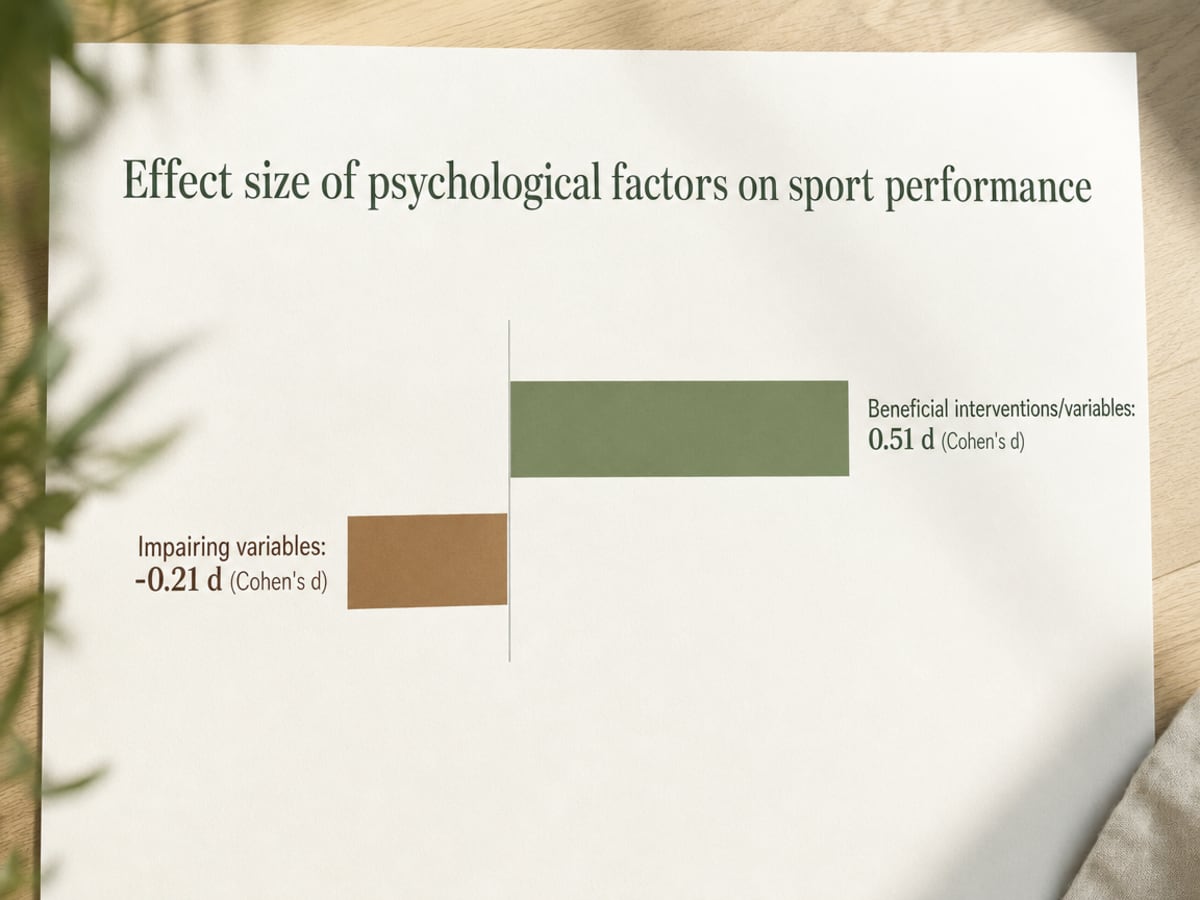
- Across 30 meta-analyses, psychological factors meaningfully shape performance and well-being, with helpful factors showing a moderate effect of d = 0.51 and harmful factors showing d = -0.21 1.
- Techniques like imagery, mindfulness, and self-talk show real but smaller effects once weaker studies are excluded 2, so expect steady skill-building rather than a weekend transformation.
- The adults matter: coach and parent programs improve task climate, enjoyment, and anxiety 10, and family and friend support is tied to lower depression and stress in athletes 13.
The Postgame Car Ride Is Part of the Field
You know the ride. Your athlete pulls the seatbelt across their chest, stares out the window, and says almost nothing. Or they say too much, and none of it sounds like them. Maybe they missed the free throw, or maybe they scored and still cannot stop replaying the one play they wish they had back. You want to help. You also want to not say the wrong thing. So you drive, and you think, there has to be a better way to be here with them.
That drive, the one you take home from the field or the gym, is already inside what sport psychology studies. The field is not just about elite athletes with headsets and visualization scripts. It is the organized, evidence-informed study of how athletes think, feel, cope, and relate inside sport, and how the adults and systems around them shape all of that. Across a review of 30 meta-analyses from 1983 to 2021, researchers found that psychological factors are genuinely tied to how athletes perform and how they feel while competing 1. That matters because it tells you this is a real area of study, not a wellness buzzword someone invented to sell a workbook.
What follows is a plain, honest look at what sport psychology is, what it is not, and how to think about it as a parent who is paying close attention.
A Working Definition for Parents
Here is sport psychology in one breath: it is the study and practice of how athletes think, feel, cope, and relate inside sport, and how that gets taught, trained, and supported. It covers performance, well-being, development, and whether your kid still wants to play next season. It is practiced by licensed psychologists, certified mental performance consultants, and researchers, and it draws on counseling, coaching education, and sometimes clinical care.
A broader way to picture it: sport itself is defined as activity that builds skills, fitness, mental well-being, and social-emotional health 6. Sport psychology works across all of those, not just the scoreboard. That is why a good practitioner may spend as much time on a slump, a rough coach relationship, or sleep before tryouts as they do on free-throw routines.
You will see the field show up in three forms. There is mental skills training, which teaches tools like goal setting, attention control, and self-talk. There is athlete mental health support, which looks more like counseling or clinical care. And there is work with the surrounding environment: coaches, parents, teams, culture. Each matters for different reasons, and knowing the difference will save you time, money, and worry.
What Sport Psychology Actually Studies
The Factors That Help and the Factors That Hurt
If you want a quick way to picture what the field studies, think of two columns. In one column: things that tend to push performance and well-being forward.
- Confidence.
- Team cohesion.
- Attention.
- Mindfulness.
- A motivational climate that rewards effort and improvement.
In the other column: things that tend to drag an athlete down.
- Anxiety.
- Depression.
- A climate that only rewards winners and shames the rest.
- Fear of making a mistake in front of a coach who treats mistakes like betrayals.
Those two columns are not just intuition. A systematic review of 30 meta-analyses published between 1983 and 2021, covering 16 different sport-psychology constructs, found that psychological factors expected to help performance showed a moderate average effect of d = 0.51, while factors expected to impair performance showed a smaller negative effect of d = -0.21 1. In plain English: the mental stuff that helps tends to help a fair amount, and the mental stuff that hurts tends to hurt, though not quite as hard on average. Neither side is magic. Both are real.
What this means for you as a parent is simple. When your athlete comes home talking about a coach who screams, a teammate who freezes, or a brain that will not stop racing before games, you are not watching soft stuff. You are watching the same variables researchers have been measuring for forty years. The field exists because these patterns show up again and again across sports, ages, and levels, and because the ways kids think and feel inside sport are teachable, not fixed.
Three Things Parents Routinely Confuse
Before you decide whether sport psychology belongs in your athlete’s life, it helps to pull apart three things that get stirred into one pot. They are related, but they are not the same job, and mixing them up is how families end up paying for the wrong help.
The first is mental skills training. This is the coaching side of the field. A practitioner teaches your athlete tools like pre-shot routines, breathing before a serve, goal setting across a season, imagery before a race, or a short cue word to reset after a mistake. The goal is skill, not treatment. You would not take your kid to a shooting coach to diagnose a knee injury, and you would not take them to a mental skills coach to diagnose depression.
The second is athlete mental health care. This is counseling or clinical work for things like anxiety disorders, depression, disordered eating, or the aftermath of a serious injury. It is done by licensed clinicians, and it looks more like therapy than like practice.
The third is sport-environment work. This is what a good practitioner does with coaches, parents, and teams to shape the climate your athlete lives inside. Youth sport is defined broadly to include skills, fitness, mental well-being, and social-emotional health 6, and the climate around a kid shapes every one of those. When you hear someone talk about culture, communication, or how a coach gives feedback, that is sport psychology too.
The Techniques, and How Much to Trust Them
Mental Skills Training, Mindfulness, and Imagery
When someone sells you sport psychology, this is usually what they are selling: a set of teachable mental skills. Goal setting across a season. Pre-performance routines. Breathing before a free throw. Imagery before a race, where your athlete mentally rehearses the turn, the handoff, the first ten strides. Acceptance-based work for the thoughts that will not quiet down. These tools have real history behind them, and when you watch a good practitioner teach them, it looks a lot like skill coaching for the inside of your kid’s head.
Here is the honest version of the evidence. A systematic review and meta-analysis pulled together 111 eligible studies on psychological interventions for athletic performance. Initial numbers looked strong:
- Psychological-skills training showed an apparent effect of g = 0.83.
- Imagery g = 0.75.
- Mindfulness- and acceptance-based approaches g = 0.67.
Those are large on paper. The catch, and it is a real one, is that those effects did not hold up once the authors stripped out weaker study designs and more subjective outcome measures 2. The techniques may still help. The strongest version of the claim does not survive the strongest version of the test.
What that means for you is not that these tools are fake. It means the honest frame is skill-building, not transformation. If your athlete learns a pre-shot routine and uses it on their own after three weeks, that is a win worth having. If someone promises a g = 0.83 jump in your kid’s game from a weekend workshop, they are quoting a number that got smaller when researchers looked harder.

Self-Talk: Louder Than Advertised, Quieter Than You Think
Self-talk is the quiet voice your athlete uses with themselves between pitches, between points, between the whistle and the next play. In sport psychology, it is studied as a trainable tool: short, intentional cues that guide attention, effort, or technique. Think of a swimmer saying “long arms” off the wall, or a batter saying “see it” as the pitcher starts the windup.
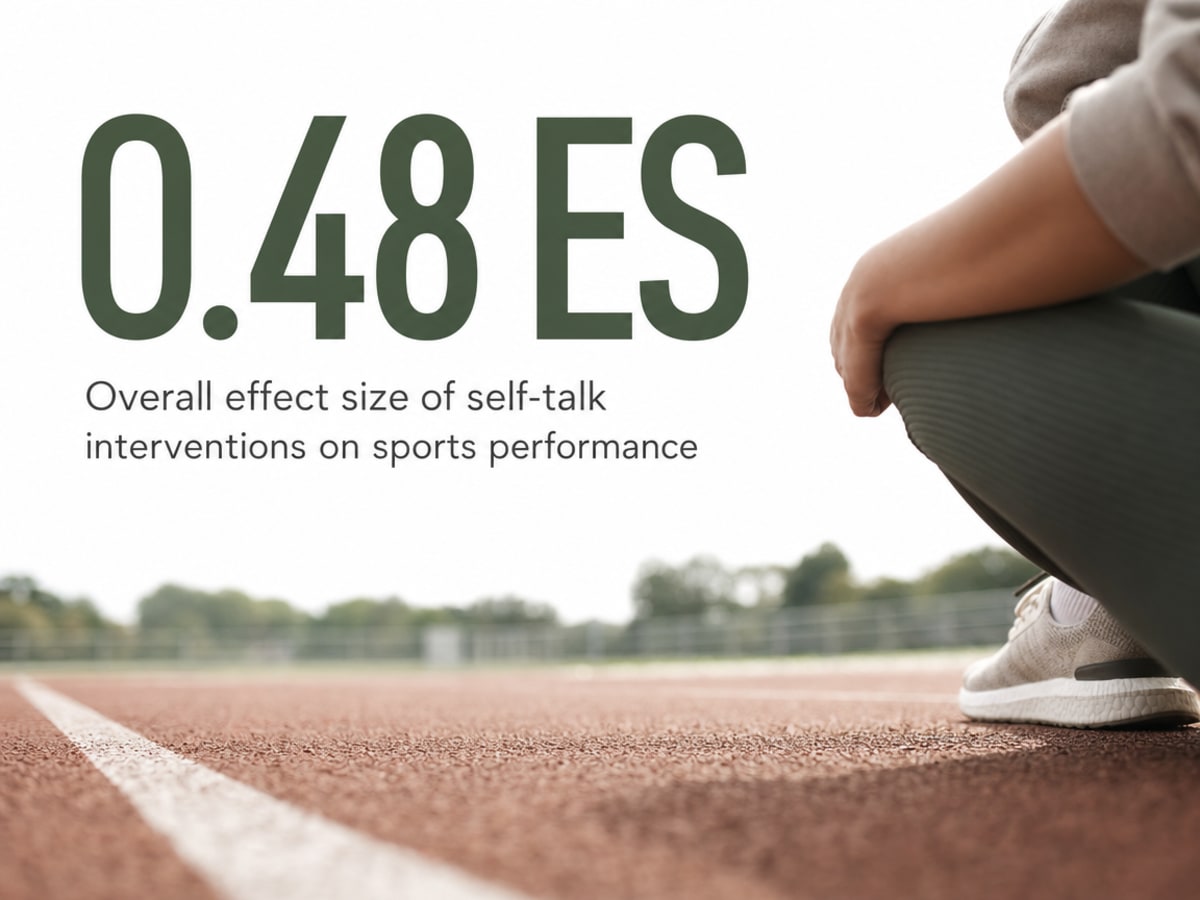
Across 32 studies and 62 effect sizes, self-talk interventions showed a moderate overall effect of ES = 0.48 on performance, with instructional self-talk especially useful for fine motor skills and new tasks 4. Translated: when kids are taught to use short, specific cues, the research tends to find a real benefit, particularly for precision work and anything they are still learning.
Now the part that may surprise you. A systematic review of self-talk found beneficial effects for positive, instructional, and motivational self-talk, as expected. It also found that negative self-talk did not consistently impede performance 5. Read that again. The reflexive advice to never let your athlete say a hard thing about themselves is not quite what the evidence shows. For some kids, in some tasks, a sharp “come on, focus” works like a slap of cold water. The task, the context, and what the words actually mean to that athlete matter more than whether the words sound nice.
So if you catch your kid muttering after a bad rep, you do not have to panic-correct them. You can be curious about what the words are doing for them instead.
Mindfulness, Specifically, in Elite Settings
Mindfulness has become the yoga pants of sport psychology: everywhere, often oversold, and sometimes genuinely useful. The careful version of the story is this. A review of 12 randomized controlled trials involving 614 elite athletes found that mindfulness-based programs were associated with reduced anxiety and stress and higher psychological well-being. The same review rated the certainty of that evidence as moderate and flagged substantial differences between studies 3.
What you can take from that: mindfulness is a reasonable tool for a kid who struggles with pre-game nerves, racing thoughts, or trouble recovering between plays. It is not a cure for an anxiety disorder, and it is not a reason to skip a conversation with a clinician if something bigger is going on. If a practitioner offers your athlete a short mindfulness practice as one piece of a larger plan, that fits the evidence. If someone frames ten minutes of breathing as the thing that will fix everything, their enthusiasm is running ahead of their citations.
Why the Adults Are Part of the Intervention
Coach and Parent Programs Move the Needle
Here is a quiet truth of this field. A lot of the work that helps a young athlete does not happen with the young athlete at all. It happens with the adults around them.
Think about who sets the emotional weather of your kid’s sport week. The coach who decides whether a missed assignment gets a teaching moment or a benching. The parent on the sideline whose face your athlete scans after every play. The assistant coach who notices the quiet kid first. Those adults are not background. They are the climate.
A systematic review and meta-analysis of coach- and parent-focused interpersonal-development programs looked at 33 studies, with 27 contributing data to the pooled analysis. Coach interpersonal skills were tied to small to medium improvements in youth-sport outcomes like task climate, enjoyment, and anxiety 10. In practical terms, when adults get trained on how to give feedback, how to frame mistakes, and how to run a practice that rewards effort as much as outcome, the kids feel it. They enjoy the sport more. They worry less. They stay.
This should take some pressure off you. If your athlete is struggling, the answer is not always to send them to a specialist and wait. Sometimes the stronger lever is a parent workshop or a coach session, and the kid gets to just be a kid while the grown-ups do some learning.
Family and Friends as Mental-Health Infrastructure
You are not just a chauffeur, a snack-provider, or a bleacher-sitter. You are infrastructure. A systematic review and meta-analysis of 40 studies involving 14,462 athletes found that social support was positively linked to well-being and negatively linked to anxiety, depression, and stress. Support from family and friends showed particularly meaningful associations with lower depressive symptoms 13.
These are correlations, not guarantees, and the researchers are careful about that. Support may both shape and be shaped by how an athlete is doing. Still, the pattern is consistent enough to take seriously. The people who ask about more than the box score, who notice the quiet weeks, who stay steady when the season turns ugly, are doing something that shows up in the data.
What that looks like at home is unglamorous. A question that is not about performance. A dinner where sport is not the topic. A text to a teammate’s parent when things feel off. You do not need a credential to offer this. You already have the relationship. The field just confirms that the relationship counts.
The Social Media Layer You Cannot Ignore
Most explainers of this field skip the phone. You cannot. Your athlete finishes a game, pulls out their device in the parking lot, and walks straight into a comment section, a group chat, a highlight reel of someone a year older doing something they cannot do yet. The pressure that used to end at the final whistle now follows them to bed.
The U.S. Surgeon General’s advisory on social media and youth mental health concluded that there is not enough evidence to determine that social media is sufficiently safe for children and adolescents, and called for stronger protections from families, platforms, researchers, and policymakers 8. The advisory does not say every post harms every kid. It says the ground is not proven safe, and that effects depend on content, time spent, the kind of interaction, and the individual child.
For a young athlete, that ground includes public evaluation after every game, comparison with recruits two states away, and comment threads where strangers grade their effort. A sport psychology practitioner worth their fee will ask about this. If no one is asking what your kid sees on their phone after a loss, something important is being left out.
When Mental Skills Are Not Enough
Mental skills training is coaching. It is not treatment. There is a line, and part of being a careful parent is knowing when your athlete has crossed it.
A scoping review of mental health and well-being among elite youth athletes screened 3,088 records and included 33 studies involving 5,826 athletes. Disordered eating was the most frequently studied concern, followed by anxiety and depression 9. These are not performance problems with a mental skills answer. They are health problems that need clinicians, and sometimes physicians, and often time. A pre-shot routine does not fix a kid who has stopped eating lunch. Breathing drills do not reach a teenager who cannot get out of bed on practice days.
Watch for the signals that sit outside the game.
- Changes in eating or weight.
- Sleep that falls apart.
- Withdrawal from friends your athlete used to text constantly.
- A flatness that stays flat for weeks, not days.
- Talk of not wanting to be here.
- An injury that heals in the body but keeps your kid off the field in ways they cannot explain.
These do not mean sport psychology was wrong for them. They mean the next right step may be a licensed mental health clinician, a pediatrician, or both, with mental skills work continuing alongside if it has been useful.
How to Tell Quality Work from Marketing
You can walk into a free consult and tell a lot in twenty minutes if you know what to listen for.
A careful practitioner will ask what you are worried about before they tell you what they do. They will separate skills coaching from clinical care without being prompted, and they will say out loud when something is outside their lane. They will ask about sleep, eating, mood, the coach, the team, and the phone. They will treat your athlete as a developing person first and a performer second, which matches how youth sport is actually defined in federal guidance: skills, fitness, mental well-being, and social-emotional health, not just results 6.
Watch for the specific credentials. Licensed psychologists, licensed mental health counselors, and Certified Mental Performance Consultants have different training. Ask which they hold, and ask what they do when a kid presents with something clinical. “I refer out” is a good answer.
The marketing version sounds different. Guarantees. Before-and-after reels. A single technique that will fix slumps, confidence, and recruiting all at once. Vague language about unlocking potential with no mention of what they measure or how long it usually takes. If no one is asking about your athlete’s phone use after a loss, or about who they talk to when things go sideways, something important is being skipped. Trust the practitioner who sounds a little less certain and a lot more curious.
A Realistic Picture of What Progress Looks Like
Progress in this work rarely looks like a highlight reel. It looks like your athlete using a breath on the free-throw line without being reminded. A car ride where they talk about the game instead of staring at the window. A phone that gets set down twenty minutes earlier on Sunday night.
The research reflects this slower picture too. Reviews of interventions for elite athlete well-being have started measuring not just performance but mood, stress, and quality of life, with psychological-skills, third-wave, and positive-psychology programs showing potentially favorable effects on well-being rather than guaranteed jumps on the scoreboard 11. Translation for your kitchen table: expect small, steady shifts in how your athlete handles themselves, not a transformation by Saturday.
Celebrate the small wins. A better warm-up. A kinder sentence after a miss. One honest conversation you did not have last month. Those are the data points that matter at home.
Start Building Mental Strength for Your Athlete
Connect with a coach to address performance pressures and mental health challenges, together.
Frequently Asked Questions
Is sport psychology the same as therapy?
No. Sport psychology is a broader field that includes mental skills coaching, athlete mental health care, and work with coaches and teams. Therapy is one slice of that, done by licensed clinicians for issues like anxiety disorders, depression, or disordered eating. A mental skills coach teaches tools. A clinician treats conditions. Good practitioners know which lane they are in and say so.
At what age does sport psychology make sense for a young athlete?
There is no single age. Mental skills work can fit a middle schooler who freezes at tryouts or a college athlete grinding through a slump. What matters more than age is whether your kid is struggling in ways that affect sleep, mood, enjoyment, or confidence. If something feels stuck, a conversation with a practitioner is reasonable, even for younger athletes.
How do I know if my child needs mental skills training or mental health care?
Watch where the problem lives. If your athlete handles life fine but freezes under pressure, mental skills work fits. If sleep, eating, mood, or withdrawal from friends is shifting, that points toward clinical care. In elite youth athletes, disordered eating, anxiety, and depression are the most studied concerns 9. When in doubt, start with a pediatrician or a licensed clinician.
Does sport psychology actually work, or is it mostly hype?
Both, honestly. Self-talk interventions show a moderate effect across 32 studies 4, and other tools show real but variable benefits. The catch: initial effect sizes for several techniques shrank when researchers excluded weaker study designs 2. The field is legitimate. The strongest sales claims usually are not. Expect steady skill-building, not a transformation by Saturday.
What credentials should I look for in a sport psychology practitioner?
Three credentials come up most: Licensed Psychologist, Licensed Mental Health Counselor, and Certified Mental Performance Consultant (CMPC). Clinicians can diagnose and treat conditions. CMPCs focus on mental skills. Ask which they hold, what training they completed, and what they do when a kid shows signs of something clinical. “I refer out” is a good answer, not a weak one.
Can parents and coaches do anything on their own, or does it all go through a specialist?
You can do a lot. Coach- and parent-focused programs showed small to medium improvements in youth-sport outcomes like task climate, enjoyment, and anxiety across 33 studies 10. Social support from family and friends is tied to lower anxiety and depression in athletes 13. A steady question that is not about the scoreboard counts. You are already part of the work.
References
- Sport psychology and performance meta-analyses: A systematic review of the literature. https://pubmed.ncbi.nlm.nih.gov/35171944/
- Effects of Psychological Interventions to Enhance Athletic Performance: A Systematic Review and Meta-Analysis. https://pubmed.ncbi.nlm.nih.gov/37812334/
- Effect of mindfulness-based programmes on elite athlete mental health: a systematic review and meta-analysis. https://pubmed.ncbi.nlm.nih.gov/36223914/
- Self-Talk and Sports Performance: A Meta-Analysis. https://pubmed.ncbi.nlm.nih.gov/26167788/
- Effects of self-talk: a systematic review. https://pubmed.ncbi.nlm.nih.gov/21984641/
- The National Youth Sports Strategy. https://odphp.health.gov/sites/default/files/2019-10/National_Youth_Sports_Strategy.pdf
- National Youth Sports Strategy Questions & Answers. https://odphp.health.gov/our-work/nutrition-physical-activity/national-youth-sports-strategy/questions-answers
- Social Media and Youth Mental Health: The U.S. Surgeon General’s Advisory. https://www.hhs.gov/sites/default/files/sg-youth-mental-health-social-media-advisory.pdf
- Mental health and well-being of elite youth athletes: a scoping review. https://bjsm.bmj.com/content/58/17/1011
- The effects of interpersonal development programmes with sport coaches and parents on youth athlete outcomes: A systematic review and meta-analysis. https://pubmed.ncbi.nlm.nih.gov/37993028/
- Psychological Interventions to Improve Elite Athlete Mental Wellbeing: A Systematic Review and Meta-analysis. https://pubmed.ncbi.nlm.nih.gov/39815135/
- Sport psychology and performance meta-analyses: A systematic review of the literature. https://pmc.ncbi.nlm.nih.gov/articles/PMC8849618/
- The relationship between social support and mental health in athletes: a systematic review and meta-analysis. https://pmc.ncbi.nlm.nih.gov/articles/PMC12442422/